Mains: GSII – Polity| Governance
Why in News?
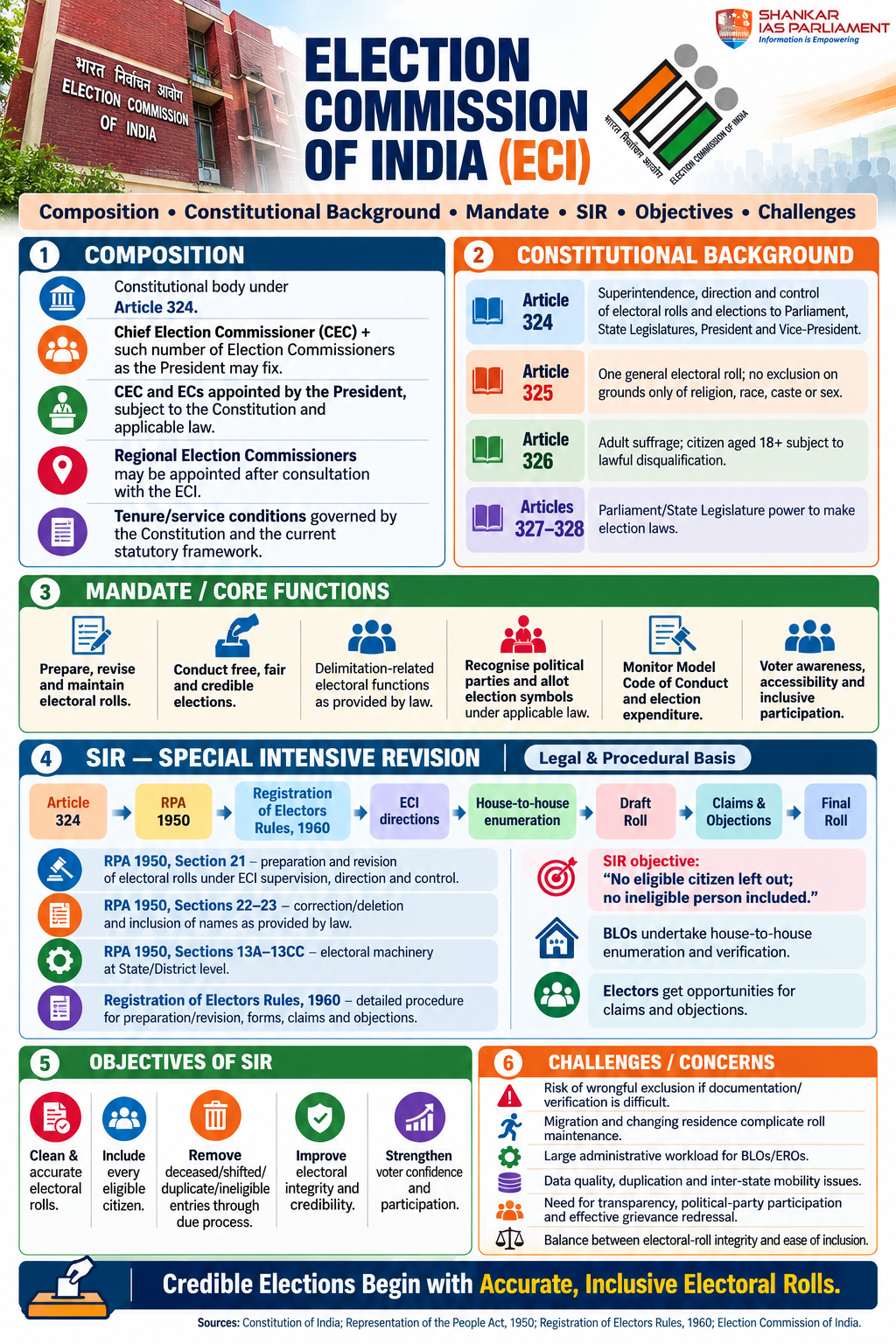
The ECI’s Special Intensive Revision (SIR) of electoral rolls has raised concerns over its legal basis, voter exclusion, institutional accountability, unilateral decision-making and the limits of its constitutional powers.
What is the Constitutional Position of the ECI?
- Constitutional Foundation –
- Article 324 vests the ECI with the superintendence, direction and control of elections to Parliament, State legislatures, President and Vice-President.
- Article 325 provides for one general electoral roll and prohibits exclusion on grounds of religion, race, caste or sex.
- Article 326 establishes elections based on universal adult suffrage, subject to constitutional and statutory disqualifications.
- Articles 327–329 provide the broader legislative and judicial framework governing elections.
- The ECI is therefore an important constitutional institution for safeguarding representative democracy.
- Constitutional Vision of Independence –
- The Constituent Assembly deliberately favoured a centralised and independent election machinery.
- Dr. B.R. Ambedkar stressed that election machinery must remain outside executive control.
- This was intended to prevent governments from manipulating electoral rolls or election administration for political advantage.
- The constitutional design therefore seeks to ensure electoral neutrality, institutional autonomy and public confidence.
Why is an Independent ECI Important for Indian Democracy?
- Protects Electoral Integrity – An impartial ECI ensures that elections remain free from undue political influence.
- Enables Peaceful Transfer of Power – Credible elections provide legitimacy to governments and facilitate peaceful changes of political power.
- Protects Political Equality – A neutral electoral system ensures that every eligible citizen enjoys an equal opportunity to participate.
- Strengthens Democratic Legitimacy – Public acceptance of electoral outcomes depends substantially on confidence in the neutrality of the election process.
- Acts as a Check on Executive Power – An independent ECI prevents the ruling establishment from controlling the electoral process that determines its continuation in office.
What are the Major Concerns Regarding the Present Functioning of the ECI?
- Legal and Constitutional Challenge – The unclear statutory basis of SIR and the limits of Article 324 raise concerns over the legality and constitutional propriety of ECI decisions.
|
Legal Basis of SIR
|
- Section 21 of the Representation of the People Act, 1950 provides for preparation and revision of electoral rolls.
- Rule 25 of the Registration of Electors Rules, 1960 recognises intensive and summary revisions.
- Section 21(3) allows the ECI to order a special revision for a constituency or part thereof.
- However, the expression “Special Intensive Revision” is not expressly provided in the statute.
- This raises the question whether Article 324 permits the ECI to devise a procedure beyond the statutory framework.
|
- Electoral Inclusion – Large-scale voter deletions may result in disenfranchisement of eligible citizens and weaken the principle of universal adult suffrage.
- Institutional Accountability – Alleged unilateral decision-making within the ECI may weaken collective functioning, transparency and institutional accountability.
- Independence–Accountability– Strong safeguards for Election Commissioners protect their independence but may create concerns regarding effective accountability for misconduct.
- Judicial Oversight – The exercise of broad electoral powers requires a balance between ECI autonomy and judicial review of legality and procedure.
- Federal Coordination – Electoral-roll revision requires effective coordination between the ECI and State-level administrative machinery.
- Social Inclusion – Documentation and verification requirements may disproportionately affect migrants, vulnerable groups and marginalised communities.
- Technological Challenge – Digital electoral systems can improve accuracy but may also cause data errors, privacy risks and algorithmic exclusion.
What are the Structural Challenges being faced by the ECI?
- Institutional – Political influence, concentration of authority and weak accountability can affect institutional credibility.
- Legal – Ambiguity over Article 324 and overlap between constitutional and statutory powers can create disputes.
- Administrative – Large electorate, migration, urban mobility and frequent updating make electoral-roll management complex.
- Technological – Data quality, privacy, cybersecurity and algorithmic errors pose new risks.
- Democratic – Voter exclusion, politicisation and declining public trust can weaken electoral legitimacy.
What Reforms are needed?
- Strengthen Legal Clarity – Parliament should clearly define different categories and procedures for electoral-roll revision to minimise disputes over the scope of ECI powers.
- Institutionalise Collective Decision-Making – Major decisions should follow transparent, recorded and collective procedures within the Commission.
- Strengthen Appointment Process – The appointment system should inspire confidence through institutional balance, transparency and bipartisan credibility.
- Establish Robust Deletion Safeguards – No genuine voter should be removed without Notice, Verification, Opportunity to respond, Reasoned decision and Appeal.
- Create Independent Audit Mechanisms – Periodic independent audits of electoral rolls can identify:
- Erroneous deletions.
- Duplicate entries.
- Systemic exclusion.
- Regional disparities.
- Make Technology Citizen-Centric – Digital tools should improve accuracy without becoming an automatic basis for exclusion.
- Improve Accessibility – Voter-verification and appeal mechanisms should be available through:
- Online platforms.
- Booth-level officials.
- Helplines.
- Local facilitation centres.
- Assisted verification for vulnerable citizens.
- Strengthen Parliamentary Oversight – Parliamentary scrutiny can improve institutional accountability while preserving the ECI's operational independence.
What lies ahead?
- The ECI is a constitutional institution at the heart of India's democratic architecture.
- Its independence was deliberately designed by the Constitution-makers to prevent political control over elections.
- However, constitutional independence must operate within the rule of law, procedural fairness, collective decision-making and accountability.
- The ultimate test of electoral reform should be simple: every ineligible voter must be prevented from distorting an election, but no eligible citizen should be denied the opportunity to participate in democracy.
Reference
The Hindu| ECI Constitutional Mandate



