0.2621
7667766266
x

Drop Shipping

iasparliament Logo
June 12, 2026

Mains: GS Paper III | Economy

Why in News?

"Nowadays, Instagram users are frequently misled by attractive products while scrolling; they often make purchases from AI-generated, decorated webpages before verifying the seller's credibility."

What is drop shipping?
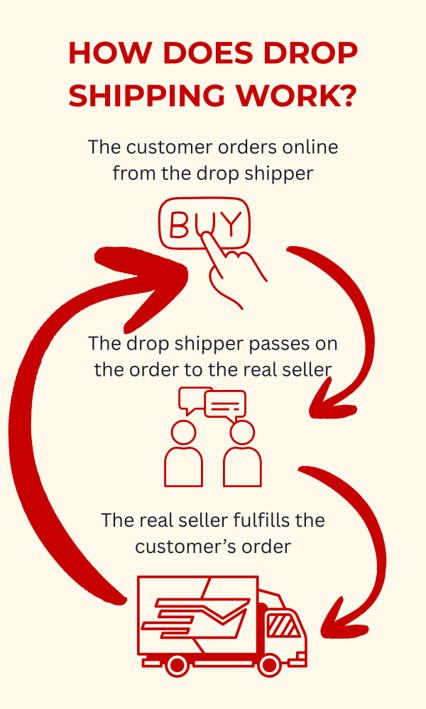
  • This is a business practice where an online individual or agent who does not hold any product takes orders from customers and passes them on to another maker/seller who actually holds the product.
  • The product is then delivered to the customers, either by the original maker/seller or a third-party delivery service.
  • To put it simply, the drop shipper inserts themselves into the transaction as a middleman.
  • One or even multiple drop shippers might stand between buyers and the original makers of the product they want.

DropShipping

  • Example - The global success of Amazon is deeply rooted in early dropshipping methodologies.
  • In its budding stage, the company avoided capital-intensive international warehouses, operating instead as a digital intermediary that fulfilled consumer demand by sourcing books directly from third-party distributors upon purchase.
  • Alternatively, drop shipping might take place through channels such as WhatsApp, Instagram, Facebook, and lesser-known websites.

How does drop shipping work?

  • Market Segmentation - Drop shippers can work with both domestic and international manufacturers and customers.
    • Market-Gap Fulfillment - Some try to fill an existing gap in their local market (such as affordable school textbooks),
    • Trend Capitalization - Some capitalise on market trends (such as the popularity of iPhone cases), and
    • Niche Cultivation - Others build hype around rarer products (such as foreign luxury fashion).
  • Most importantly, the drop shipper does not need to buy or store any of the products they are selling.
  • Drop shipping has become a popular source of income for both public-facing Instagram creators monetising their virality as well as private marketers looking for discreet revenue streams.
  • AI-Driven Automation - With AI automating customer service and streamlining business analytics, dropshipping has drastically lowered the barrier to entry, enabling virtually anyone with internet connectivity to launch an e-commerce venture.
  • In addition to promoting products and setting up online storefronts, drop shippers may also buy/sell courses that reveal current market trends, customer interests, trusted wholesalers, and useful AI tools, in order to generate further profits.
  • Value Proposition of Vetted Dropshipping - While superficially counterintuitive, dropshipping remains a highly prevalent model because it effectively mitigates consumer friction in cross-border e-commerce.

Is drop shipping legal?

Regulatory Frameworks and Compliance Loopholes

  • Dropshipping is globally legal, contingent upon strict tax compliance and operational transparency.
  • Platform policies, such as Instagram’s Commerce Eligibility Requirements, mandate that professional accounts link directly to a verified domain representing the actual point of sale.
  • However, the proliferation of rapid, AI-driven web development tools enables actors to bypass these safeguards, easily constructing sophisticated storefronts that mimic original manufacturers while merely rerouting orders to third-party suppliers.

Deceptive Marketing and the Erosion of Accountability

  • Social media environments frequently obscure the distinction between independent influencers, marketers, and actual merchants.
  • Dropshippers often utilize highly curated content—such as simulated behind-the-scenes footage of order fulfillment—to cultivate unearned consumer trust.
  • Furthermore, diverting transactions to external communication channels like WhatsApp effectively dismantles platform-level consumer protections, rendering supply chains opaque and leaving buyers unaware of product origins or data privacy vulnerabilities.

Supply Chain Risks and Product Quality Failures

  • The absence of a transparent supply chain exposes both consumers and intermediaries to significant vulnerabilities:
  • Financial Exploitation - Multi-tiered price inflation by both primary suppliers and dropshippers routinely artificially raises costs.
  • Quality and Authenticity Deficits - Relying on unverified wholesalers increases the prevalence of defective items, counterfeit goods, and misleading, AI-generated product imagery.
  • Logistical Instability - Consumers frequently face protracted delivery timelines, unfulfilled shipments, and a total absence of accountability regarding product safety or hygiene standards during transit.

Systemic Frauds and Legal Liabilities

  • Beyond basic transaction failures, complex cross-border dropshipping structures present severe systemic and legal threats:
  • Sanctions and Regulatory Breaches- Layered international supply chains run the risk of inadvertently violating global trade sanctions.
  • Data Insecurity and Cybercrime- Unauthorized sharing of financial details across unchecked networks exposes consumers to phishing, data theft, and payment fraud.
  • Illicit Business Models- The framework is highly susceptible to mutating into predatory pyramid schemes designed to exploit aspiring sellers rather than deliver genuine retail value.

Ethical Dimensions of Dropshipping

  • Information Deception- Masking mass-produced, third-party goods behind AI-curated storefronts exploits consumer trust and violates the ethical right to transparency and informed choice.
  • Accountability Vacuum - Operating via transient domains allows sellers to shirk systemic liabilities, leaving consumers to bear the financial and safety risks of defective or hazardous products.
  • Socio-Environmental Exploitation - The model profits off unchecked upstream labor practices, widespread intellectual property theft, and carbon-intensive, individual cross-border shipping of disposable goods.

What are the Comparative Advantages of Dropshipping?

Feature / Metric

Advantages for Sellers

Advantages for Buyers

Financial & Capital Requirements

Ultra-Low Overhead & High Margins- Sellers can launch businesses with zero upfront inventory, storage, or staffing costs, generating lucrative global profits entirely through strategic price markups.

No Minimum Order Quantities (MOQ) - Buyers can purchase single or small quantities of items directly, bypassing the bulk-purchase mandates typically imposed by traditional wholesalers.

Operational Convenience

Automated Workflow - Ethical operations can be managed entirely from home; the integration of AI-driven customer service tools further simplifies order management and query resolution.

Frictionless Global Logistics - Buyers are insulated from complex customs clearance, surprise import duties, or international cargo confiscations, provided the seller has a streamlined supply chain.

Market Outreach & Communication

Rapid Audience Monetization - Influencers and digital creators can swiftly convert their existing social media following into an active customer base, yielding high velocity, early-stage profits.

Localized & Trustworthy Support - Buyers can communicate seamlessly in a shared native language and cultural context, avoiding the friction of dealing directly with unfamiliar foreign manufacturers.

What are the Comparative Disadvantages of Dropshipping?

Feature / Risk Metric

Disadvantages for Sellers

Disadvantages for Buyers

Operational & Support Vulnerabilities

Overwhelming Customer Relations - Sellers bear the brunt of managing complaints, returns, delayed shipments, and defective products, despite having zero physical control over inventory or transit.

Unpredictable After-Sales Support- Buyers face highly inconsistent customer service, which poses a severe risk when purchasing high-ticket items, electronics, or complex gadgets.

Fraud & Security Risks

Target for Exploitation - Low-barrier storefronts are frequent targets for financial scams, fraud, and predatory wholesale partners attempting to offload spurious or sub-standard goods at inflated prices.

Risk of Financial Exploitation- Buyers face a high probability of being overcharged via inflated markups or falling victim to multi-tier scams if the seller's supply chain partners act deceptively.

Market Constraints & Compliance

Constant Pivot & Compliance Burden - Sellers must continually track volatile consumer trends while navigating complex, ever-changing legal, tax, and cross-border compliance frameworks.

Loss of Transparency & Craftsmanship - Because the supply chain is completely opaque, buyers lose the opportunity to verify product origins or support local, artisanal, and ethical creators at fair prices.

What is the Way Forward?

  • Regulatory Tightening - Mandate formal business/GST registration and update consumer protection laws to hold virtual intermediaries legally accountable for product safety and refund defaults.
  • Platform Vigilance - Enforce stringent merchant KYC verification, mandate clear algorithmic labels on AI-generated product advertisements, and penalize off-platform transaction migration.
  • Supply Chain Audits- Encourage dropshippers to perform rigorous upstream quality checks and adopt secure escrow payment systems to mitigate wholesale fraud.
  • Consumer Empowerment - Promote digital literacy campaigns emphasizing structural verification steps like tracking domain histories and conducting reverse-image searches.
  • Financial Safety - Incentivize the use of secure, protected payment gateways that feature robust chargeback mechanisms over direct, non-reversible UPI transfers.

To takemains test click here

Reference

The Hindu | What is drop shipping?

Login or Register to Post Comments
There are no reviews yet. Be the first one to review.

ARCHIVES

MONTH/YEARWISE ARCHIVES

sidetext
Free UPSC Interview Guidance Programme
sidetext