Mains: GS Paper II | Governance
Why in News?
The Parliamentary Committee on Empowerment of Women, chaired by Dr. D. Purandeswari, submitted a landmark report titled "Cyber Crimes and Cyber Safety of Women".
What are the highlights of the report?
- National Crime Records Bureau (NCRB) data revealed a 239% surge in cybercrimes against women between 2017 and 2022.
- The report also reveals that a multi-fold increase in online offences targeting children.
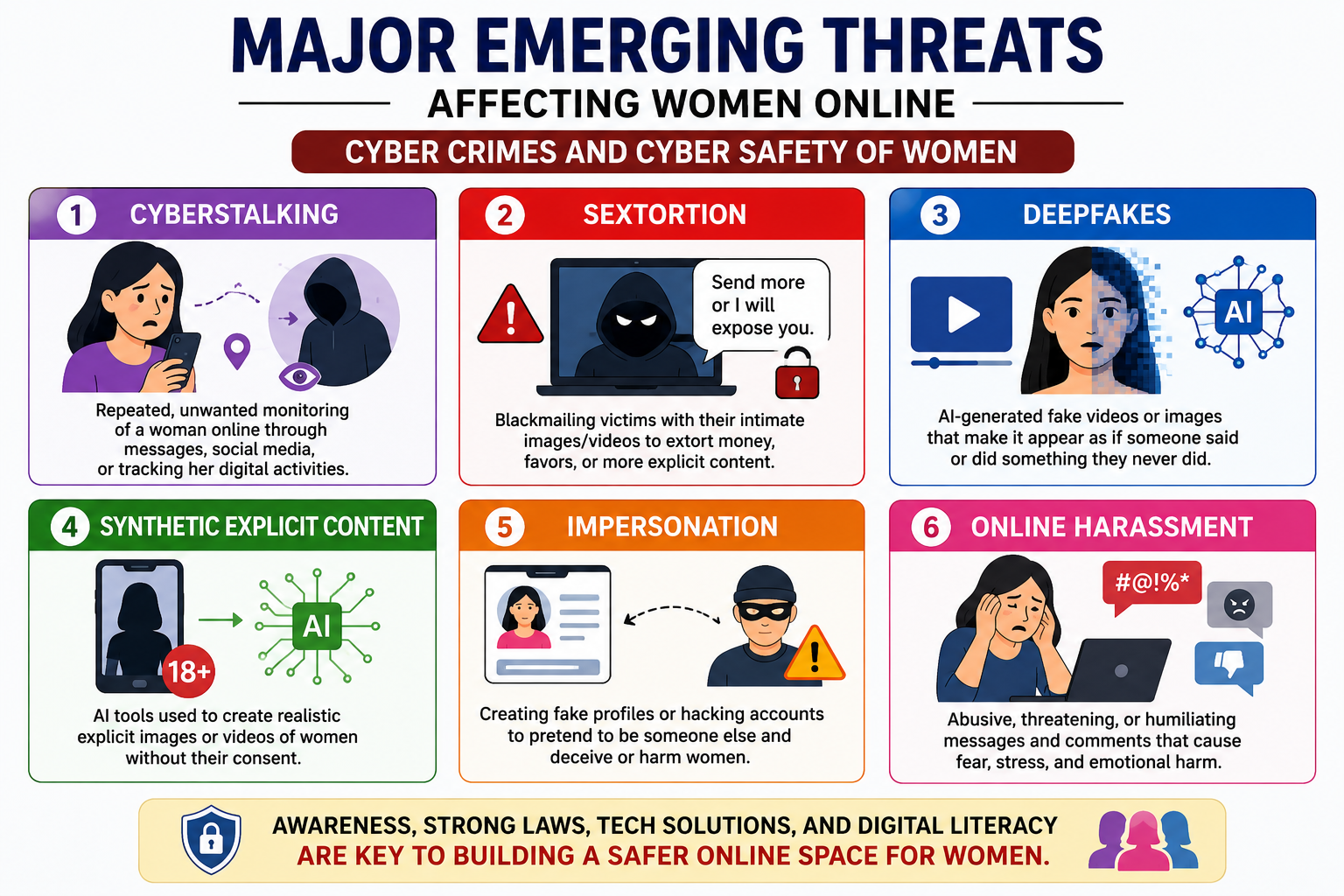
- The report emphasizes that digital spaces are increasingly weaponized through
- AI-generated deepfakes,
- Sextortion,
- Non-consensual intimate imagery (NCII),
- Cyberstalking, and
- Online harassment, necessitating a fundamental overhaul of India’s cyber-governance architecture.
- Cyberstalking and online abuse are among the major forms of gender-based cyber violence.
- Social media platforms are frequently used for harassment, impersonation, morphed images and non-consensual sharing of intimate content.
- Under-reporting remains a concern due to social stigma, fear, lack of awareness and limited knowledge of cybercrime reporting mechanisms.
What are the key dimensions of gendered cybercrimes?
- Deepfakes - Generative AI tools allow the creation of hyper-realistic, non-consensual deepfake images and videos, causing psychological, social, and economic damage to women.
- Sextortion - Fraudulent romantic engagements on dating/social media platforms transitioning into blackmail and financial exploitation.
- Cyberstalking - Malicious exposure of private personal information (addresses, phone numbers) alongside persistent harassment, often driving victims to delete their digital footprint entirely (digital exclusion).
- Anonymized Fake Profiles - The widespread availability of unverified, anonymous accounts on gaming, social media, and messaging platforms enables persistent abuse with near-total impunity.
What are the structural bottlenecks in the existing system?
|
Dimension
|
Key Bottleneck / Deficit
|
Impact on Victims
|
|
Investigative Capacity
|
Acute shortage of trained cyber investigators and certified digital forensic personnel across state police forces.
|
High case pendency, loss/corruption of ephemeral digital evidence.
|
|
Platform Accountability
|
Delayed responses by social media intermediaries to takedown requests; lax verification of user profiles.
|
Rapid virality of objectionable content; prolonged trauma for victims.
|
|
Reporting Mechanisms
|
Complexity of the National Cyber Crime Reporting Portal (NCRP); social stigma and fear of police interactions.
|
Severe under-reporting, especially in rural and tier-2/3 regions.
|
|
Judicial Capacity
|
Lack of specialized training among prosecutors and lower court judges in handling digital evidence and online harms.
|
Low conviction rates and delayed trial proceedings.
|
What are the major recommendations of the parliamentary standing committee?
- Forensic Decentralization - Establish additional regional forensic units, mobile cyber forensic vans, and deploy dedicated digital forensic consultants in every state.
- Specialized Judicial Units- Set up dedicated prosecution units for cybercrimes against women and mandate specialized training modules on digital evidence across state judicial academies.
- Scaling Up 'CyberShakti - Expand the Ministry of Electronics and Information Technology’s (MeitY) CyberShakti program, creating a dedicated vertical to train women police officers, cyber-cell personnel, and frontline social welfare officials.
- Mandatory KYC Verification - Introduce mandatory Know Your Customer (KYC)-based verification across all social media, dating, and gaming platforms to eliminate fake profiles and anonymous harassment.
- Proactive AI Monitoring- Deploy advanced AI tools (such as MeitY/MHA's Proactive Monitoring Tool) to detect child sexual abuse material (CSAM) and non-consensual imagery proactively.
- Shorter Takedown Timelines - Enforce a strict 24-hour SLA (Service Level Agreement) for initiating content takedown via the SAHYOG portal.
- Child-Centric Digital Guardrails - Formulate age-appropriate usage limits and safety regulations to protect children and adolescents from psychological harms.
- Grassroots Complaints Enablers - Empower local touchpoints Anganwadi centres, ASHA workers, Women Helplines, and Panchayat Digital Kiosks to register complaints on the NCRP on behalf of victims while maintaining strict confidentiality.
- Grievance Escalation Matrix - Establish a clear escalation protocol for victims if local police stations fail to act in accordance with the Standard Operating Procedure (SOP).
- Standalone Gender-Sensitive Cyber Law - Initiate a time-bound legislative process to draft a comprehensive, gender-sensitive cybercrime framework that explicitly addresses emerging threats like deepfakes, sextortion, and AI-driven harassment.
What is the way forward?
- Transitioning from the current reactive model under the Information Technology (IT) Act, 2000 to a proactive, victim-centric regime.
- Thus, it recognizes "digital bodily integrity" as an extension of Article 21 (Right to Life and Personal Liberty).
- Strengthening cross-functional coordination between the Ministry of Home Affairs (MHA), MeitY, Ministry of Women and Child Development (MWCD), and state police forces through real-time data sharing via the Indian Cyber Crime Coordination Centre (I4C).
- Integrating digital citizenship, online consent, and cyber safety modules into school and college curricula to address the root cultural causes of online discrimination.
Reference
PRS India | Cyber Crimes and Cyber Security of Women



