Why in News?
European Union (EU) companies operating in India want New Delhi to streamline or remove non-tariff barriers.
- The Survey provides an outlook and overview of evolving EU-India bilateral trade and investment ties as well as offers an insight into the opportunities and challenges faced by European businesses.
- The survey done ahead of resumption of negotiations for a free trade agreement (FTA) between both the sides scheduled to be concluded by year-end.
- The survey was conducted among 51 FEBI member companies across 11 sectors.
- Conducted by – The Federation of European Business in India (FEBI).
- Key Findings - The EU-India FTA is expected to create a favorable business environment with 92% of respondents anticipating a positive impact.
- Among them, 72% plan to increase their investment in India within the next 2 years, demonstrating strong confidence in the agreement’s success.
- EU investors are expected to increase their presence, particularly in technology-driven and sustainable industries, as India continues to enhance its business environment and trade policies.
- While 22% EU companies plan to maintain their current investment levels, 76% of EU firms surveyed aim to increase their investments compared to pre-2025 levels.
- EU businesses increasingly see India as a key driver of overall growth, with
- 80% viewing it as an expanding sales market,
- 61% recognizing it as an emerging hub for production, and
- 49% seeing it as a location to manufacture for exports.
- Confidence creating factors - Investment decisions are driven by India’s strong political stability (66%), position amid evolving global geopolitics (60%), and the availability of a skilled workforce (60%).
- Most respondents (59%) find the ease of doing business in India increasingly favorable, reflecting confidence in the country’s business environment.
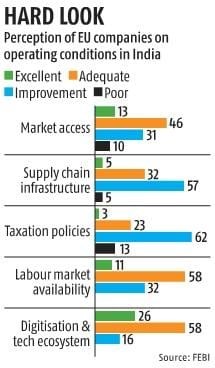
- 83% of respondents rated India’s digital and technology ecosystem as excellent or adequate, highlighting the country’s advancements in digital infrastructure, e-governance, and tech-driven services.
- 69% expressed confidence in the availability of skilled labour, recognizing the country’s strong talent pool, particularly in engineering, IT, and manufacturing.
EU is India’s largest trading partner, accounting for 12.2% of India’s goods trade in 2023 while India is the EU’s 9th -largest trading partner, accounting for 2.2% of total EU trade in goods during the same year.
- Streamlining non-tariff barriers - European Union (EU) companies operating in India want New Delhi to streamline or remove non-tariff barriers such as
- Quality Control Orders (qcos),
- Complex Customs procedures;
- Simplify labelling, testing, and import procedures; and
- Facilitate cross-border digital transactions without data localisation constraints.
- Challenging areas - Even amid favorable investment plans, EU businesses in India encounter multiple challenges, with taxes and tariffs being the most significant, affecting 51% of respondents.
- However, India’s supply chain infrastructure and taxation policies remain two challenging areas for EU businesses in India.
- More than 60% of respondents expressed the need for improvements in the supply chain and around 75% in taxation.
- Risk Factors - Complex visa and work permit processes hinder talent mobility, affecting workforce availability.
- Weak intellectual property enforcement, the prevalence of counterfeit goods, and insufficient protection of confidential data add to the risks faced by EU businesses.
Reference
Business Standard | Business Sentiment Survey, 2025



