Prelims: Current events of National & International importance | Geography
Why in News?
A recent study suggests that building a massive 50‑mile dam across the Bering Strait could, in theory, help stabilise the AMOC, a critical ocean current system that regulates global climate.
- AMOC – It is a massive system of ocean currents that moves warm water north and cold water south, acting like a “global conveyor belt.”
- It regulates climate by distributing heat and nutrients, but scientists warn it is weakening due to climate change, which could disrupt rainfall, raise sea levels, and cool Europe.
- Working
- Surface currents – It transports warm, salty surface water from the tropics toward Europe via the Gulf Stream and the North Atlantic Current.
- As it reaches Europe, it releases heat into the air and helps moderate the weather in Britain and the Nordic countries.
- Deep currents – In the process, the water cools, sinks in the Arctic, forming the North Atlantic Deep Water (NADW) and heads back southwards.
- It goes on to influence rainfall patterns in Africa, South America and beyond.
- Global link – These currents connect with the Antarctic Bottom Water (AABW) and circulate through the Indian and Pacific Oceans.
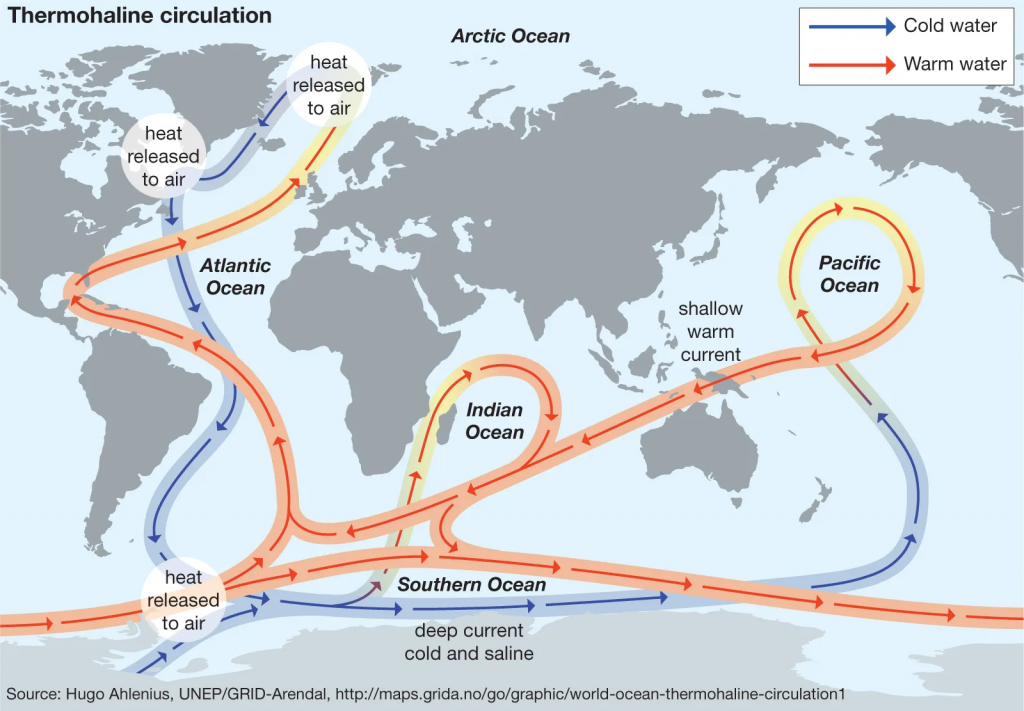
- Driving Forces – The system is driven by thermohaline circulation, which depends on differences in temperature & salinity of the water.
- Carbon & Nutrients – It plays a vital role in the global carbon cycle by sequestering carbon from the atmosphere into the deep ocean and circulating nutrients that support marine life.
- Disruption/Weakening due to Climate Change – The warming from greenhouse gases in the atmosphere is disrupting this system.
- Rising temperatures make the Arctic wetter.
- Greenland’s ice sheet melts, adding fresh water to the North Atlantic.
- This fresh water dilutes the saltiness, making the surface less dense.
- Without enough density, the water doesn’t sink properly, slowing the circulation, which in turn causes it to draw less warm water northward from the tropics.
- Impact of weakening of AMOC – If the AMOC were to stop completely -
- Northern Europe would lose its warming influence and become much colder.
- U.S. East Coast sea levels would rise as water shifts westward.
- Tropical regions would see rainfall patterns change—some areas drying out, others flooding more.
References
- Indian Express | Recent study published about weakening of AMOC
- Britannica | AMOC
- NOAA | AMOC



