Mains: GS III – Energy| Disaster Management
Why in News?
India's nuclear therefore represents a convergence of energy security, technological self-reliance, environmental sustainability and human development, with safety remaining its fundamental principle.
How nuclear energy play a role in India’s development journey?
- India's civilian nuclear programme – It dates back to the early decades after independence and entered the electricity-generation phase with the commissioning of the Tarapur Atomic Power Station in 1969.
- Currrent status – India currently operates 24 nuclear power reactors across seven sites, with an installed capacity of 8.78 GW.
- 9 additional reactors are under construction, while preparations are underway for further capacity addition.
- The Government has set an ambitious target of 100 GW of nuclear capacity by 2047.
- Schemes & Initiatives – The Nuclear Energy Mission announced in the Union Budget 2025–26 has also provided Rs.20,000 crore for the research, development and deployment of indigenous Small Modular Reactors (SMRs).
- The SHANTI Act, 2025 seeks to provide a contemporary legal framework for the expansion of India's nuclear-energy sector while emphasising safety, security and responsible development.
What are the applications beyond electricity generation?
- Healthcare – Nuclear technology has become an important component of modern healthcare through:
- Medical imaging and diagnosis;
- Nuclear medicine and radiopharmaceuticals;
- Cancer radiotherapy;
- Sterilisation of medical equipment; and
- Research into advanced cancer treatments.
- Institutions such as the Bhabha Atomic Research Centre (BARC), Tata Memorial Centre (TMC), Indira Gandhi Centre for Atomic Research (IGCAR) and other research institutions contribute to indigenous nuclear and medical technologies.
- The Tata Memorial Centre has also played a major role in cancer treatment, diagnosis and screening, particularly in expanding access to affordable cancer care.
- Radiation-based sterilisation can further improve the safety of medical devices by reducing microbial contamination.
- Agriculture and Food Security – Nuclear techniques contribute to agricultural development through radiation-induced mutagenesis, which can help develop crop varieties with desirable characteristics.
- These include higher yield, early maturity, improved quality, tolerance to drought, heat and salinity; and greater resistance to certain diseases.
- Radiation technology also has applications in food irradiation, which can extend shelf life, reduce post-harvest losses and facilitate the preservation of grains, spices, fruits and vegetables.
- For a country where substantial agricultural losses occur between production and consumption, such technologies can contribute to both food security and farmer incomes.
- Industry, Mining and Critical Minerals – Nuclear analytical techniques can support mineral exploration, ore characterisation and quality control.
- Such capabilities are particularly relevant for India's growing focus on critical minerals and rare earth elements, which are essential for electronics, renewable-energy technologies, defence and advanced manufacturing.
- The development of indigenous analytical standards and specialised nuclear technologies can reduce dependence on imported expertise and strengthen India's strategic supply chains.
- Semiconductors and Advanced Materials – Nuclear science is also contributing to India's semiconductor ambitions through the production and processing of specialised materials and isotopes.
- The establishment of an indigenous electronics-grade Boron-11 enrichment facility represents an effort to develop domestic capabilities in materials required for advanced electronics and semiconductor applications.
- This illustrates how investments in nuclear science can generate technological spillovers across strategic sectors.
- Clean Hydrogen – Nuclear energy can contribute to the emerging hydrogen economy by providing both reliable electricity and high-temperature process heat.
- This is particularly significant because conventional hydrogen production is still heavily dependent on fossil fuels.
- Nuclear-assisted hydrogen production can therefore support India's objectives under the National Green Hydrogen Mission and its broader decarbonisation strategy.
- The development of nuclear process-heat applications at Kalpakkam demonstrates the potential for integrating nuclear technology with future clean-fuel systems.
What about safety of Nuclear energy?
- Concerns – The principal concern associated with nuclear power is the possibility of accidental exposure to radiation or release of radioactive material.
- Consequently, nuclear safety must remain the overriding priority.
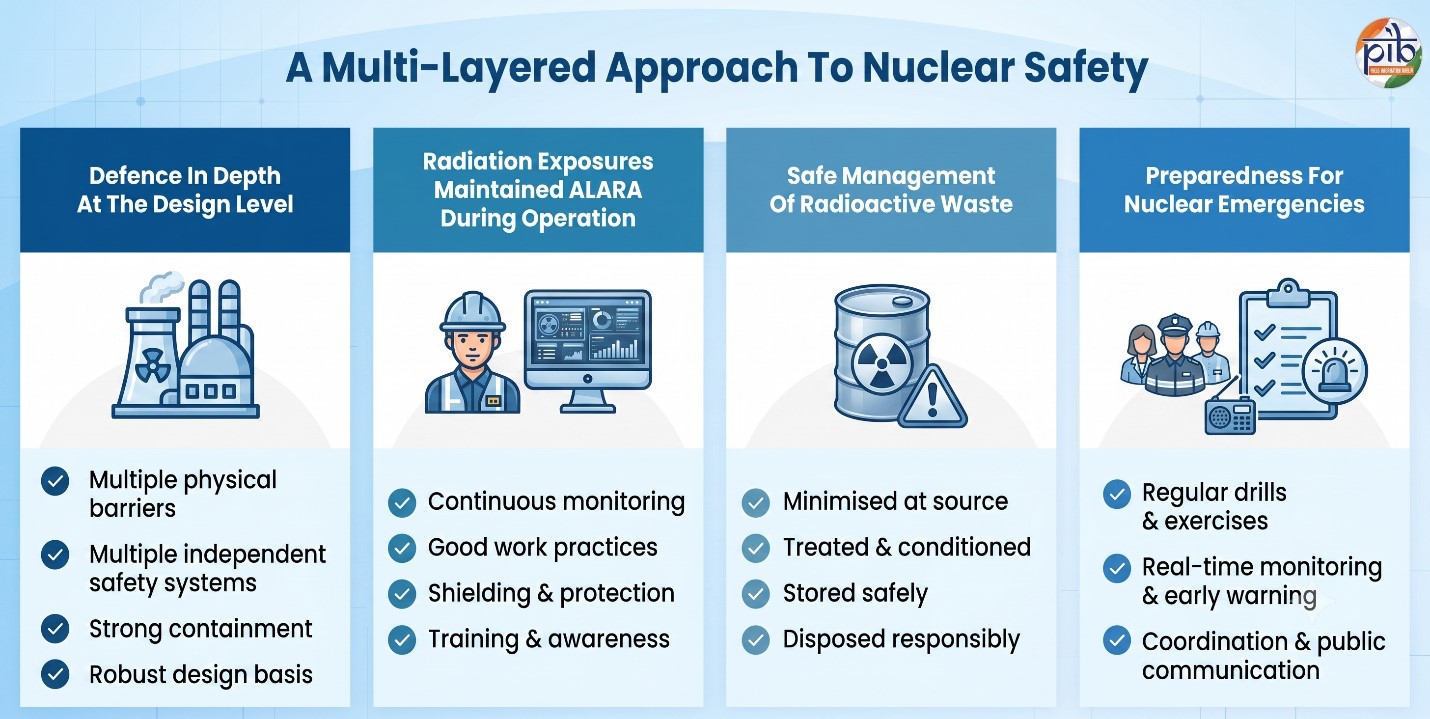
- Safety measures adopted in India – Indian nuclear facilities follow the internationally recognised Defence-in-Depth philosophy, under which multiple independent and complementary layers of protection are provided.
- These include:
- Robust reactor design and construction,
- Quality assurance and rigorous testing,
- Multiple physical barriers against radioactive release,
- Redundant and diverse safety systems,
- Emergency reactor shutdown mechanisms,
- Core-cooling systems,
- Backup power supplies, and
- Protection against external hazards such as earthquakes, floods, cyclones and tsunamis.
- Indian PHWRs, for instance, incorporate two independent and diverse shutdown systems, along with systems for continued removal of heat from the reactor core.
- The objective is not to depend on a single safety mechanism but to ensure that failure of one layer does not automatically lead to a serious accident.
- Radiation Protection and ALARA Principle – Radiation protection is governed by the principle of ALARA — As Low As Reasonably Achievable.
- Plant design, shielding, ventilation, maintenance procedures and worker training are used to minimise occupational exposure.
- The Atomic Energy Regulatory Board (AERB) prescribes radiation protection standards, while dedicated Health Physics Units monitor radiation levels, occupational exposure, plant systems and environmental releases.
- For members of the public, the prescribed annual effective dose limit from planned exposure associated with nuclear facilities is 1 mSv, excluding exposure from natural background radiation and medical procedures.
- This regulatory approach seeks to ensure that exposure remains within prescribed limits during normal operations.
- Radioactive Waste Management – Radioactive waste management is an essential component of the nuclear fuel cycle.
- India follows a closed fuel-cycle approach, under which spent fuel can be reprocessed to recover valuable nuclear materials for subsequent use.
- Radioactive waste that cannot be reused is treated, conditioned and stored or disposed of according to its characteristics and radioactivity.
- High-level radioactive waste can be immobilised through vitrification, in which the waste is incorporated into a stable glass matrix suitable for long-term management.
- Continuous environmental monitoring is also undertaken around nuclear installations to detect and assess radioactive releases and ensure compliance with prescribed limits.
- Nuclear Emergency Preparedness – Even though nuclear accidents are highly unlikely under normal operating conditions, preparedness for exceptional events is essential.
- India follows a multi-level emergency-management framework involving the national, state, district and plant levels.
- Key elements include:
- Mandatory On-site and Off-site Emergency Plans for nuclear power plants;
- Regulatory approval and periodic review of emergency arrangements;
- Regular mock drills and emergency exercises;
- Coordination among nuclear facilities, district administrations, police and disaster-management authorities;
- Radiation detection and monitoring capabilities;
- Specialised medical preparedness for radiation emergencies; and
- Continuous environmental surveillance.
- The Department of Atomic Energy (DAE) plays a central role in technical preparedness, while the AERB provides regulatory oversight.
- Nuclear and radiological emergencies are also incorporated into India's broader disaster-management framework.
|
Lessons from Fukushima
|
- The Fukushima Daiichi accident of 2011 highlighted the importance of preparedness for extreme natural hazards and beyond-design-basis events.
- Following Fukushima, Indian nuclear power plants underwent comprehensive safety assessments.
- Additional safety measures were introduced or strengthened, particularly in areas such as emergency power, cooling systems, severe-accident management and protection against external hazards.
- The lesson is clear: nuclear safety is not a one-time achievement but a continuous process of assessment, learning and technological improvement.
|
What are the challenges before India?
- High capital costs and long gestation periods can make nuclear projects financially demanding.
- Technological complexity requires sustained investment in R&D, specialised manpower and domestic manufacturing.
- Radioactive waste and long-term safety require robust institutions and public confidence.
- Social acceptance can be affected by perceptions of radiation risk and inadequate communication.
- Emergency preparedness must continuously evolve in response to new technologies, climate-related risks and extreme natural events.
- Therefore, rapid capacity addition must never come at the cost of safety or regulatory credibility.
What could be done?
- Strengthen independent and credible regulation while ensuring adequate technical capacity for the AERB.
- Accelerate indigenous reactor technologies, including PHWRs, Fast Breeder Reactors and SMRs.
- Invest in nuclear R&D and human capital to maintain technological competitiveness.
- Strengthen radioactive-waste management and long-term disposal capabilities.
- Integrate nuclear power with renewable energy, storage and modern grids to achieve a resilient electricity system.
- Improve public communication through transparent disclosure of safety and environmental-monitoring data.
- Strengthen disaster preparedness through frequent multi-agency exercises and community-level awareness.
- Expand peaceful applications of nuclear technology in healthcare, agriculture, food processing, critical minerals, advanced materials and hydrogen.
What lies ahead?
- As India moves towards Viksit Bharat 2047 and Net Zero emissions by 2070, nuclear energy can serve as a reliable pillar of a diversified low-carbon energy system.
- The way forward is therefore not a choice between nuclear and renewables, but their strategic integration, backed by scientific temper, strong institutions and an unwavering commitment to public and environmental safety.
Reference
PIB| Applications and Safety of Nuclear Energy



