Prelims: Current events of national and international importance | Health | Science & Technology
Why in News?
Recently, researchers have developed a liquid crystal (LC)-based sensor integrated with artificial intelligence (AI) capable of distinguishing between cobra and viper venom.
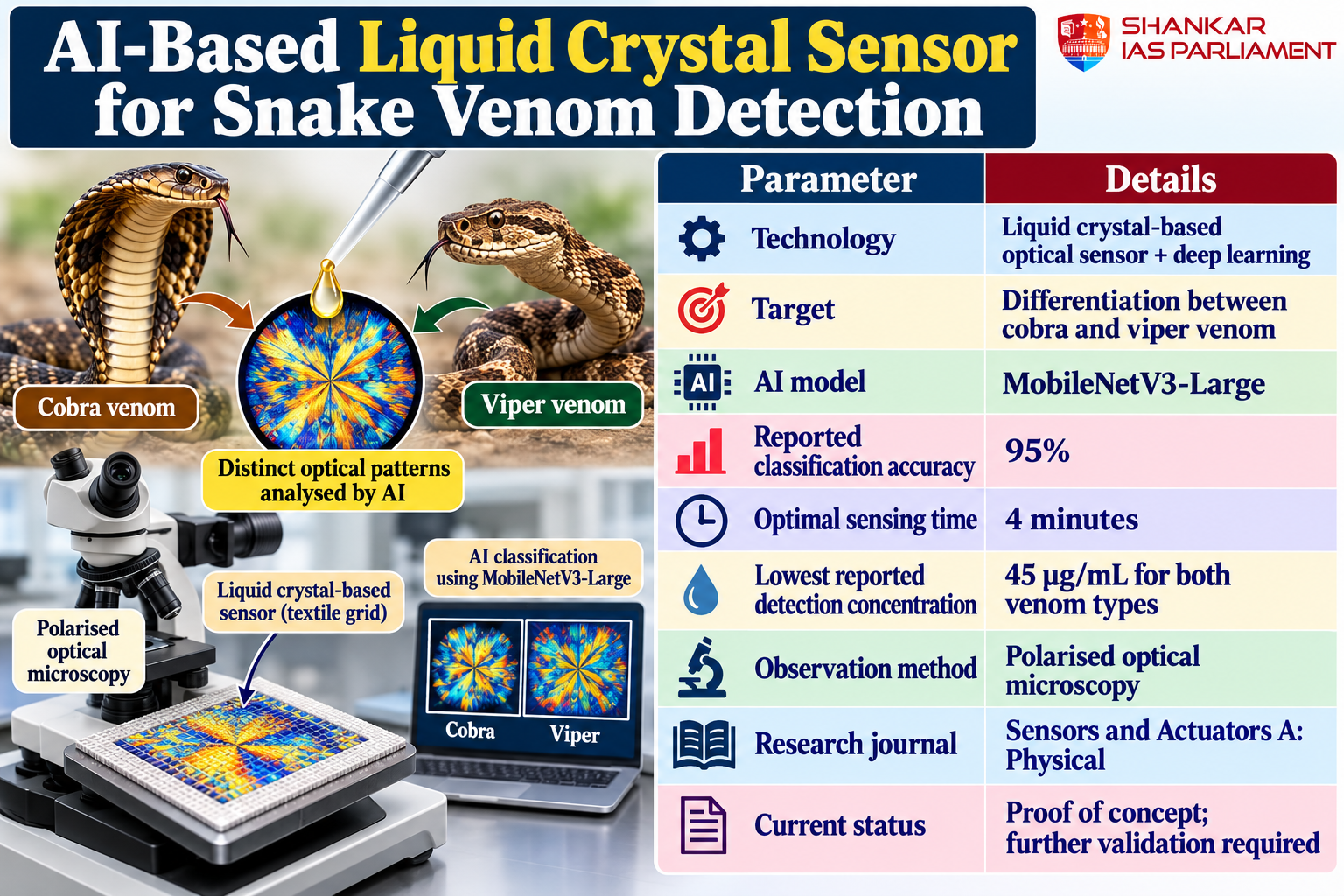
- The system achieved a classification accuracy of 95% with an optimal sensing time of four minutes.
- The study demonstrates a promising rapid diagnostic approach; however, additional validation is necessary prior to clinical implementation.
Potential advantages
- Rapid identification – It provides a classification result in approximately four minutes under the reported experimental conditions.
- Cost-effectiveness – It utilizes a relatively simple sensing mechanism, reducing overall operational costs.
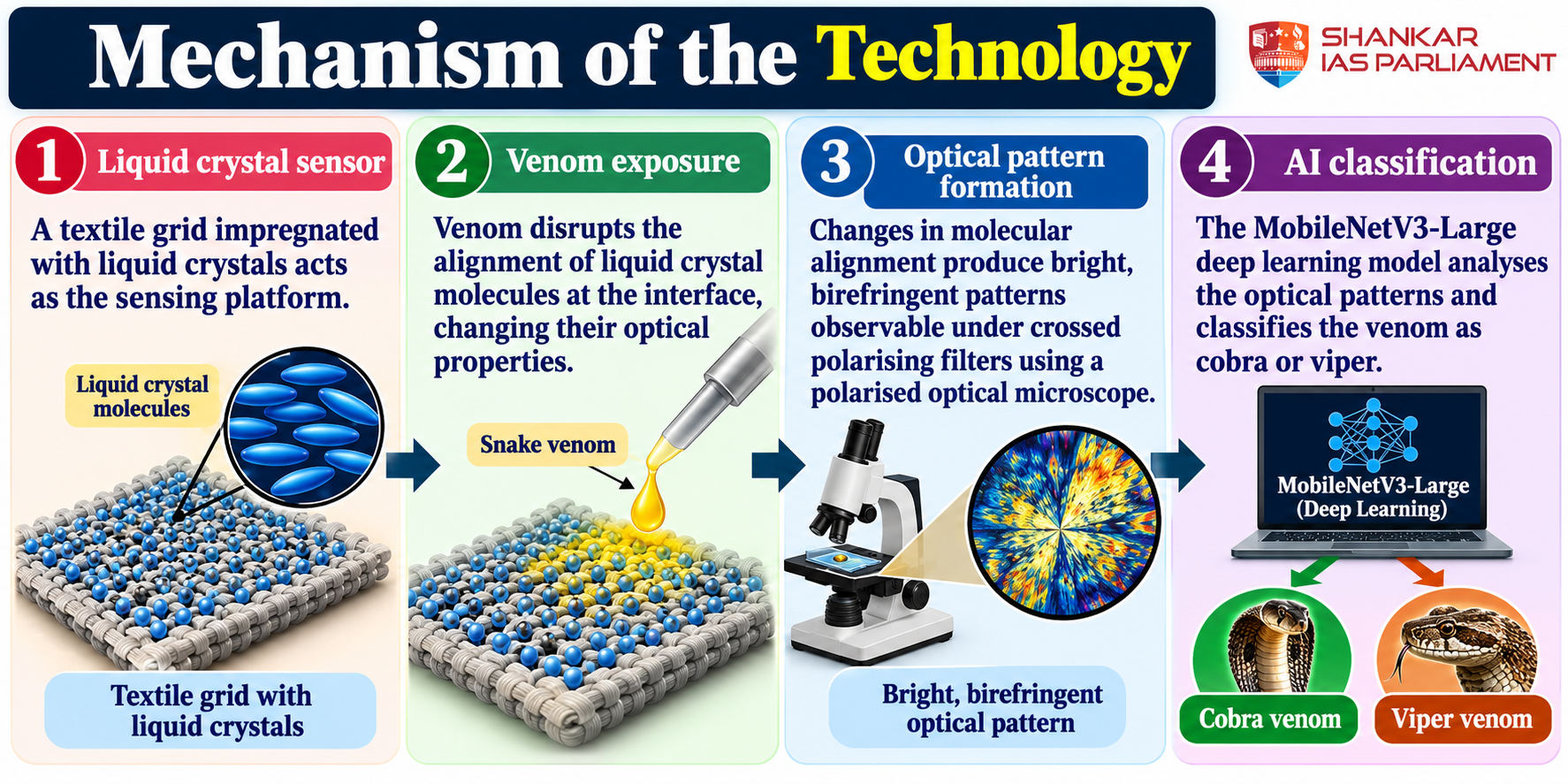
- No requirement for venom-specific antibodies – It relies on changes in liquid crystal alignment instead of specific antigen–antibody binding.
- AI-assisted analysis – It detects optical texture patterns that are challenging to distinguish through visual inspection alone.
- Potential clinical relevance – It could support healthcare professionals in making more informed decisions regarding snakebite treatment.
Snakebite as a Public Health Concern
- Snakebite represents a significant public health concern, especially within rural and agricultural communities.
- Delayed access to treatment and challenges in identifying the snake species involved may complicate clinical management.
- The study reports approximately 4,500 to 7,000 snakebites annually in Iran; this figure is distinct from the snakebite burden reported in India.
- Type of Antivenom
|
Type
|
Description
|
|
Monovalent antivenom
|
Directed against the venom of a particular snake species or type
|
|
Polyvalent antivenom
|
Designed to neutralise venoms from multiple specified snake species
|
- Accurate identification of the snake species may facilitate the selection of the most appropriate treatment.
- Polyvalent antivenoms are commonly administered in cases where the responsible snake species cannot be reliably identified.
- Administration of antivenoms may result in adverse effects, such as allergic reactions and serum sickness.
Conventional Methods vs. Liquid Crystal–AI Sensor
|
Parameter
|
Conventional diagnostic approaches
|
Liquid crystal–AI approach
|
|
Principle
|
May use immunochemical methods or clinical assessment
|
Venom-induced changes in liquid crystal alignment
|
|
Signal
|
Biochemical reaction or clinical indicators
|
Optical patterns
|
|
Analysis
|
Laboratory testing and/or clinical interpretation
|
Deep learning-based image classification
|
|
Reported time
|
Depends on the method
|
4 minutes under study conditions
|
|
Main limitation
|
May require specialised equipment, time or reagents
|
Clinical performance and generalisability remain unvalidated
|
Limitations and Challenges
- Limited scope – Differentiates cobra and viper venom, but does not identify all venomous snake species.
- Clinical validation – Requires evaluation in real-world clinical settings.
- Sensitivity issues – Detection of low venom concentrations needs improvement.
- Performance variability – Variations in venom composition, sample quality, and environmental factors may affect results.
- Diagnostic reliability – Study accuracy may not directly translate to routine clinical practice.
- Implementation barriers – Cost, equipment requirements, training, and integration into healthcare systems remain challenges.
|
Key Scientific Concepts
|
- Liquid crystals – Materials exhibiting properties that are intermediate between conventional liquids and crystalline solids.
- Birefringence – A property of materials in which light experiences different refractive indices depending on its polarization and direction.
- Polarised optical microscopy – A technique for observing optical properties and structural changes in materials.
- Deep learning – A branch of machine learning employing multilayered neural networks to identify patterns in data.
- MobileNetV3-Large – A convolutional neural network architecture optimized for efficient visual recognition tasks.
|
Reference
TOI | AI-Based Liquid Crystal Sensor for Snake Venom Detection



