Blooming Beyond Borders
Roots of a Blooming Industry
- India’s diverse agro-climatic conditions support varied flower cultivation, while cultural and religious practices sustain strong domestic demand.
- Recognised as a sunrise industry, floriculture contributes to farmer incomes, agricultural exports, rural enterprises and horticultural diversification.
- Rising consumer demand, technological advancements and policy support are driving its commercial growth.
Inside India’s Floral Economy
- Floriculture involves the cultivation, harvesting, marketing and processing of flowers, ornamental plants and planting materials.
- Major product categories:
- Loose flowers: Marigold and jasmine, sold by weight for garlands and religious purposes.
- Cut flowers: Roses, gerberas, carnations, orchids and lilies, marketed with stems for bouquets.
- Other products include cut foliage, potted plants, bedding plants and ornamental planting materials.
Flowers That Shape the Market
- Roses: Major cultivation in Karnataka and Maharashtra; significant export value.
- Marigolds: Widely cultivated in Tamil Nadu and Madhya Pradesh for religious ceremonies.
- Carnations, Chrysanthemums and Gerberas: Grown under controlled conditions for quality and exports.
- Lilies and Orchids: Premium flowers cultivated in regions such as Sikkim and Mizoram.
- Growing demand for exotic flowers supports urban landscaping, event decoration and wellness industries.
From Open Fields to Protected Farms
- Open-field cultivation: Used for Chrysanthemum, Rose, Marigold, Aster, Lily and Tuberose.
- Protected cultivation: Greenhouses regulate temperature and humidity, ensuring uniform quality, higher productivity and year-round availability.
- Gerberas and Carnations are important export-oriented greenhouse crops.
Beyond Bouquets: Multiple Applications
- Religious and social: Jasmine, Marigold and Crossandra are used in worship and ceremonies.
- Lifestyle: Urbanisation increases demand for bouquets, gifting and landscaping.
- Perfumery and cosmetics: Rose, Jasmine and Lavender provide raw materials.
- Pharmaceuticals: Calendula, Hibiscus and Chamomile have medicinal applications.
- Natural dyes: Marigold and Hibiscus are used for colour extraction.
Mapping India's Flower Belt
According to the Third Advance Estimates (2025–26):
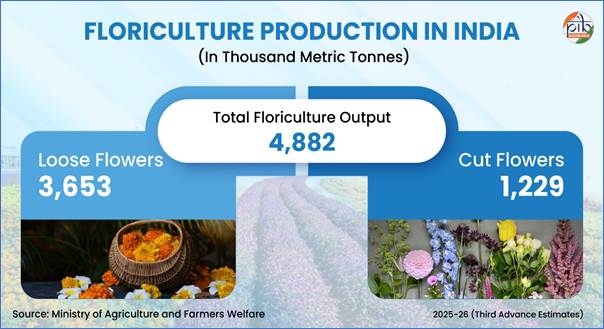
- Total cultivation area: 410 thousand hectares.
- Loose flower production: 3,653 thousand MT.
- Cut flower production: 1,229 thousand MT.
- Total production: 4,882 thousand MT.
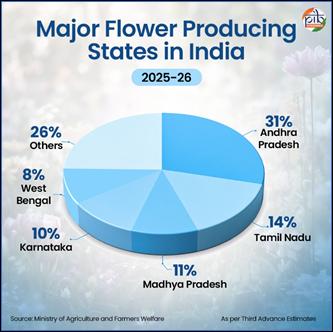
Leading producing states:
- Andhra Pradesh – 31%
- Tamil Nadu – 14%
- Madhya Pradesh – 11%
- Karnataka – 10%
- West Bengal – 8%.
The Northeastern states collectively contribute around 4%, with Assam and Nagaland emerging as important producers.
India's Growing Footprint in Global Markets
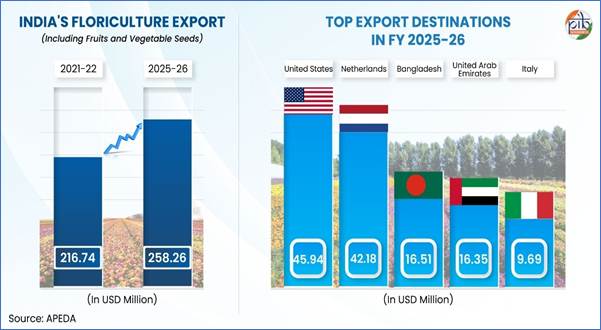
- Floriculture exports, including fruits and vegetable seeds, increased from USD 216.74 million (2021–22) to USD 258.26 million (2025–26).
- Major export destinations (2025–26):
- USA – USD 45.94 million
- Netherlands – USD 42.18 million
- Bangladesh – USD 16.51 million
- UAE – USD 16.35 million
- Italy – USD 9.69 million.
Export portfolio: Roses, Carnations, Chrysanthemums, Gerberas, Orchids, Anthuriums, Tulips and Lilies.
- Fresh flowers serve Europe, Japan, Australia, the Middle East and USA.
- Loose flowers cater largely to Gulf markets; cut foliage serves Europe.
- Dry flowers constitute a major export segment due to longer shelf life and wider market reach.
Export breakthrough: In February 2025, Mizoram exported its first consignment of 1,024 Anthurium flowers (70 kg) to Singapore, facilitated by APEDA.
Enabling Growth Through Policy Support
- MIDH: Promotes horticultural development through the National Horticulture Mission and initiatives for Northeastern and Himalayan states.
- NABARD: Provides financial assistance for protected cultivation and precision farming.
- APEDA: Facilitates agricultural exports and international market access.
- Other support: Subsidies on seeds, planting materials, equipment and air freight, alongside farmer training and capacity building.
- Research: ICAR, CSIR, State Agricultural Universities and All India Coordinated Floriculture Improvement Project support technological development.
Cultivating Innovation: CSIR Missions
CSIR Floriculture Mission (2021):
- Covers over 2,208 hectares across 399 clusters in 26 States/UTs.
- Benefitted 16,220 individuals as of December 2025.
- Promotes entrepreneurship, technology transfer and farmer incomes.
CSIR Aroma Mission (2017):
- Expanded aromatic crop cultivation beyond 51,000 hectares.
- Established 4,500+ clusters across 28 States.
- Trained 1.22 lakh people through 2,096 programmes.
- Generated around one crore rural employment opportunities and produced 6,000+ tonnes of essential oils worth approximately ₹600 crore.
From Laboratory to Field: Exotic Flowers
- Tulips in Palampur: CSIR-IHBT research enabled scientific cultivation of tulips in Himachal Pradesh, attracting over 1.5 lakh visitors by May 2026 and promoting floriculture tourism.
- Eustoma in Odisha: Scientific interventions in temperature management and disease control enabled successful cultivation in Sambalpur, demonstrating the potential to grow exotic flowers beyond traditional climatic regions.
A Sector Poised for Sustainable Growth
- Floriculture can diversify agriculture, enhance farmer incomes, generate rural employment and strengthen exports.
- Future growth requires protected cultivation, precision technologies, quality planting materials, improved post-harvest infrastructure and international quality standards.
- Stronger research, market linkages, regional specialisation and value addition can transform India into a competitive global floriculture hub.
Conclusion
Floriculture represents an emerging opportunity to combine agricultural diversification, scientific innovation and export-led rural development, creating sustainable livelihoods one bloom at a time.
Reference
PIB



