|
The Geostationary Earth Orbit (GEO)
|
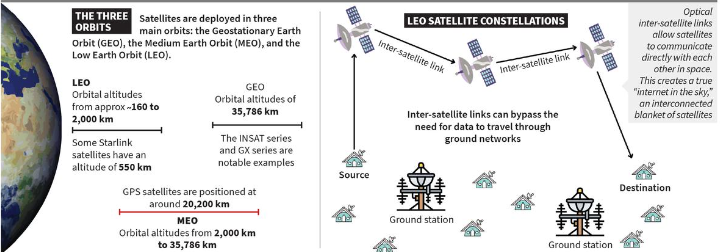
- Altitude – They orbit at 35,786 km above the equator.
- They match the Earth’s rotation, allowing them to remain stationary relative to a point on the ground.
- Advantages – The high altitude allows a single GEO satellite to cover nearly one-third of the Earth’s surface, except the Polar Regions.
- For example, Viasat’s Global Xpress (GX) system.
Viasat, is a global communications company specializing in satellite-based internet and networking systems for both commercial and government sectors.
- GEO satellites are also typically large.
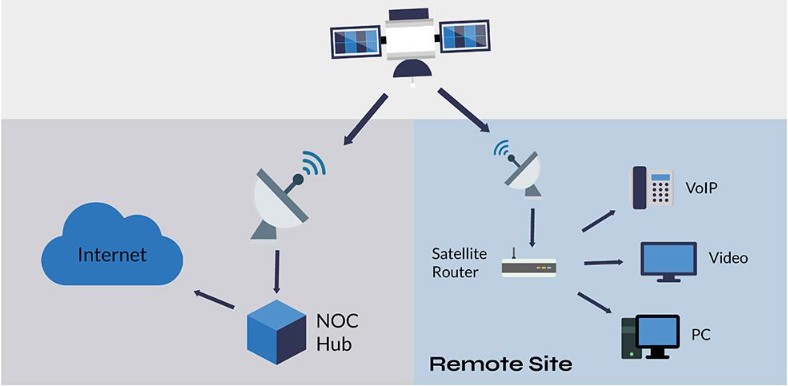
- They act as “bent-pipes,” simply relaying signals back to Earth without processing them.
- Drawback – They have high propagation latency.
Latency refers to the delay, or time it takes, for data to travel from one point to another on a network.
- This makes GEO systems unsuitable for time-sensitive applications like video conferencing or real-time transactions.
|
|
The Medium Earth Orbit (MEO)
|
- Altitude – MEO satellites operate at altitudes between 2,000 km and 35,786 km.
- Advantages – They offer a compromise between GEO and LEO systems
- Their latency is lower than that of GEO satellites,
- Drawbacks – They still require a constellation for global coverage
- For example, O3b MEO constellation, consists of 20 satellites.
- Their latency is often insufficient for many real-time applications.
- The satellites remain large and costly to launch.
|
|
The Low Earth Orbit (LEO)
|
- Altitude – They orbit at altitudes below 2,000 km
- Advantages – Their proximity to Earth results in very low latency
- They are also smaller, often table-sized, making them cheaper and quicker to deploy.
- Drawbacks – Smaller coverage area.
|