Mains: GS III - Environment
Why in News?
Recently,for the first time, two captive-bred great Indian bustards have been released into the wild.
What is the Great Indian Bustard and population status of the Great Indian Bustard (GIB)?
- Historical Range and Habitat – The Great Indian Bustard is a large, ground-dwelling bird inhabiting open savannahs, grasslands, and semi-arid deserts.
- Historically spread across 11 states ranging from Haryana in the north to Tamil Nadu in the south, and from Rajasthan to Odisha, its natural range has drastically shrunk.
- Population Collapse – From an estimated population of 1,260 to 1,400 birds in the early 1970s, the wild GIB population has plummeted to only about 150 individuals.
- Roughly 130 reside in Rajasthan, while the remaining survive precariously across Gujarat, Maharashtra, Karnataka, Telangana, and Andhra Pradesh, facing a high risk of local extinction.
- Project GIB – To combat extinction, the Centre, along with the Wildlife Institute of India (WII) and the state governments of Rajasthan and Gujarat, launched a long-term conservation project in 2012–13, expanded in 2014 with dedicated breeding centres.
- Wild eggs collected from Desert National Park (DNP) were artificially incubated at centres in Sam and Ramdevra, successfully producing 98 captive-bred birds.
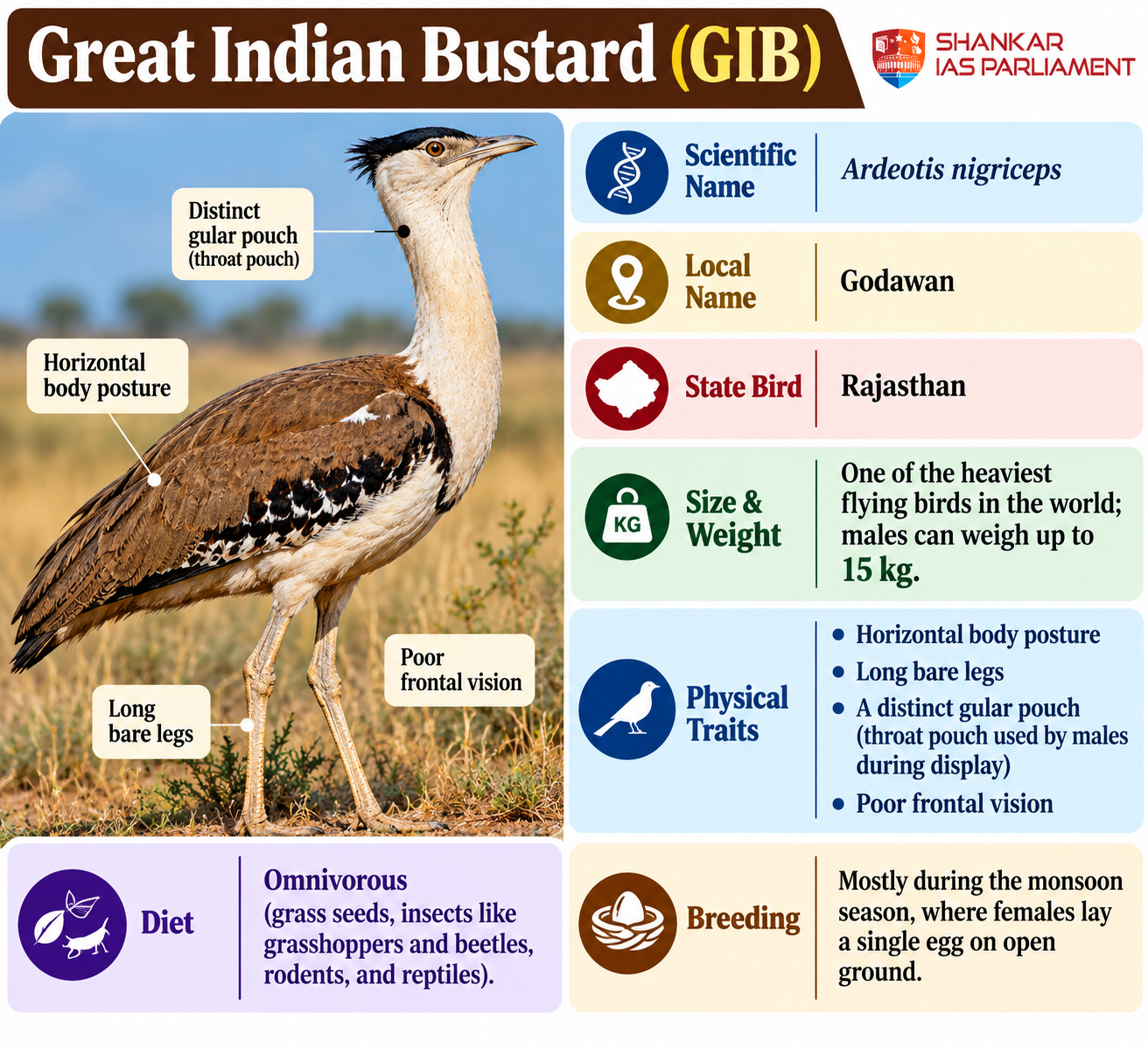
What does the recent rewilding experiment entail?
- Pilot Release – Two captive-bred male GIBs were released into the wild for the first time in Rajasthan’s Desert National Park near Jaisalmer.
- It marks a critical milestone in Project GIB, another 11 birds have been earmarked for subsequent wild release.
- Anti-Imprinting – To prevent human imprinting, young chicks aged three to four months were moved to specialized rewilding aviaries and soft-release facilities inside DNP to help them adapt naturally to open wilderness.
- Post-Release Monitoring – The released birds have been fitted with satellite transmitters that transmit coordinate and movement alerts thrice daily, allowing scientific teams to conduct rigorous remote and field-based monitoring.
What are the primary ecological and structural threats facing GIB recovery?
- Power Line Collisions – Overhead high-voltage renewable energy transmission lines pose a leading mortality threat.
- Due to their heavy bodies and poor frontal vision, GIBs struggle to detect power cables, resulting in frequent fatal collisions.
- Afforestation of Grasslands – A major systemic threat identified by conservationists stems from bureaucratic perceptions within forest departments that seek to "improve" open habitats by planting trees or building waterholes in native grassland ecosystems, destroying the natural arid terrain required by bustards.
- Habitat Fragmentation – The gradual conversion of open grasslands and arid scrublands into intensive croplands, industrial zones, and mining leases severely fragments remaining habitats.
- Proposed limestone mining near the northern boundary of Desert National Park continues to threaten core release sites.
What judicial interventions and policy measures are required for long-term survival?
- Supreme Court Directives on Power Lines – The Supreme Court accepted expert panel recommendations, demarcating strict priority areas (14,013 sq km in Rajasthan and 740 sq km in Gujarat) and mandating that critical power lines be moved underground between 2027 and 2028 alongside dedicated powerline corridors.
- Grassland Protection and Tenure Recognition – State governments must legally recognize grasslands as vital, distinct ecosystems rather than degraded wastelands, protecting them from tree plantation drives and commercial land diversion.
- Multi-State Range Expansion – While Rajasthan serves as the primary pilot site, successful rewilding must eventually expand to historical range states like Maharashtra, Madhya Pradesh, Karnataka, and Gujarat, backed by prior comprehensive habitat restoration.
Reference
Indian Express | GIB



