0.2010
7667766266
x

Pumped Storage Hydropower (PSH)

iasparliament Logo
November 03, 2026

Mains: PIB Analysis

What is Pumped Storage Hydropower and How Does it Work?

  • Pumped Storage Hydropower is a mature, large-scale electricity storage technology.
  • It operates using two water reservoirs located at different elevations (an upper reservoir and a lower reservoir).
  • The Charging Phase (Pumping)- When there is excess electricity in the grid (such as during a sunny afternoon when solar generation peaks but local demand is low), surplus power is used to pump water from the lower reservoir up to the upper reservoir. Energy is stored as gravitational potential energy.
  • The Discharging Phase (Generating)- When electricity demand spikes (such as during evening hours when people turn on home appliances and lights), the stored water is released from the upper reservoir back down to the lower reservoir.
  • As the water rushes down, it spins turbines to generate electricity.

What are the types of pumped storage projects?
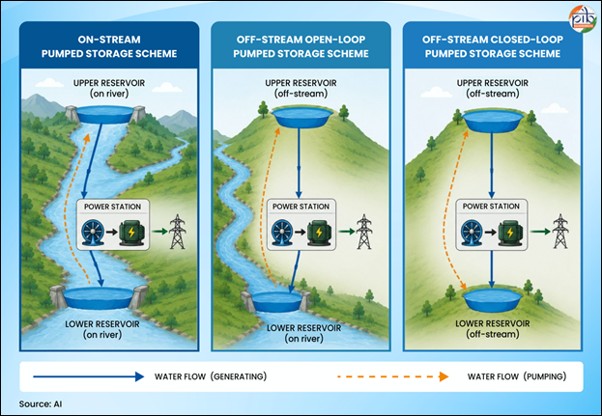
  • On-Stream PSPs- Both the upper and lower reservoirs are built directly on a flowing river or stream. While cheaper to construct because they utilize existing river flows, they cause higher ecological disruption to river ecosystems.
  • Off-Stream Open-Loop PSPs- One reservoir is connected to a natural river stream, while the other is situated away from it.
  • Off-Stream Closed-Loop PSPs - Neither reservoir is connected to a perennial natural watercourse.
  • Water is cycled continuously between the two man-made pools, with minimal natural inflow.
  • India is increasingly prioritizing closed-loop systems to protect aquatic biodiversity and speed up clearances.

Pumped Storage 1

Comparative Analysis

Feature

Pumped Storage Hydropower (PSH)

Battery Energy Storage Systems (BESS)

Storage Duration

Long-duration storage (can supply power for 6 to 12+ hours)

Typically, short-to-medium duration storage (2 to 4 hours)

Lifespan

Very long operational life (40–60+ years with minimal degradation)

Shorter lifecycle; batteries degrade over time and require replacement

Scale

Gigawatt-scale capacity suitable for entire regional grids

Modular, scalable from local microgrids to utility-scale substations

Site Dependency

Highly dependent on specific hilly topography and water availability

Location-independent; can be set up anywhere flat land is available

What is the significance for India?

  • Fulfilling 2030 Climate Targets- India aims to achieve 500 GW of non-fossil fuel capacity by 2030. Energy storage is the backbone required to back this intermittent capacity.
  • Grid Stability & Frequency Regulation - PSH plants can start up and deliver full power within minutes, making them ideal for stabilizing sudden fluctuations in grid frequency.
  • Reducing Reliance on Fossil Fuels- By storing cheap solar and wind power for night use, India can avoid ramping up expensive and polluting coal or gas-fired peaking power plants.
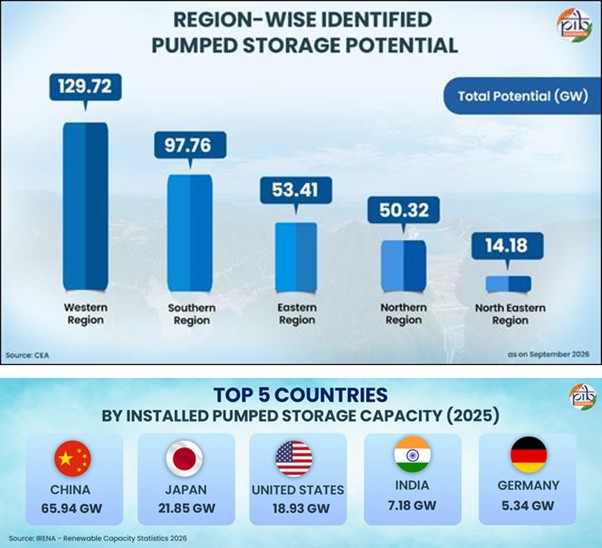
  • Global Standing- India ranks fourth globally in installed pumped storage capacity, backed by an expanding national pipeline mapped out by the Central Electricity Authority (CEA).

Pumped Storage 2

What are the Government initiatives and policy push?

  • Tariff-Based Competitive Bidding (TBCB) - The Ministry of Power notified TBCB guidelines to streamline transparent procurement of stored energy.
  • Transmission Charge Waiver - To attract private investments, inter-state transmission system (ISTS) charges are waived for PSPs whose construction is awarded by June 30, 2028.
  • Regulatory Exemptions - The capital expenditure threshold requiring Central Electricity Authority (CEA) concurrence was revised to Rs.3,000 crore, with off-stream closed-loop PSPs completely exempted irrespective of project cost to fast-track approvals.
  • Digital Monitoring- Implementation of portals like the CEA’s Jal Vidyut DPR portal for real-time tracking of project investigations and clearances.

What is the way forward?

  • To unlock India's massive identified pumped storage potential (exceeding 340 GW), policy frameworks must focus on de-risking investments, encouraging closed-loop off-stream designs.
  • It helps to bypass environmental bottlenecks, and promoting hybrid renewable parks where solar, wind, and pumped storage are packaged together.
  • Streamlining land acquisition and offering green-finance incentives will be vital to turning India's storage blueprints into reality.

Reference

PIB | Pumped Storage Hydropower

There are no reviews yet. Be the first one to review.

ARCHIVES

sidetext