Mains: GS III – Science and Technology- Space Technology
Why in News?
Recently, Indian government has approved a ₹27,000-crore programme to launch about 52 new surveillance satellites, with the first expected in 2026.
What are satellites?
- Satellites – Satellites are celestial bodies or man-made objects that orbit a larger body, such as a planet or star.
- Types – There are two main types
- Natural satellites – This includes Earth's Moon, which orbit planets
- Artificial satellites – Human-made objects launched into orbit for various purposes like communication, navigation (GPS), weather monitoring, and scientific research
- Uses – Satellites today guide airplanes and ships, power the internet, television services, and global financial transactions, and help scientists monitor the weather and climate change.
- They are also indispensable for national security as contemporary armies depend on satellites for communications, surveillance, and navigation.
- Bodyguard satellites – It is also known as surveillance satellites.
- They are dedicated spacecraft designed to escort and protect high-value satellites by monitoring close approaches, detecting threats, and countering hostile manoeuvres in orbit.
What are the risks faced by satellites?
- Associated risks – As the number of satellites in orbit has grown, so have the risks.
- Spacecraft can collide with debris, be jammed by radio interference, hacked through ground systems, and threatened by hostile manoeuvres by other satellites.
- Threat of debris– Even as a physical environment, space presents risks that would be unimaginable on the ground.
- For example, a small screw left over from a rocket can punch a hole in a spacecraft traveling at 28,000 km per hour, enough to terminate the mission.
- Risk from transmitters – Satellites use radio signals to talk to the earth, including with users of navigation services.
- A powerful ground transmitter can jam a satellite’s uplink or downlink or use spoofing.
Spoofing is where false signals imitate genuine ones can mislead navigation users.
- Natural threats – Solar storms can damage electronics, induce currents in power systems, and increase atmospheric drag, causing spacecraft to fall out of orbits sooner than expected.
- Geopolitical threats – Beyond debris and natural threats also lies the shadow of geopolitics. Satellites can be inspected, shadowed or even targeted by third-party actors.
- Rendezvous and proximity operations used to be a niche technology but have become ubiquitous today.
- While the satellite that allegedly approached the Indian satellite in 2024 didn’t result in a collision, officials are said to be reading it as a test of capability and a warning.
What are the measures taken by various countries?
- Managing debris risk – To manage this risk, International organisations and countries have built large debris-tracking networks.
- UN – The UN Committee on the Peaceful Uses of Outer Space (COPUOS) adopted voluntary guidelines in 2019 for the long-term sustainability of space.
- NATO – It has declared space to be an operational domain, and have come together under the Combined Space Operations Initiative to promote responsible behaviour in orbit.
- US – The US operates the Space Fence, a radar that can spot objects the size of a marble.
- EU – The European Union runs EU Space Surveillance and Tracking (EUSST), which warns satellite operators about impending threats.
- India – India has the Indian Space Situational Awareness and Management (IS4OM) centre in Bengaluru.
- It is a satellite-tracking hub that tracks satellites, warns of dangerous encounters, and coordinates collision avoidance manoeuvres.
- Indeed, in 2023 alone, Indian satellites executed more than 10 collision-avoidance manoeuvres.
- In 2024, India hosted the Inter-Agency Debris Coordination Committee (IADC), where ISRO publicly declared its intention to pursue ‘Debris-Free Space Missions by 2030’.
- Project NETRA – India’s Project NETRA is expanding these capabilities with new radars and telescopes.
- The Multi-Object Tracking Radar at Sriharikota already provides some coverage while some new sites around the country are in the works.
- Combating cyber threats - Agencies worldwide issued advisories and set up partnerships.
- US – The US has the Space Information Sharing and Analysis Centre (ISAC) to coordinate cyber threat intelligence.
- Spacefaring agencies have responded to such threats by designing hardened waveforms and systems.
- For instance, the US military developed its ‘Protected Tactical Waveform’ for anti-jam communications and ‘Advanced Extremely High Frequency’ satellites that use frequencies that are harder to disrupt.
- The US is also deploying an encrypted GPS M-code.
- Europe – It has rolled out Galileo OSNMA, which authenticates navigation messages to minimise spoofing.
- India – With the use of NavIC, The Indian Space Research Organisation (ISRO) has been testing Navigation Message Authentication (NMA).
Navigation Message Authentication (NMA), is a system that will allow receivers to verify that signals are the real deal.
-
- India’s CERT-In has issued guidelines for satellite operators that emphasise strong encryption, network segmentation, secure credentials, regular patching, and incident reporting.
- India’s new licensing framework through IN-SPACe also requires private operators to comply with safety and security standards.
- Protecting from solar flares – India also took a major step with the Aditya-L1 mission, launched to study the sun from the L1 Lagrange point.
- Data from this mission can yield early warning of coronal mass ejections and other solar activity.
- This helps satellite-controllers place spacecraft in safe mode and/or plan orbital manoeuvres that minimise exposure.
What can be the potentials of bodyguard satellites?
- Positioning – These spacecraft could be positioned near a critical satellite to monitor its surroundings.
- Detection and warning – It can detect suspicious manoeuvres by other satellites, warn of threats, and physically intervene if required.
- Supports orbital assets – They may also accompany orbital assets that protect against suspicious approaches.
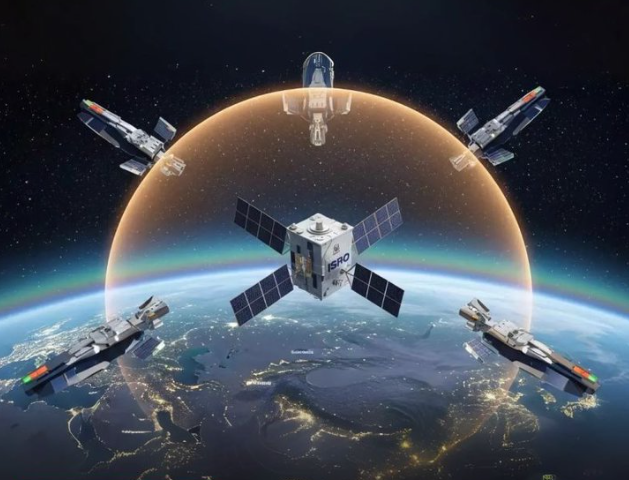
- Protection from hostile actions – It act as a shield against anti-satellite (ASAT) weapons or hostile spacecraft.
- It can intercept or disable enemy satellites that try to approach or tamper with the protected satellite.
- Inspection and repair – It can move close to the main satellite to check for damages, malfunctions, or tampering.
- Backup functions – It can take over communication or navigation services if the main satellite fails.
What needs to be done?
- Continuous monitoring – Constant monitoring and signals must be encrypted, networks must be segmented to avoid threats from various sources.
- Framing clear rules – Clear and strict international rules could play an important role in protecting the satellites.
- Ensuring re-entry – Once a satellite has neared the end of its life, finally, operators need to ensure controlled re-entry and passivation, or adhere to restrictions on how long dead spacecraft can remain in orbit.
What lies ahead?
- In the final analysis, protecting satellites is no small feat — but the benefits have increasingly outweighed the expenses.
Reference
The Hindu| Protecting Our Satellites