Mains: GSII – Polity| Governance
Why in News?
The Supreme Court directed the Centre and Delhi Police to prevent illegal detentions and ensure free movement amid anti-CEC protests, highlighting the need to balance public order with fundamental rights.
What Is Preventive Detention?
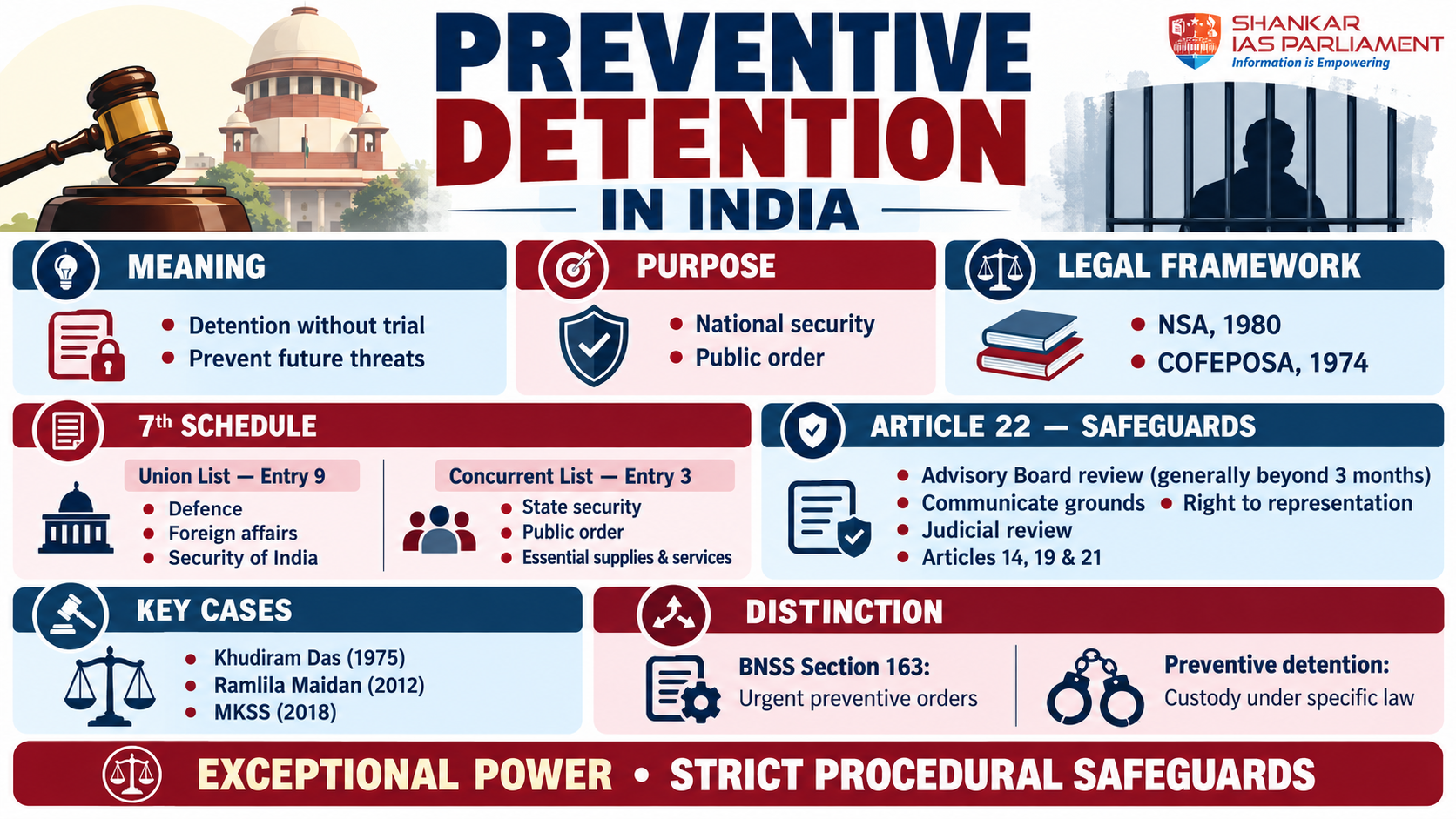
- Meaning – Detention without trial or conviction to prevent a person from committing a potential offence.
- Objective – To protect national security and public order rather than punish past offences.
- Legal Framework – The National Security Act (NSA), 1980, provides for preventive detention on specified grounds.
Preventive detention falls under both the Union List (List I) and the Concurrent List of Constitution of India.
- Schedule 7 of Constitution –
- Union List (Entry 9) – Parliament has exclusive power to make laws for preventive detention connected with defence, foreign affairs, or the security of India.
- Concurrent List (Entry 3) – Both Parliament and State Legislatures the power to make laws for preventive detention connected with
- Security of a State,
- Maintenance of public order,
- Maintenance of supplies and services essential to the community.
How Does Section 163 of BNSS Differ from Preventive Detention?
- Section 163, BNSS – Empowers designated Executive Magistrates to issue urgent orders to prevent threats to public safety, disturbances, riots and other specified harms.
- Key Difference – Section 163 regulates activities and assemblies, whereas preventive detention involves detaining individuals under specific laws.
- Safeguard – Orders must be justified by urgency and sufficient grounds and are subject to judicial scrutiny.
How Has Preventive Detention Evolved in India?
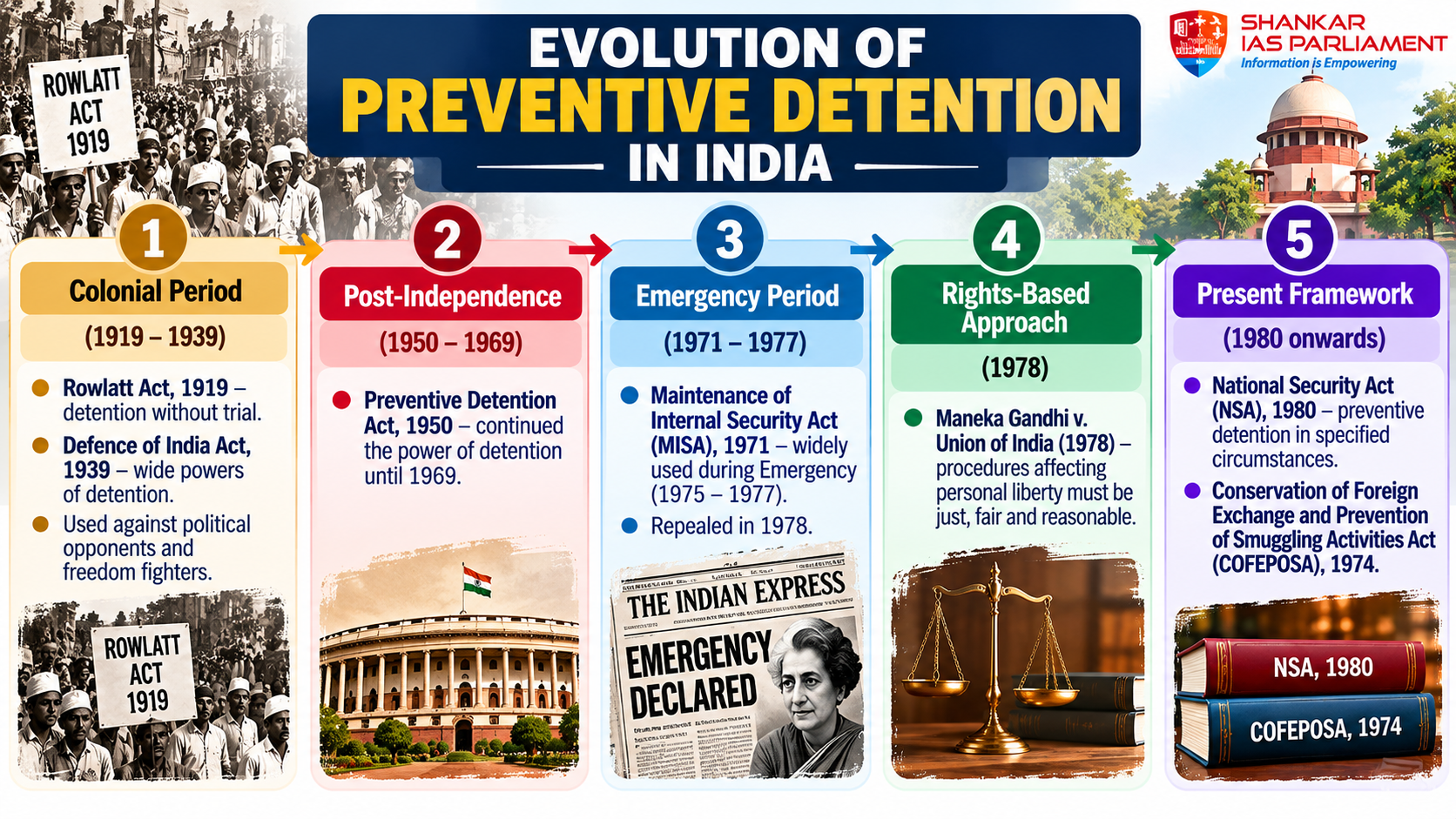
- Colonial Period – The Rowlatt Act, 1919, and the Defence of India Act, 1939, enabled detention without trial and were used against political opponents and freedom fighters.
- Post-Independence – The Preventive Detention Act, 1950, continued this power until 1969.
- Emergency Period – The Maintenance of Internal Security Act (MISA), 1971, was extensively used during the Emergency (1975–1977) and repealed in 1978.
- Rights-Based Approach – In Maneka Gandhi v. Union of India (1978), the Supreme Court held that procedures affecting personal liberty must be just, fair and reasonable.
- Present Framework – The NSA, 1980, and the Conservation of Foreign Exchange and Prevention of Smuggling Activities Act (COFEPOSA), 1974, provide for preventive detention in specified circumstances.
What Are the Constitutional Safeguards Against Preventive Detention?
- Article 22 – It provides specific safeguards against arbitrary detention.
- Article 22(4) – Preventive detention beyond three months generally requires the review of an Advisory Board, subject to constitutional provisions and exceptions.
- Article 22(5) – The detaining authority must communicate the grounds of detention as soon as possible and provide an opportunity to make a representation against the order.
- Judicial Review – Courts can examine whether detention complies with legal requirements, relevant procedures and constitutional safeguards.
- Fundamental Rights – Articles 14, 19 and 21 protect equality before law, specified freedoms and life and personal liberty, respectively. State action must respect these constitutional protections.
What Have the Courts Held on Preventive Detention and Peaceful Protests?
- Babulal Parate v. State of Maharashtra (1961) – The Supreme Court upheld the constitutional validity of prohibitory powers while emphasising that they must operate within legal limits.
- Khudiram Das v. State of West Bengal (1975) – The Court stressed that communicating the grounds of detention provides an important safeguard against arbitrary action and enables the detainee to challenge the order.
- Ramlila Maidan Incident (2012) – The Court emphasised that prohibitory powers should be used in grave and urgent circumstances to prevent immediate harm.
- Mazdoor Kisan Shakti Sangathan v. Union of India (2018) – The Court rejected a blanket ban on protests at Jantar Mantar and called for a system to regulate demonstrations rather than prohibit them altogether.
- Shaik Naznen v. State of Telangana (2022) – The Court reiterated that preventive detention is an exceptional power that must not be exercised routinely.
- Ameena Begum v. State of Telangana (2023) – The Court highlighted the importance of enforcing constitutional safeguards under Articles 14, 19 and 21.
What Were the Supreme Court’s Directions on the Delhi Protests?
- Freedom of Movement – The Court directed authorities to ensure the smooth movement of people and traffic, subject to law and public order.
- No Illegal Detention – All detentions must follow the procedure established by law, and authorities must justify the legal basis of detention.
- Essential Services – Metro and railway services should operate normally, while internet services must remain available in accordance with law.
- Peaceful Assembly – Peaceful protests should be permitted in accordance with law, subject to valid prohibitory orders.
- Accountability – The Court sought a compliance report and agreed to hear habeas corpus petitions alleging mass detentions.
What lies ahead?
- Preventive detention is a legal instrument intended to protect public order and security, but their exercise must remain within constitutional limits.
- The challenge is to maintain public order without arbitrarily restricting personal liberty or the right to peaceful protest.
- Effective judicial review, procedural safeguards and proportionate restrictions are essential to preserving this balance.
Reference
The Hindu| Preventive Detention



