Prelims: Current events of National and International Importance | Polity and Governance
Why is in news?
Parliament's Monsoon session remains unprorogued for 100 days.
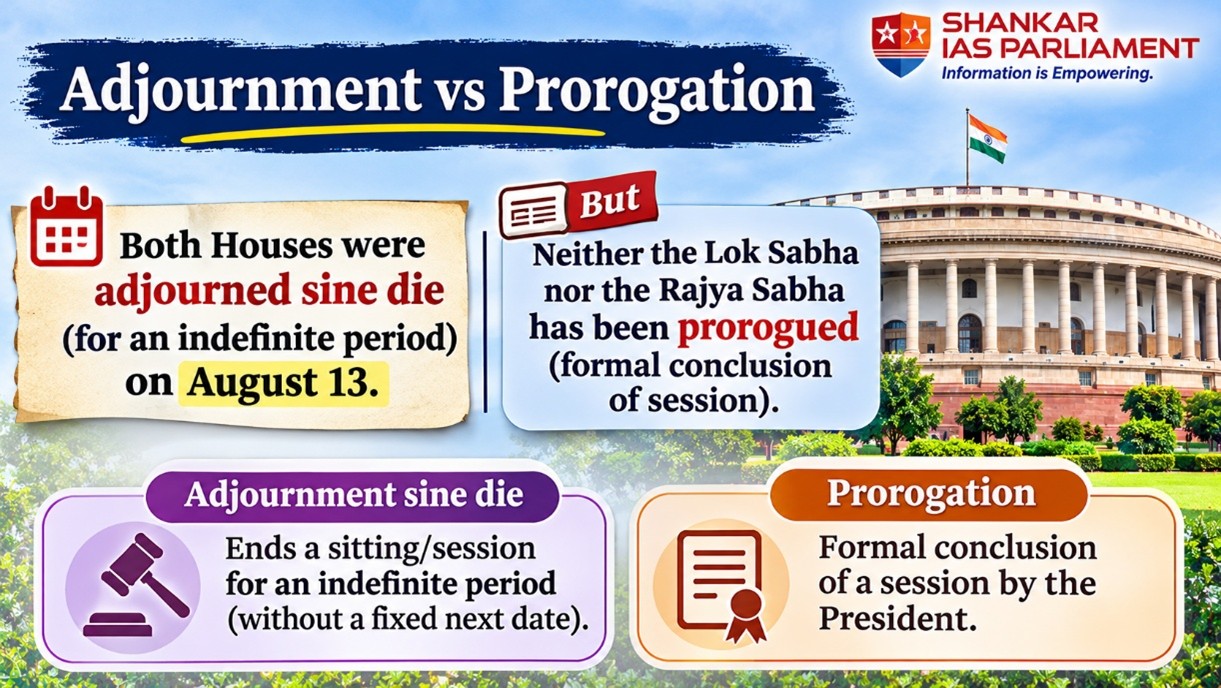
- Both Houses were adjourned sine die (for an indefinite period) on August 13, but neither the Lok Sabha nor the Rajya Sabha has been prorogued (formal conclusion of session).
- It will be allowing the government to summon the House for what could be treated as the second part of the Monsoon Session.
- The previous record was 87 days, set in 2008.
- An extended sitting of the existing session requires a minimum notice of two days, while convening a fresh session requires at least 14 days' notice.
- The Constitution does not prescribe any specific time frame for proroguing a House after it has been adjourned sine die.
- Keeping a session unprorogued for an extended period does not, by itself, amount to any constitutional or procedural impropriety.
- A British or German MP can plan their calendar years ahead with complete predictability, knowing when they are required to discuss the nation’s business.
- Similarly, a 15-day clear notice period is essential for a member to file a question.
- Members thus start submitting their questions as soon as a new session is summoned, which itself requires a 15-day notice.
- The uncertainty over the special sitting has also fuelled speculation about the timing of the Winter session, which is likely to begin in the first week of December.
Winter Session of Parliament
- The Winter Session of Parliament has been skipped only four times in India’s parliamentary history.
- The absence of any move to summon Parliament for its customary winter sitting has also fueled discussion about whether the session could be skipped altogether.
- The first time Parliament missed its winter session was during the 19-month Emergency.
- The Lok Sabha met from July 21 to August 7, 1975, and then only from January 5 to February 6, 1976, without sitting during November or December, when the Winter Session is normally held.
- The next instance came in 1979 after the premature dissolution of the Sixth Lok Sabha on August 22.
- The newly elected House met only in January 1980, resulting in the Winter Session being skipped.
- A similar situation arose in 1984 following the assassination of Prime Minister Indira Gandhi on October 31.
- General elections were called, and the Eighth Lok Sabha held its first sitting on January 15, 1985.
- After a gap of 36 years, the Winter Session was skipped again in 2020 during the COVID-19 pandemic.
- Amid fears over the spread of the virus and stringent social-distancing norms, Parliament did not meet after the truncated Monsoon Session that ran from September 14 to 23.
- Article 85 of the Constitution, which deals with the summoning and prorogation of Parliament, does not prescribe the number of sessions to be held each year.
- It only mandates that the interval between two sessions cannot exceed six months.
- According to Rajya Sabha at Work, until 1961, the two Houses often commenced their sessions on different dates, except for the first session of the year or the first session after a general election.
- The practice was to summon the Rajya Sabha a few days after the Lok Sabha so that legislation introduced in the Lower House could subsequently be considered by the Upper House.
- On at least two occasions, the Rajya Sabha met while the Lok Sabha stood dissolved: from February 28 to March 1, 1977, and from June 3 to 4, 1991, when special sessions of the Upper House were convened.
Reference
The Hindu | Parliament Prorogation



