Why in News?
Recently the Supreme Court disposed of a long-pending reference concerning the relationship between legislative privileges and freedom of speech and expression.
What Was the Case About?
- In 2003, The Hindu published reports on Tamil Nadu Assembly proceedings and an editorial criticising the then Chief Minister.
- The Assembly alleged a breach of privilege under Article 194 and passed a resolution seeking the arrest of senior editors, police raided the newspaper’s Chennai office.
- Editor N. Ravi approached the Supreme Court, arguing that legislative privileges could not curtail press freedom under Article 19(1)(a)
- Recent Development – The recent Supreme Court order did not establish a final judicial rule on the precedence of legislative privilege over freedom of speech.
What Is Legislative Privilege?
- Legislative privileges – These are special powers, rights and immunities granted to legislatures and their members to enable them to perform their constitutional functions independently and effectively.
- Constitutional Provisions –
- Article 105 - Deals with the powers, privileges and immunities of Parliament, its members and committees.
- Article 194 - Deals with the powers, privileges and immunities of State legislatures, their members and committees.
- Article 194(3) - Provides for the determination of State legislative privileges by law and specifies the applicable position until such a law is made.
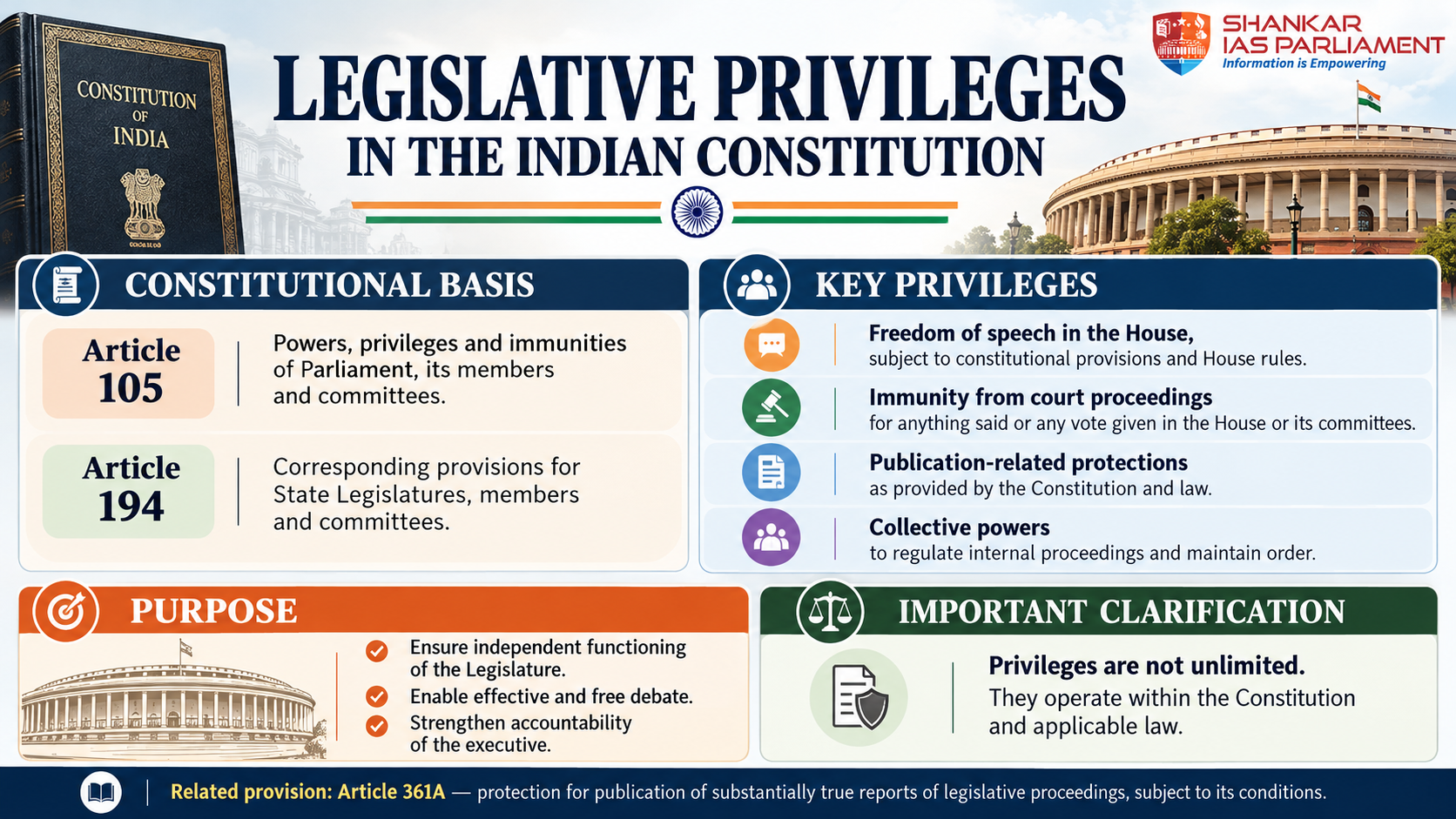
- Objectives of Legislative Privileges –
- Legislative independence – Protect legislatures from undue external interference.
- Freedom of deliberation – Enable members to debate and express views within the House.
- Institutional authority – Protect the functioning and dignity of legislative institutions.
- Effective functioning – Provide powers necessary for legislatures to discharge their constitutional responsibilities.
What Is Freedom of Speech and Expression?
- Article 19(1)(a) – It guarantees citizens the fundamental right to freedom of speech and expression.
- It protects the expression of opinions, dissemination of information and criticism of public institutions.
- Freedom of the press, although not separately mentioned in the Constitution, is protected as part of Article 19(1)(a).
- Article 19(2) – It permits reasonable restrictions on this freedom on specified grounds, including public order, defamation, contempt of court, decency or morality, and incitement to an offence.
- Importance of Press Freedom
- Democratic accountability – Enables the media to scrutinise government and legislative actions.
- Transparency – Helps citizens access information about public institutions.
- Public debate – Facilitates informed discussion of public policies and legislative decisions.
- Checks on power – Discourages arbitrary exercise of public authority.
What Are the Major Constitutional Issues Involved?
- Legislative Privilege vs Fundamental Rights –The key issue is the extent of legislative privileges to be invoked against speech and publications outside the legislature.
- The extent of legislative powers – Particularly the power to punish for breach of privilege or contempt of the House, requires constitutional clarity.
- Such powers must be examined in the context of the Constitution and the rights of affected individuals.
- Accountability of Legislative Institutions – Unclear boundaries may create uncertainty for journalists reporting on legislative proceedings.
- The exercise of privilege powers raises questions about procedural fairness, proportionality and safeguards against arbitrary action.
- Judicial Review and Constitutional Supremacy – The dispute raises questions about the role of courts in examining the exercise of legislative privilege.
- It also highlights the need to reconcile legislative autonomy with fundamental rights and constitutional limitations.
|
Earlier Judicial Developments
|
- Searchlight case (1959) – It examined the relationship between legislative privilege and freedom of the press in the context of publication of Assembly proceedings.
- Keshav Singh case 1964 – It examined the relationship between legislative privilege and judicial authority, including the scope of legislative powers and judicial review.
- The differing legal positions raised in these earlier decisions contributed to the need for an authoritative examination by a larger Bench.
|
What Is the Way Forward?
- Clarify the legal framework – Legislatures should consider clearly defining their privileges through law, as envisaged under the Constitution.
- Protect press freedom – Ensure that legitimate criticism and fair reporting are not unnecessarily restricted through privilege proceedings.
- Ensure procedural fairness – Establish transparent procedures and safeguards when allegations of breach of privilege are considered.
- Promote constitutional balance – Reconcile legislative independence with fundamental rights and judicial review.
- Develop clear judicial standards – An appropriate future case may help clarify the scope and limits of legislative privileges in relation to speech outside the House.
What lies ahead?
- The Supreme Court’s disposal of the reference ended a long-pending proceeding but did not settle the confusion between legislative privilege and freedom of speech.
- The issue remains important for protecting legislative independence while safeguarding press freedom, democratic accountability and fundamental rights.
- A clear legal framework and constitutionally balanced exercise of privilege powers are essential for a healthy parliamentary democracy.
Reference
The Hindu| Legislative privilege versus free speech



