Prelims: Current events of national and international importance | Geography
Why in news?
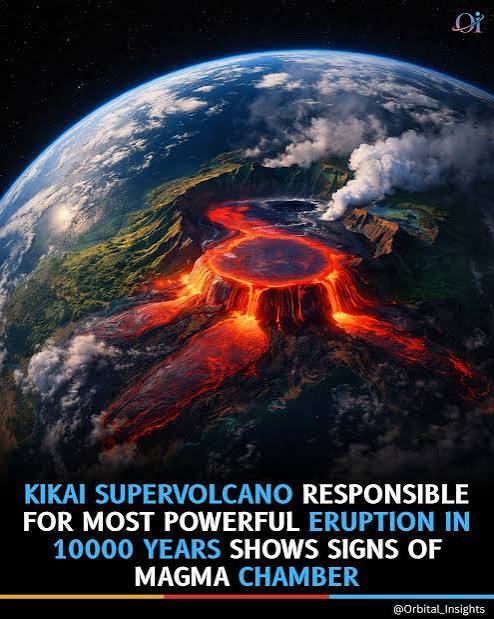
A new study reveals that Japan's Kikai Caldera is gradually refilling with fresh magma, offering key insights into volcanic eruption cycles and future risk prediction.
- Kikai Caldera – Kikai is a largely submerged volcanic caldera located off southern Japan.
- Location – It is situated mostly submerged in the East China Sea off the coast of Kagoshima Prefecture in southern Japan.
- Historical context – Around 7,300 years ago, it produced the Akahoya eruption, regarded as the largest known eruption of the Holocene epoch.
- The eruption released an estimated 160 cubic kilometres of volcanic material, far exceeding famous eruptions such as Mount Pinatubo (1991).
A caldera is a large, cauldron-like volcanic depression that forms when a volcano violently empties its underlying magma chamber and the ground above collapses into the void.
Key findings of the Study
- Researchers from Kobe University and the Japan Agency for Marine-Earth Science and Technology (JAMSTEC) used seismic surveys beneath the caldera and identified that
- Magma Reservoir – A large underground magma reservoir beneath the volcano, active magma chamber located 2.5 km to 6 km beneath the seabed.
- Fresh Magma – Evidence that the chamber is being replenished by newly injected magma, not leftover magma from the ancient eruption.
- Continued volcanic activity, including the gradual formation of a lava dome over the last several thousand years
- Recharge Timeline – A central lava dome has been slowly growing inside the caldera for about 3,900 years.
Reference
NDTV | One of Earth's Deadliest Volcanoes Is Slowly Reloading With Magma: Study



