Mains: GS III – Environmental Conservation & Waste Management
Why in News?
The Supreme Court directed MoEF&CC to create guidelines for imposing and collecting environmental compensation under the Solid Waste Management (SWM) Rules, 2026.
What is Solid Waste Management (SWM) Rules, 2026?
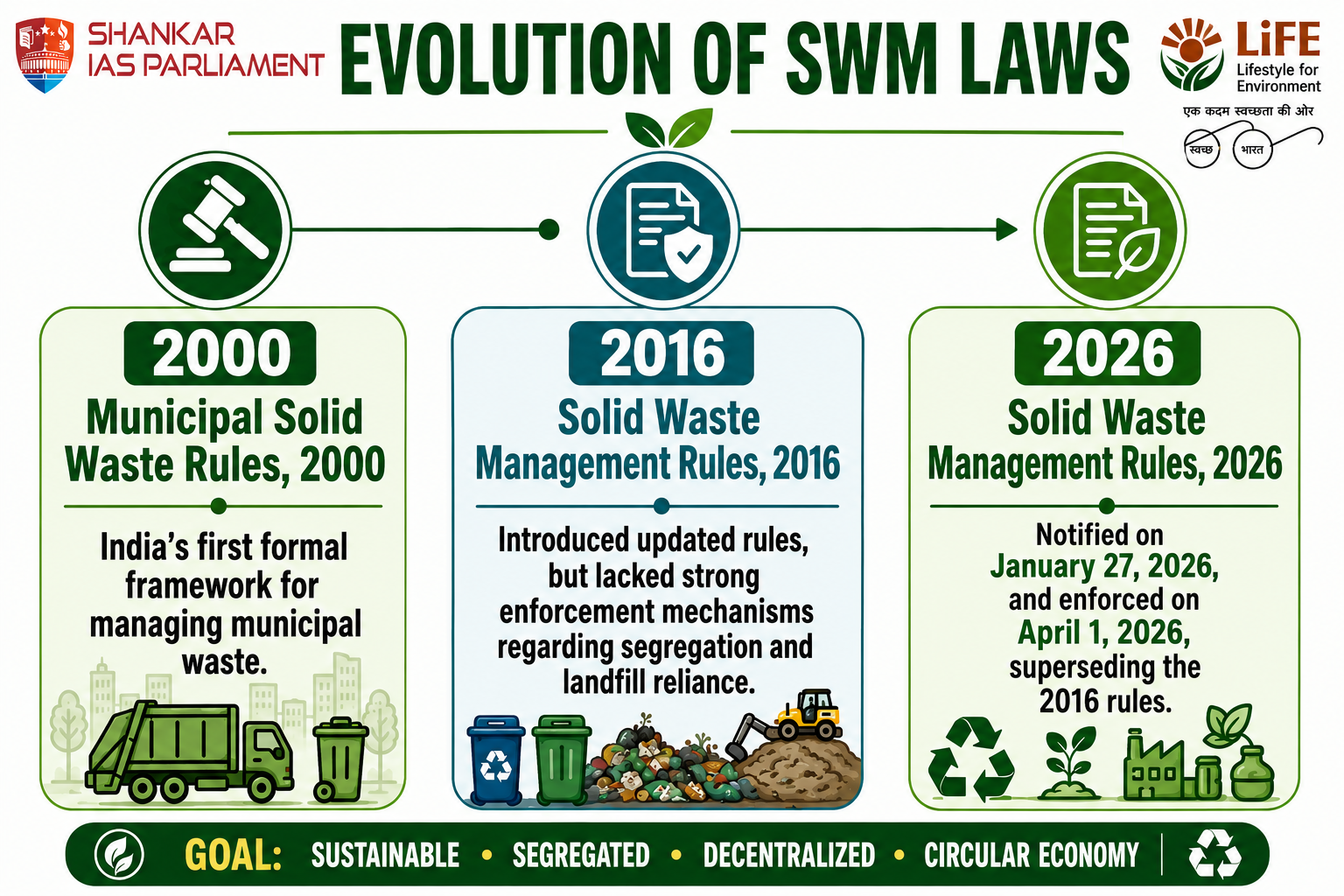
- SWM Rules, 2026 – It supersedes the Solid Waste Management Rules, 2016.
- Notified under – Environment (Protection) Act, 1986 and came into full effect from April 1, 2026.
- Objective – To integrate the principles of Circular Economy and Extended Producer Responsibility, with a specific focus on efficient waste segregation and management.
- ‘Polluter Pays’ principle for non-compliance – It includes cases of operating without registration, false reporting, submission of forged documents or improper solid waste management practices.
What are the key Provisions of the SWM Rules, 2026?
- Four-Stream Waste Segregation – It mandates segregation of waste at the source into dry, wet, sanitary, and hazardous or special-care categories.
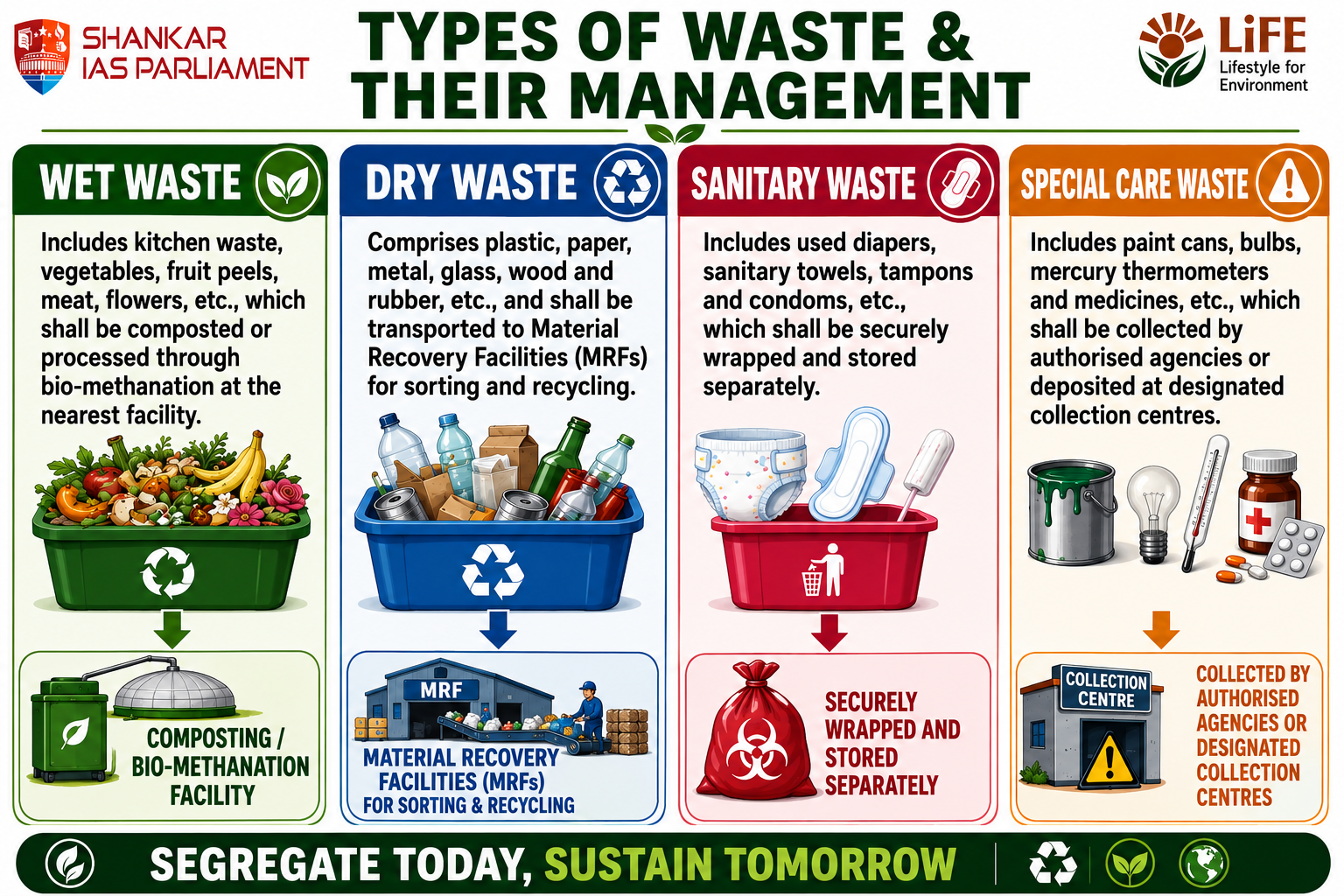
- Circular Economy – It promotes reduction, reuse, and local processing of waste instead of disposal at large dumping sites.
- National Monitoring Portal – It establishes a centralized digital platform to track municipal and rural waste data nationwide.
- Producer and Bulk Generator Accountability – It expands responsibilities for bulk waste generators.
- Legacy Dumpsite Remediation – It mandates time-bound actions to remediate historical landfills and dumping yards.
- Rule 17 (Environmental Compensation) – It requires the imposition of compensation on non-compliant entities in accordance with the polluter pays principle.
What is the evolution of Solid Waste Management (SWM) Rules?
What are the Supreme Court's guidelines on environmental compensation?
- Key Principles for Environmental Compensation (Rule 17)
- Restitutionary Nature – Compensation serves as an additional measure to penal fines and is intended to restore damaged environments, rather than replace fines.
- Predictable and Structured Regime – Compensation must adhere to transparent rules, enabling individuals and entities to anticipate specific penalties for defined violations.
- Tangible and Intangible Damage – Compensation calculations are required to address both observable losses and broader ecological or health-related impacts.
- Potential or Imminent Harm – Entities may be held liable if their activities present a significant risk of harm, even in the absence of actual damage.
- Proportionality and Valuation – The amount of compensation imposed must correspond directly to the extent and duration of the damage incurred.
- High-Level Monitoring and Directives – The Court established a Central Implementation Committee (CIC) to oversee implementation, provide guidance for the national online portal, and standardise compensation rules.
- The Court directed that collected compensation be maintained in a dedicated escrow account to be used exclusively for solid waste management projects.
What are the challenges?
- Systemic Breakdown in Collection & Transport – Although urban areas claim over 95% waste collection, the waste is frequently mixed again in single-compartment trucks or transfer stations.
- This mixing contaminates organic waste and makes recyclable paper or plastic unusable, leaving dumping yards as the only disposal option.
- Flawed Data & Unverified Reporting – There is a discrepancy between official records and actual conditions; official reports indicate high collection and processing rates, yet open dumpsites are still growing.
- CAG audits regularly expose inconsistencies in municipal reports.
- Lack of Capacity at Local Bodies – Many urban and rural local bodies lack the technical expertise, trained staff, and stable funding needed to operate processing facilities effectively.
- Mismatch Between Tech Solutions and Market Demand – Waste management facilities are often constructed without considering local waste composition or end-market demands.
- For example, Delhi's Okhla compost plant produces about 40 tonnes per day, which is far below its 200-tonne capacity due to limited regional demand.
What steps should be taken?
- Prioritise Source Segregation and Verification – Require comprehensive multi-stream segregation at both household and bulk generator levels prior to investment in downstream processing facilities.
- Mandate installation of digital weighbridges at transfer stations and processing plants to ensure accuracy of reported waste tonnages.
- Institute Third-Party Audits and Strengthen Governance
- Conduct independent third-party audits to validate the accuracy of local waste management data.
- Impose stringent penalties for falsification of waste management data or misreporting on central data portals.
- Leverage Digital Public Infrastructure (DPI) – Integrate municipal data with the national waste portal utilising artificial intelligence and big data analytics to establish a Decision Support System (DSS).
- Employ a technology suitability matrix to guide local authorities in selecting waste processing technologies aligned with local waste composition and market demand.
- Ensure Rigorous Compensation Recovery – Enforce the Supreme Court-mandated compensation regime, ensuring that collected penalties are allocated to dedicated local waste management escrow accounts.
What lies ahead?
- Going forward, the focus is expected to shift from framing laws to ensuring effective implementation.
- The Supreme Court has laid down a framework for determining environmental compensation under the SWM Rules, 2026, and directed the Environment Ministry to formulate comprehensive guidelines for its imposition and collection.
Reference
Indian Express | Solid Waste Management



