Why in News?
NITI Aayog has identified solar PV manufacturing among the 12 key sectors with the potential to position India as a global manufacturing hub.
What is a Photovoltaic (PV) Cell?
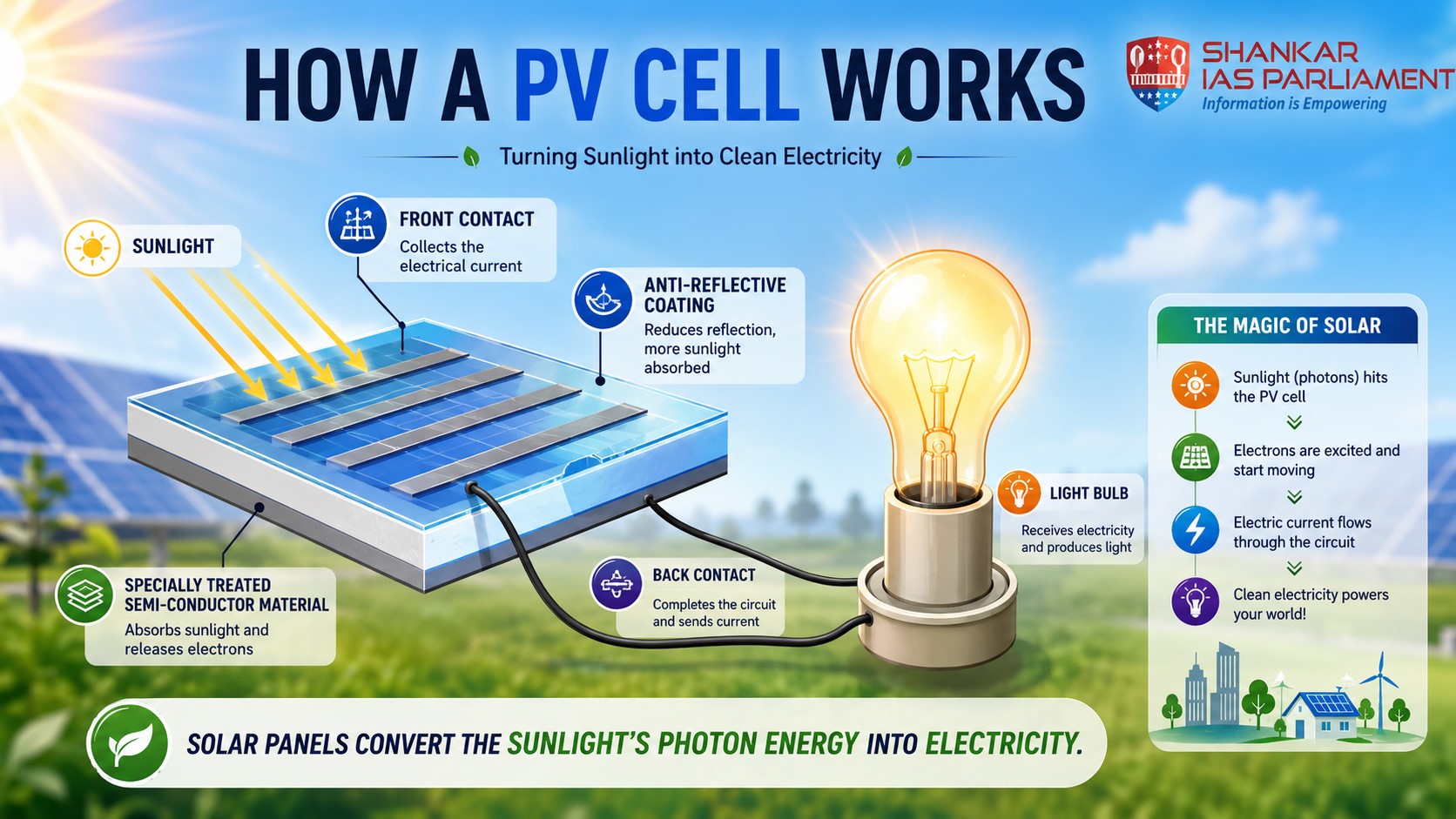
- PV cell - A photovoltaic cell, also commonly called a solar cell, is an electronic device that converts sunlight directly into electricity using the photovoltaic effect.
- Working
What is India’s Solar PV Manufacturing Scenario?
- Significant Growth – India’s solar photovoltaic (PV) manufacturing sector has witnessed remarkable expansion over the past decade.
- Solar PV manufacturing capacity has increased from less than 3 GW in 2014 to around 100 GW, reflecting the country’s growing emphasis on renewable energy and clean-tech manufacturing.
- Schemes and Initiatives – The government has supported this expansion through a combination of industrial-policy measures such as:
- Approved List of Models and Manufacturers (ALMM)
- Basic Customs Duty (BCD)
- Production Linked Incentive (PLI) scheme
- Other measures promoting domestic manufacturing
- The reimposition of ALMM has contributed to a decline in imports of solar cells and modules by requiring eligible projects to source from approved manufacturers.
- Concerns– However, this growth has been predominantly concentrated in the downstream segments, particularly solar cells and modules.
- India remains heavily dependent on imports for critical upstream inputs such as polysilicon, ingots and wafers.
- Thus, the central challenge is to convert India’s rapid capacity expansion into a globally competitive, integrated and technologically advanced solar manufacturing ecosystem.
- However, India's progress remains uneven across the value chain.
- The solar PV manufacturing chain broadly consists of:
- Polysilicon → Ingots → Wafers → Cells → Modules
- India's dependence on imports remains close to 100% for polysilicon, above 90% for wafers, above 60% for cells and above 40% for modules, based on available domestic supply after exports.
- China remains a major source of this dependence. Vietnam, Thailand and Malaysia together accounted for around 14% of India’s PV imports in FY2025.
- Thus, India has achieved substantial downstream capacity but has yet to develop a fully integrated manufacturing ecosystem.
- India's dependence on imports remains close to 100% for polysilicon, above 90% for wafers, above 60% for cells and above 40% for modules, based on available domestic supply after exports.
- China remains a major source of this dependence. Vietnam, Thailand and Malaysia together accounted for around 14% of India’s PV imports in FY2025.
- Thus, India has achieved substantial downstream capacity but has yet to develop a fully integrated manufacturing ecosystem.
- Need for Upstream Integration – The biggest strategic weakness of Indian solar manufacturing is the limited development of upstream capabilities.
- More than 80% of the value of the PV manufacturing chain, along with the associated capital goods, remains concentrated in China.
- India's dependence on imported polysilicon and wafers exposes manufacturers to global price fluctuations, supply-chain disruptions and geopolitical risks.
- The government’s proposal to mandate the use of India-made wafers under ALMM is therefore significant.
- Such measures can create assured domestic demand for upstream manufacturers and encourage investment in polysilicon, ingot and wafer production.
- An integrated domestic value chain would also reduce import dependence, improve supply-chain resilience and increase the domestic value addition generated by the sector.
- Growing Domestic Demand – India’s rapidly expanding solar capacity provides a strong foundation for domestic PV manufacturing.
- The country had installed around 106 GW of solar capacity by March 2025 and needs to add approximately 174 GW more to achieve its 2030 target of 280 GW.
- Prospects – Future demand is expected to be supported by multiple segments:
- Utility-scale solar parks
- Rooftop solar installations
- Open-access renewable energy projects
- Solar-powered industrial applications
- Green hydrogen-linked electricity demand
- The scale of this upcoming demand provides Indian manufacturers with a large domestic market and an opportunity to achieve economies of scale.
- The Central Electricity Authority’s National Electricity Plan/Transmission Plan 2024 projects solar installations to reach around 365 GW by FY2032, implying additional demand of nearly 283 GW between FY2025 and FY2032.
- Therefore, India's expanding solar market can become the anchor for building a globally competitive domestic manufacturing ecosystem.
What is the Global Solar PV Manufacturing Landscape?
- Increasing demand for PV – The global renewable-energy transition is creating unprecedented demand for solar PV.
- Renewable sources accounted for around 30% of global electricity generation in 2023, and this share is projected to rise to approximately 46% by 2030, driven largely by solar and wind.
- Solar has already emerged as the dominant component of installed renewable power capacity.
- By the end of 2025, it accounted for approximately 46% of global installed renewable capacity, compared with around 25% each for hydropower and wind.
- Dominance of China – However, global PV manufacturing remains highly concentrated.
- China accounts for more than 85% of global manufacturing capacity, giving it substantial control over the global solar supply chain.
- Other Asian countries – Vietnam, Malaysia, Thailand, Cambodia, Indonesia, Laos and India—collectively account for a much smaller share.
What are the Major Challenges Faced by India?
- Dependence on China – China's dominance extends beyond finished modules to raw materials, intermediate products, machinery and manufacturing know-how.
- Competing with an ecosystem built around massive economies of scale is difficult.
- Capital Intensity – Polysilicon, wafer and advanced cell manufacturing require large upfront investments.
- High capital requirements, long gestation periods and technological risks can discourage private investment.
- Lack of Specialised Machinery – India continues to face constraints in accessing specialised machinery required for advanced polysilicon, wafer and cell manufacturing.
- Building domestic capabilities in capital goods for solar manufacturing is therefore essential.
- Technology Gap – The industry is rapidly moving towards high-efficiency technologies such as TOPCon, heterojunction (HJT), perovskite and tandem solar cells.
- Indian manufacturers need continuous technological upgrading to remain competitive. However, Indian firms generally spend considerably less on R&D than their Chinese counterparts.
- Low Productivity – Employee productivity per MW in India is estimated to be around one-third that of global peers, partly because of lower manufacturing scale and limited process integration.
- Greater automation, skill development and integrated production can help bridge this gap.
What is India’s Export Potential?
- India's PV exports increased eightfold between FY2018 and FY2025, driven substantially by increased cell-to-module manufacturing capacity under the PLI scheme.
- However, the export basket remains geographically concentrated. The United States accounted for around 97% of India's PV exports in FY2025.
- This concentration reflects both opportunity and vulnerability. US restrictions on products associated with China's Xinjiang region created opportunities for Indian manufacturers as global buyers sought alternative supply chains.
- However, India has achieved limited penetration in other major markets such as Germany, Brazil and the Netherlands.
- One reason is cost competitiveness: Indian modules were reportedly around $0.10–$0.12 per watt more expensive than Chinese modules.
- The absence of free-trade agreements with several major importing economies also limits India's export competitiveness.
What could be done?
- Incentives under the PLI scheme should increasingly promote integrated manufacturing from polysilicon to modules rather than isolated downstream capacity.
- India should develop domestic capabilities in specialised machinery and capital goods, reducing dependence on imported manufacturing equipment.
- Greater public-private investment in R&D is necessary to develop next-generation technologies such as TOPCon, HJT, perovskites and tandem cells.
- India should improve productivity through automation, skilling, process integration and economies of scale.
- Export diversification should be prioritised through trade agreements, standards harmonisation and targeted market-access strategies.
- Policies should balance domestic-content requirements with cost competitiveness, ensuring that the expansion of domestic manufacturing does not unnecessarily increase the cost of India's clean-energy transition.
What lies ahead?
- India's rise from less than 3 GW of solar PV manufacturing capacity in 2014 to around 100 GW today demonstrates the potential of targeted industrial policy combined with rapidly expanding domestic demand.
- The country is already the world's second-largest module manufacturer, with 183 GW of capacity enlisted under ALMM as of May 1, 2026.
- Yet, capacity alone does not constitute manufacturing leadership. India's continued dependence on imported polysilicon, wafers, machinery and advanced technologies remains a structural weakness.
- The next phase must therefore focus on upstream integration, technological innovation, productivity, competitive costs and export diversification.
- If India successfully addresses these bottlenecks, solar PV manufacturing can become a cornerstone of Atmanirbhar Bharat, strengthen energy security, create high-value employment and position India as a trusted global hub for clean-energy manufacturing.
Reference
Down To Earth| India’s PV Manufacturing



