Mains: GSIII – Science & Technology
Why in News?
The recent trends of emerging space threats highlights the need for a comprehensive Indian Space Security Doctrine to address and protect India's growing dependence on space-based services.
What is the Growing Significance of Space Security?
- Critical Infrastructure – Satellites support communication, navigation, weather forecasting, logistics, banking and disaster management.
- National Security – Space assets provide armed forces with surveillance, positioning, timing, communication and situational awareness.
- Strategic Autonomy – Reliable space capabilities strengthen India's technological independence and national resilience.
- Economic Dependence – Increasing civilian and commercial use of satellite services makes space security essential for economic stability.
What is the Changing Threat Landscape in Space?
- Jamming – Interfering with satellite signals to disrupt communication and navigation.
- Spoofing – Transmitting false signals to mislead navigation and positioning systems.
- Cyberattacks – Targeting satellite networks, ground stations and supporting infrastructure.
- Electronic Warfare – Degrading satellite signals and reducing the reliability of space-enabled systems.
- Attribution Challenges – Identifying perpetrators becomes difficult when attacks originate through complex networks or involve multiple actors.
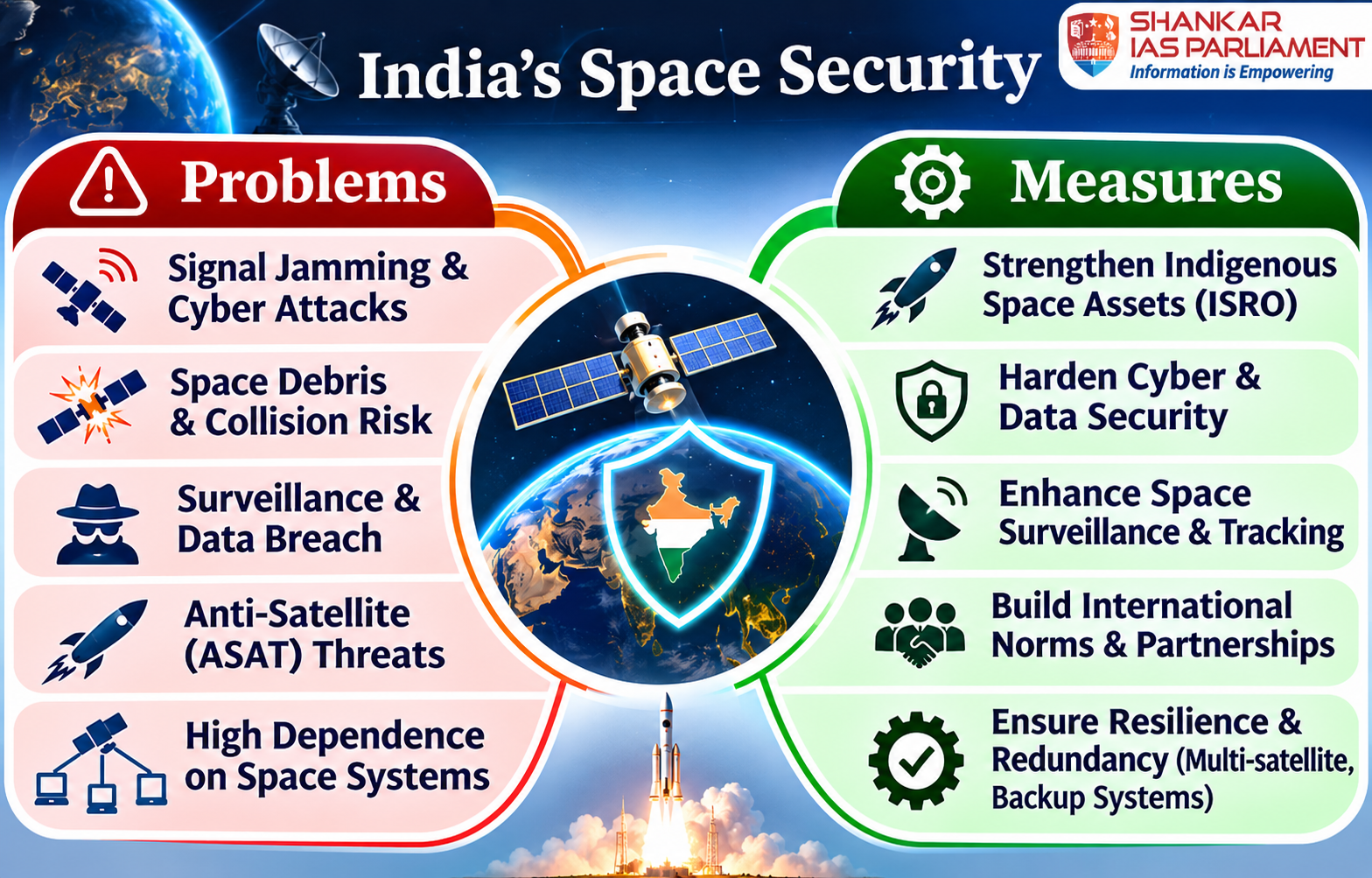
What are the Major Challenges for India's Space Security?
- Lack of Clear Doctrine – Absence of clearly defined thresholds for distinguishing accidental interference from deliberate attacks.
- Attribution Difficulties – Determining responsibility for temporary disruptions, cyber interference and signal manipulation.
- Civil-Military Interdependence – Disruption of commercial satellite services can affect both civilian infrastructure and military operations.
- Escalation Risks – Responding to uncertain or ambiguous threats may unintentionally escalate strategic tensions.
- Infrastructure Vulnerability – Dependence on interconnected satellite systems increases the possibility of cascading disruptions.
What is the Existing Policy Framework?
- Indian Space Policy 2023 – Provides an overarching framework for India's space activities and participation of private entities.
- Indian Space Situational Awareness Report (ISSAR-2025) – Documents India's efforts in space situational awareness, collision avoidance and space-debris mitigation.
- However, India needs to strengthen the integration of these frameworks with hostile disruption assessment, attribution and crisis-response mechanisms.
What the Way Forward?
- Establish Clear Thresholds – Define what constitutes an attack on space assets, including jamming, spoofing and cyber interference.
- Strengthen Space-Domain Awareness – Monitor activities around Indian space assets and identify suspicious behaviour and potential threats.
- Build System Resilience – Develop multiple systems, redundancy and alternative capabilities to ensure continuity of essential services.
- Improve Attribution Mechanisms – Establish standards to identify perpetrators and assess the nature and severity of interference.
- Ensure Rapid Recovery – Develop reconstitution and restoration capabilities to recover essential space services after disruption.
- Public-Private Coordination – Strengthen cooperation among government agencies, armed forces, ISRO and commercial satellite operators.
- Responsible Space Governance – Promote peaceful utilisation of outer space while developing credible deterrence against hostile activities.
What lies ahead?
- India's objective should not be to transform outer space into another arena of conflict but to prevent disruptions in space from creating vulnerabilities on Earth.
- A comprehensive doctrine based on resilience, deterrence, attribution and recovery is essential to protect national security and preserve the peaceful use of outer space.
Reference
The Hindu| India needs a holistic doctrine on space security



