Mains: GS III – Disaster management
Why in News?
Recently there are series of natural and manmade disasters that stand as a test for the disaster resilience of India.
What is disaster resilience?
- Disaster resilience – It is the ability of communities, individuals, and systems to effectively resist, absorb, adapt to, and recover from the negative impacts of hazards and disasters, while minimizing losses and preserving essential functions.
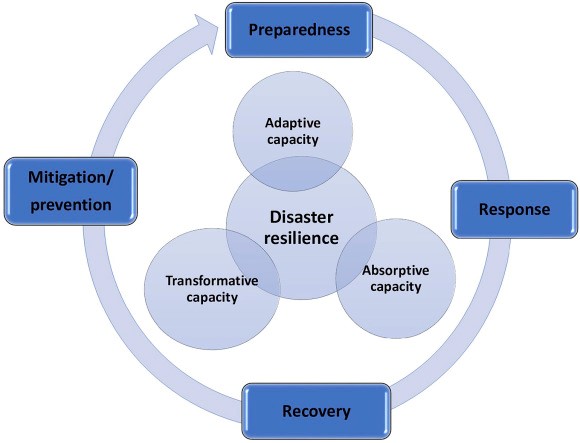
- It is a dynamic process involving preparedness, response, and recovery efforts that builds capacity to withstand and learn from adverse events
- International coordination is crucial in shaping how much India will learn from and teach the world.
- Need – India, is a vast, multi-hazard country, and a multi-faceted approach is essential to deal with heat-related issues and extreme rainfall events.
- The Home Ministry (MHA) and the National Disaster Management Authority (NDMA) oversee the post-disaster.
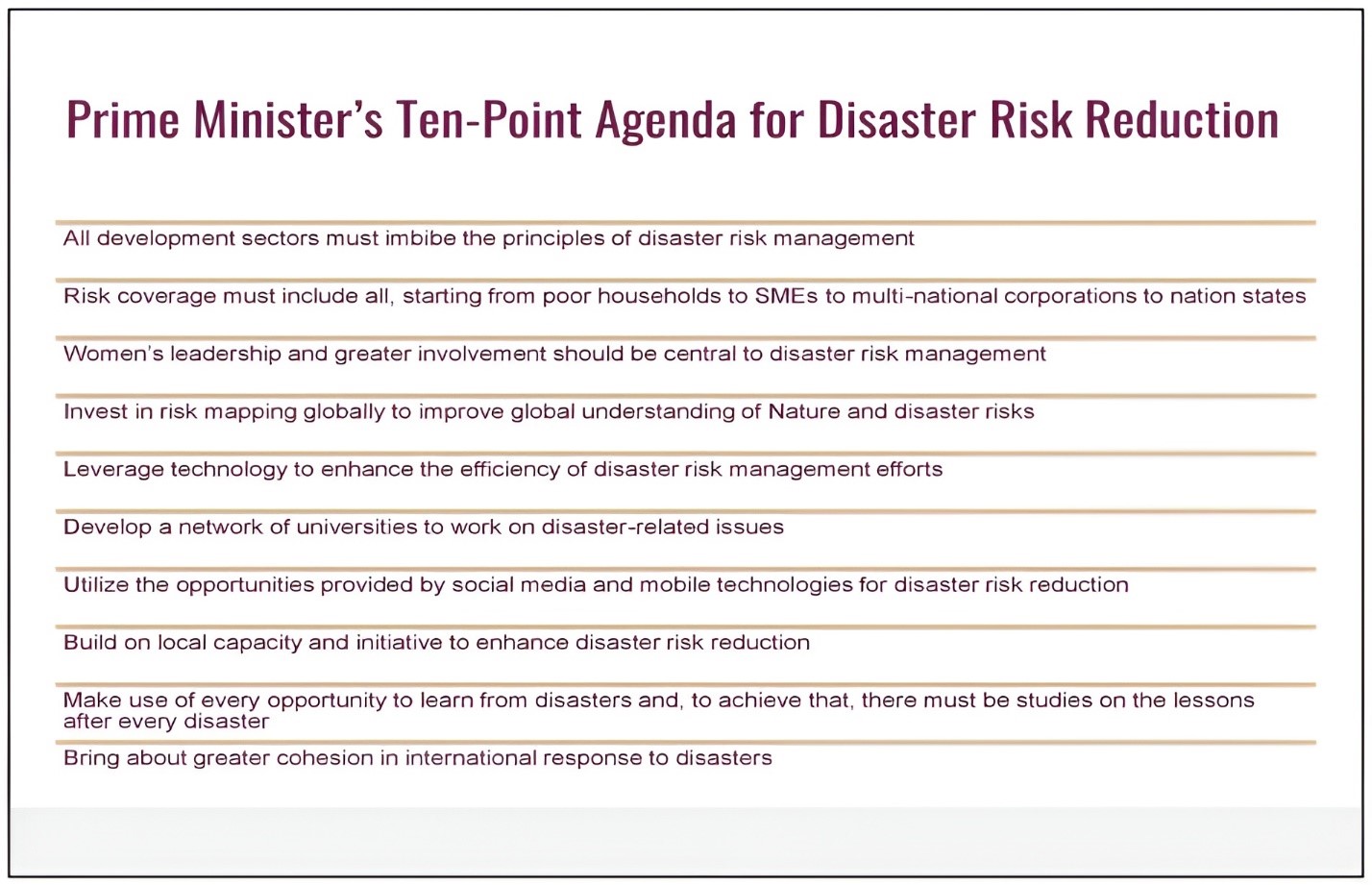
- 10 point agenda – They also monitor the pre-disaster phases, using the Prime Minister’s ten Point Agenda on Disaster Risk Reduction of 2016 as guiding principles.
What is the strategy of 15th FC for disaster risk reduction?
- Approach – In 2021, the 15th Finance Commission adopted a nuanced approach to disaster risk reduction (DRR).
- Fund allocation – It aligned public finances with technological and practical advances, and allocated ₹2.28 lakh crore ($30 billion) over its five-year term.
- Widened focus – It broadened the focus from just post-disaster relief to include prevention, mitigation, preparedness, capacity building, and post-disaster reconstruction.
- Previously, the financial gap for reconstruction was filled through multilateral debt instruments.
- Break up of allocation – The Commission allocated
- 30% for the first segment, divided between
- Preparedness and capacity building (10%)
- Mitigation (20%).
- 70% was assigned to the post-disaster phase, split into
- Response (40%)
- Reconstruction (30%).
- 5 priority areas – In establishing the process chain from budget-to-project for nature-based DRR, five priority areas were identified
- Evaluating the scale of and prioritising India’s multi-hazard challenges
- Integrating scientific concepts of mitigation and reconstruction into public finance
- Avoiding duplication with existing programmes
- Synergizing inter-ministerial, institutional, and Centre-State relationships in developing such programmes
- Establishing processes for light-touch regulation.
- Last year, the procedures and standards for design and the manner of expense for such programmes have been established.
- Coordination – Inter-ministerial, cross-institutional and Centre-State appraisal committees are in place for all hazard- or region-specific projects.
- Reconstruction – Over the past two years, the MHA has approved the first five reconstruction project packages worth about ₹5,000 crore for Uttarakhand, Himachal Pradesh, Sikkim, Assam and Kerala.
- Work is underway to conduct scientific assessments of damage and loss caused by extreme precipitation in the current monsoon.
- Pre-disaster phase – For this much of the preparedness and capacity-building funds were allocated to modernising fire safety (₹5,000 crore).
- Specialised group – Additionally, two specialised groups of 2.5 lakh volunteers, Apda Mitra and Yuva Apda Mitra, were created.
- Capacity building – Some of the capacity-building funds will now be directed towards establishing geo-spatial training labs and expanding faculty-led, action-based research at the National Institute of Disaster Management (NIDM).
- Strengthening NIDM’s three core objectives of training, research, and documentation, a standard course covering 36 streams of disaster management has been initiated.
- The aim of capacity building is to mainstream the subject and its practical application to each panchayat.
- Mitigation – For the 20% window allocated for mitigation, the best scientists, academicians, and numerous public servants were consulted to develop innovative projects.
- In the past year, projects worth ₹10,000 crore ($1.2 billion) have been approved and are being implemented across States.
- They aim to prioritise neglected nature-based solutions as long-term responses to climate change and extreme weather events.
- Cyclone mitigation – As precursor to these forward-looking mitigation programmes, the National Cyclone Mitigation Programme (2011-22) worth ₹5,000 crore had already succeeded in reducing vulnerability of coastal communities to cyclones across eight States.
- Key infrastructure built – It included seven-day early warning systems, cyclone shelters, and embankments.
- Plans of NDMA – Under these mitigation programmes, the NDMA urges States and urban authorities to
- Revitalise water bodies and green spaces to mitigate urban floods.
- Use remote sensing and site-specific automated weather stations to assess the size of at-risk glacial lakes continually.
- Stress bio-engineering solutions for slope-stabilisation in landslide prevention in high-risk zones.
- Rejuvenate water bodies called beels along the Brahmaputra.
- Focus on break lines, water body rejuvenation and fuel evacuation to prevent forest fires.
- Early warning systems – Over the years, the government has also developed advanced early warning systems for various hazards, which have significantly reduced casualties.
- The multi-media Common Alerting Protocol ensures timely alerts in regional languages.
- Support from universities and institutions – To enhance community capacities, initiatives such as a 327-member network of universities and institutional support from the NIDM are crucial.
- The NDRF Academy, the National Fire Service College, and NIDM train hundreds of public servants annually, in the science of hazards and policy.
- Mock exercises – These are carried out to promote hazard- and region-specific awareness, while school safety programmes educate children and distribute resources.
What lies ahead?
- International coordination is crucial in shaping how much India will learn from and teach the world.
- In the face of unrelenting climate change, India created the Coalition for Disaster Resilient Infrastructure and leads DRR-related initiatives at the G-20, SCO, BIMSTEC, and IORA.
- On advice from public and private entities, and academic and scientific institutions, India is successfully preparing to de-risk its complex hazard profile through innovative and sustainable nature-based solutions.
Reference
The Hindu| Disaster Resilience of India



