What is happening in India’s agri-exports?
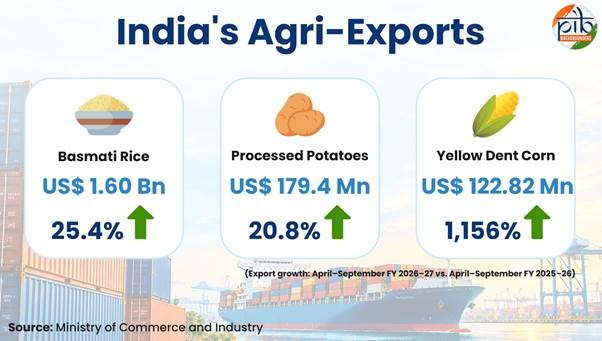
- Basmati Rice - Exports rose about 25.4%, climbing from US$ 1.28 billion in April–September FY 2025–26 to US$ 1.60 billion in April–September FY 2026–27.
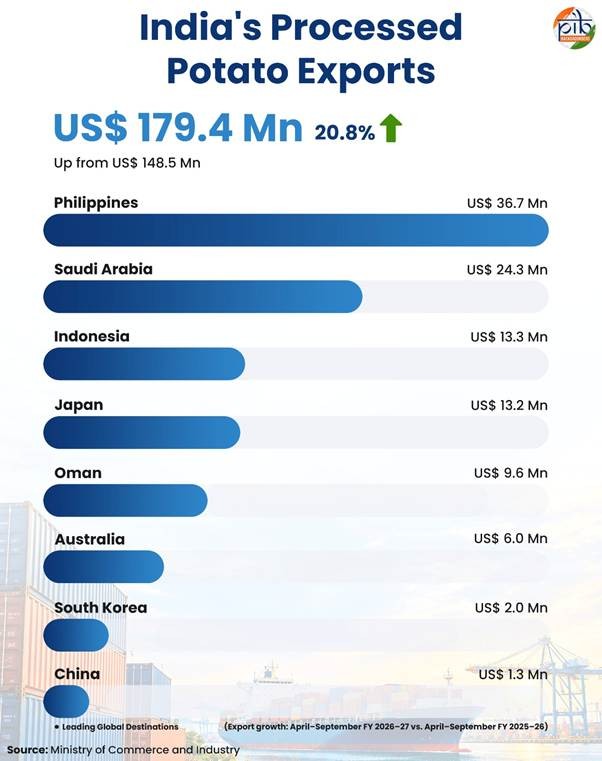
- Processed Frozen Potatoes - Shipments of prepared or preserved frozen potatoes grew 20.8%, increasing from US$ 148.5 million to US$ 179.4 million over the same period.
- Yellow Dent Corn - Exports surged by roughly 1,156% (around 12-fold), jumping from US$ 9.78 million to US$ 122.82 million.
What is the commodity-wise performance and key destinations?
|
Commodity
|
Export Growth
|
Value (Apr–Sep FY 2026–27)
|
|
Basmati Rice
|
+25.4%
|
US$ 1.60 billion
|
|
Frozen Potatoes
|
+20.8%
|
US$ 179.4 million
|
|
Yellow Dent Corn
|
~+1,156%
|
US$ 122.82 million
|
Why market and product diversification matters?
- Wider Geographic Footprint - Growth across West Asia, East and Southeast Asia, North America, and other regions reduce reliance on any single destination.
- Value Addition Beyond Raw Staples - Growth in processed frozen potatoes alongside traditional Basmati rice and yellow dent corn shows expanding demand for both staple grains and processed food products.
- Understanding Percentage Jumps vs. Base Size - Very large percentage spikes such as in yellow dent corn or specific country shipments like Vietnam and Jordan often reflect a small starting base in the previous year, so analysts look at both percentage rates and absolute dollar gains.
What are the challenges for sustaining agri-exports?
- Buyer Concentration in Specific Commodities - When a large share of a commodity’s exports goes to a single destination (such as Vietnam accounting for over half of yellow dent corn shipments in this period), shifts in that buyer's import demand can affect trade flows.
- Quality, Cold-Chain, and Food Standards- Processed and perishable items like frozen potatoes require reliable cold chains, strict quality compliance, and smooth logistics to stay competitive in Asian and global markets.
- Global Price and Supply Fluctuations- Agricultural trade remains sensitive to harvest conditions, global commodity prices, and shifting trade policies across importing countries.
What is the way forward?
- Invest in cold storage, processing facilities, grading, and quality testing so farmers and exporters can capture higher value from processed and perishable goods.
- Build on gains in West Asia, Southeast Asia, and East Asia while expanding outreach into additional compliant international markets.
- Support farmer groups and exporters with market intelligence, sanitary and phytosanitary (SPS) compliance, and farm-gate linkages so export growth translates into better farmer realization.
Reference
PIB | Agri-Exports Gather Pace



