0.3048
7667766266
x

Indian Ocean Dipole (IOD)

iasparliament Logo
July 02, 2026

Mains: GS I – Geography

Why in News?

With a ‘Super El Niño’ forecast for this year, it is an open meteorological question if a 1997 situation could recur.

What is Indian Ocean dipole?

  • IOD – The Indian Ocean Dipole (IOD is an ocean-atmosphere phenomenon defined by the difference in sea-surface temperatures between the western and eastern tropical Indian Ocean.
  • The Indian Ocean Dipole is often called the "Indian Niño".

The  1997 situation and Expectations

  • The 1997 Scenario - In the monsoon of 1997, the Central Pacific was running one of the fiercest fevers in its recorded history in the form of an El Niño so violent that, by every rule of thumb, India ought to have stared at one of its worst droughts.
  • However, in the greatest of meteorological surprises, June-September monsoon rainfall ended up being surplus, about 2% above normal.
  • The Director-General of the India Meteorological Department (IMD), Mrutyunjay Mohapatra, observes that it has “happened only once ever.”
  • The agent of that escape sat not in the Pacific but in India’s backyard sea and is called the Indian Ocean Dipole (IOD).
  • Current Expectations - With a ‘Super El Niño’ forecast for this year, it is an open meteorological question if a 1997 situation could recur.
  • Currently, the monsoon is running a 40% deficit in India, with the IMD expecting June-September rain to be 90% — a tad above ‘deficient’ --of the long-period average.

What are the phases of IOD?

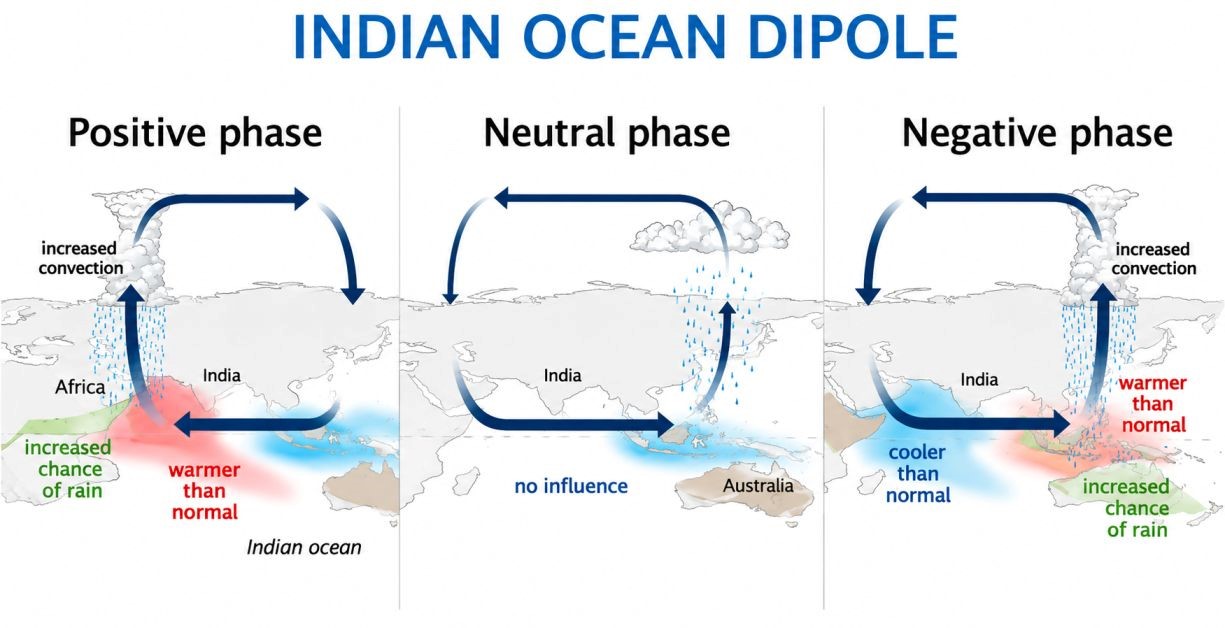
  • Positive IOD – The western Indian Ocean becomes warmer than normal, while the eastern part becomes cooler.
  • This pressure and temperature difference drives moisture-laden winds toward the Indian subcontinent, which generally enhances monsoon rainfall.
  • Negative IOD – The western Indian Ocean becomes cooler than normal, while the eastern part warms up.
  • This causes moisture to be drawn away from the subcontinent, often leading to below-normal rainfall and increased 'break' (dry) days in the monsoon.
  • Neutral IOD – Sea-surface temperatures remain close to average, with little to no contrast between the two poles.

IOD NEW

How the Indian Ocean Dipole is measured?

  • Measurement of IOD – The Indian Ocean Dipole (IOD) is measured using the Dipole Mode Index (DMI).
  • The DMI calculates the difference in sea surface temperature (SST) anomalies between two specific areas in the equatorial Indian Ocean.
  • Positive DMI – The western equatorial Indian Ocean is warmer relative to the eastern side.
  • A negative DMI means the eastern side is warmer relative to the western side.
  • Because this gradient influences convection and circulation, the DMI provides a practical way to monitor whether the IOD is positive, negative, or neutral.
  • For forecasters, the value of the DMI is that it offers a compact, trackable signal for a climate driver that can persist for weeks to months and affect seasonal rainfall risk.
  • Current status – The Indian Ocean Dipole (IOD) is currently in a neutral phase.
  • Sea surface temperature anomalies in the eastern and western equatorial Indian Ocean are near their historical averages, failing to provide immediate atmospheric moisture support or interference for the current monsoon season.

What are the impacts of IOD?

  • Positive IOD
    • Temperature & WindsThe western tropical Indian Ocean becomes warmer than normal, while waters near Indonesia and Australia cool.
    • Trade winds that typically blow east-to-west weaken, allowing moisture to pool in the west.
    • Regional ImpactThis phase usually brings above-average rainfall and potential flooding to East Africa.
    • Conversely, it causes severe dry spells, drought, and increased bushfire risks in Indonesia and Australia.
    • Impact on IndiaA positive IOD frequently strengthens the Southwest Monsoon, bringing increased moisture over the Indian subcontinent which can help offset dry conditions caused by El Niño.
  • Negative IOD
    • Temperature & WindsThe typical east-to-west winds intensify, driving warmer waters toward the eastern Indian Ocean (near Indonesia) and causing the western part near Africa to cool.
    • Regional ImpactIndonesia and parts of Australia experience heightened rainfall and increased flood risks.
    • Meanwhile, East Africa often experiences drier conditions.
    • Impact on IndiaA negative IOD tends to reduce moisture convergence, which can lead to subdued rainfall and drier conditions across much of India.
  • Neutral Phase
    • Conditions Sea-surface temperatures remain relatively balanced, with wind and ocean circulation operating close to their normal historical averages.

What lies ahead?

  • The IMD’s models, and most others, forecast a neutral dipole across the four monsoon months, the Australian Bureau of Meteorology allows a slim chance of a positive turn late in the season, in August or September.
  • But a level seesaw lends the rains nothing, and a positive phase arriving that late and that faintly would be too weak to blunt an El Niño.

To take mains test click here

References

The Hindu| IOD

World Climate Service| Indian Ocean Dipole

Login or Register to Post Comments
There are no reviews yet. Be the first one to review.

ARCHIVES

MONTH/YEARWISE ARCHIVES

sidetext
Free UPSC Interview Guidance Programme
sidetext