Mains: GS-I – Social Issues
Why in News?
The Supreme Court has drawn a close link between migration and human trafficking, which it described as one of the worst forms of human exploitation & stressing that trafficking often feeds on migration flows.
What is Human Trafficking?
- Human Trafficking – It is the recruitment, transportation, transfer, harbouring or receipt of people through force, fraud or deception, with the aim of exploiting them for profit.
- Victims – Men, women and children of all ages and from all backgrounds can become victims of this crime, which occurs in every region of the world.
- Methods Used by Traffickers – The traffickers often use violence or fraudulent employment agencies and fake promises of education and job opportunities to trick and coerce their victims.
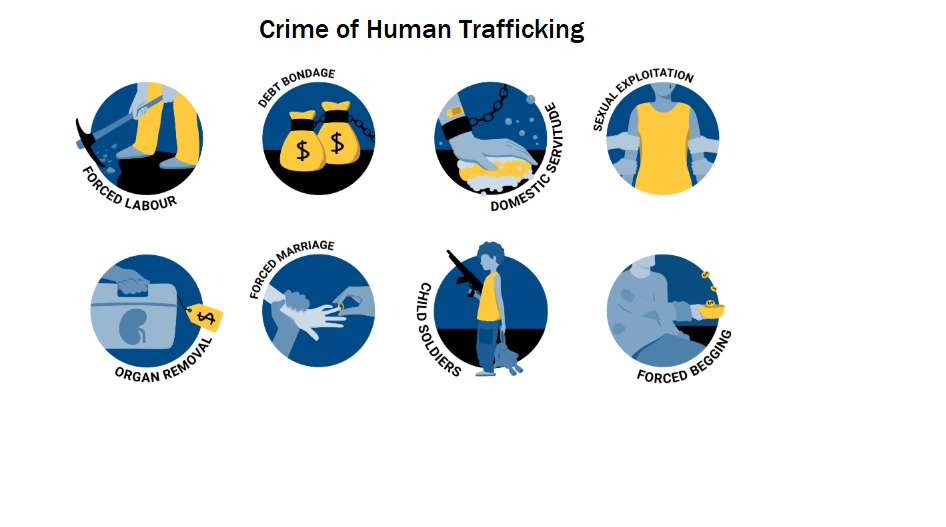
Status of Human Trafficking in India
- National Crime Records Bureau (NCRB) – In India, an estimated 65 million individuals (NGO data) are trapped in modern-day slavery, with forced and bonded labor making up over half of these cases.
- Highest volumes of human trafficking cases are registered in Odisha, Bihar, Telangana, and Maharashtra.
What are the constitutional & legislative provisions related to Trafficking in India?
- Article 23 (1) – Prohibits traffic in human beings, begar (forced labor), and other similar forms of forced labor; any violation is a punishable offense under the law.
- Article 24 – Prohibits the employment of children below the age of 14 in any factory, mine, or other hazardous employment.
- The Immoral Traffic (Prevention) Act, 1956 (ITPA) – It is the premier legislation for prevention of trafficking for commercial sexual exploitation.
- Criminal Law (amendment) Act 2013 – It replaced IPC Section 370 with Sections 370 & 370A.
- Expanded definition of trafficking which includes children, sexual exploitation, slavery, servitude, forced organ removal.
- Protection of Children from Sexual offences (POCSO) Act, 2012 – It is a special law to protect children from sexual abuse and exploitation.
- It provides precise definitions for different forms of sexual abuse, including penetrative and non-penetrative sexual assault, sexual harassment.
- Other specific legislations includes
- Prohibition of Child Marriage Act, 2006,
- Bonded Labour System (Abolition) Act, 1976,
- Child Labour (Prohibition and Regulation) Act, 1986,
- Transplantation of Human Organs Act, 1994,
- Section 143 of the Bharatiya Nyaya Sanhita (BNS) – It criminalizes the offense of human trafficking; it replaces and broadens the provisions previously covered under Section 370 of the IPC.
- Aligns with Palermo Protocol, which requires proof of act + means + purpose for trafficking (except in case of children).
Major Conventions
- UN Convention against Transnational Organized Crime (UNTOC) – It is the premier global instrument combating organized criminal syndicates.
- India signed this convention in 2002 and ratified it in May 2011.
- The Palermo Protocol – Formally known as the Protocol to Prevent, Suppress and Punish Trafficking in Persons, Especially Women and Children, India ratified this alongside the UNTOC in 2011.
- 1949 UN Suppression Convention – It was ratified in 1950, led to India’s Immoral Traffic (Prevention) Act, 1956 (ITPA).
- UN Convention on the Rights of the Child (UNCRC) – It was ratified in 1992, includes Optional Protocol on Sale of Children, Child Prostitution, and Child Pornography.
- SAARC Convention on Trafficking – India ratified the SAARC Convention on Preventing and Combating Trafficking in Women and Children for Prostitution.
- This agreement fosters cross-border law enforcement cooperation, victim repatriation, and joint task forces across South Asia.
- International Labour Organization (ILO) Conventions – India has ratified core ILO conventions explicitly targeting trafficking's economic drivers (forced labor and economic exploitation).
What about the recent Supreme Court findings?
- Migration–Trafficking Link – The Supreme Court highlighted a close link between migration and human trafficking, stressing that trafficking often feeds on migration flows.
- Vulnerable migrants are often exploited, making migration a fertile ground for traffickers.
- Voluntary Sex Work – The Court emphasized that voluntary adult sex work should not be blended with trafficking.
- This distinction is crucial for protecting sex workers’ rights.
- Rights of Sex Workers – The judgment clarified that sex workers’ rights (like dignity, safety, and protection from violence) exist even without recognizing sex work itself as a legal right.
- That is, the sex workers’ rights can exist independently of the “right to sex work.
- Section 143 of BNS – Requires that for an act of sexual exploitation to amount to trafficking, it has to fulfill the three-tiered framework of act, means, and purpose of the Palermo Protocol.
- But, on the other hand, all sex work was treated as trafficking under the Immoral Traffic (Prevention) Act.
What are the measures taken by Government of India to Prevent and Combat Human Trafficking?
- Anti Trafficking Cell (ATC) – It was set up in the Ministry of Home Affairs to act as a focal point for coordinating anti‑trafficking measures.
- National Investigation Agency (NIA) – The NIA Act was amended to give the agency jurisdiction over inter-state and cross-border human trafficking cases.
- Raksha AI – An AI-powered child protection platform that uses geospatial data & machine learning to map vulnerable communities, forecast trafficking routes, and identify organized trafficking networks before harm occurs.
- Emergency Response Support System – It provides a pan-India, toll-free distress number (112) linked to rapid, computer-aided police and resource dispatch.
- Safe City Projects – High-tech safety and surveillance management systems implemented in major urban hubs like Chennai, Mumbai, and Delhi.
- Mission Shakti – An umbrella scheme that includes 'Shakti Sadan' to provide shelter, food, and vocational training for destitute women and victims of trafficking.
- Railway Interventions – The Railway Protection Force (RPF) and the National Commission for Women conduct localized "Anti-Human Trafficking Awareness" seminars and operate rescue operations at major rail transit hubs.
What are the challenges in controlling human trafficking?
- Low Conviction Rates – Trafficking cases often collapse due to poor investigation, lack of evidence, or hostile witnesses.
- Inadequate Training – Police and prosecutors may not be trained to handle complex trafficking cases, especially those involving cyber‑enabled exploitation.
- Poor Coordination Among Agencies – Trafficking networks often span states or countries, but coordination between police forces and immigration authorities is weak.
- Socio‑Economic Vulnerabilities – Poverty, unemployment, illiteracy, and gender discrimination push vulnerable groups into exploitation.
- Implementation Gaps – India has multiple laws (ITPA, IPC Sec. 370, POCSO, BNS Sec. 143), but enforcement is patchy and uneven across states.
- Technology Exploitation – Criminal networks increasingly use cyberspace for recruitment and exploitation; Online anonymity and global reach make detection harder.
What need to be done?
- Strengthen Law Enforcement – Enhance proactive investigations, train police to identify victims, disrupt illicit financial networks, and strictly penalize traffickers.
- Improve Coordination – Develop an integrated national database of traffickers, victims, and missing persons & ensure seamless cooperation among police, immigration, child protection agencies, and NGOs.
- Victim Protection & Rehabilitation – Expand shelters like Shakti Sadan under Mission Shakti, provide legal aid, counseling, vocational training, and reintegration support.
- Address Root Causes – Implement poverty alleviation, education, and skill development programs, introduce safe migration policies to reduce vulnerability.
- Technology & Innovation - Platforms like Raksha AI to forecast trafficking routes, use of geospatial mapping, predictive analytics and surveillance systems.
- Raise Awareness – Educate the public on the warning signs of human trafficking and promote official reporting channels.
References
- The Hindu | Human trafficking feeds on migration, said Supreme Court
- UNODC | Human Trafficking
- Ministry of External Affairs | Human Trafficking



