Prelims: Current events of national and international importance | Environment
Why in News?
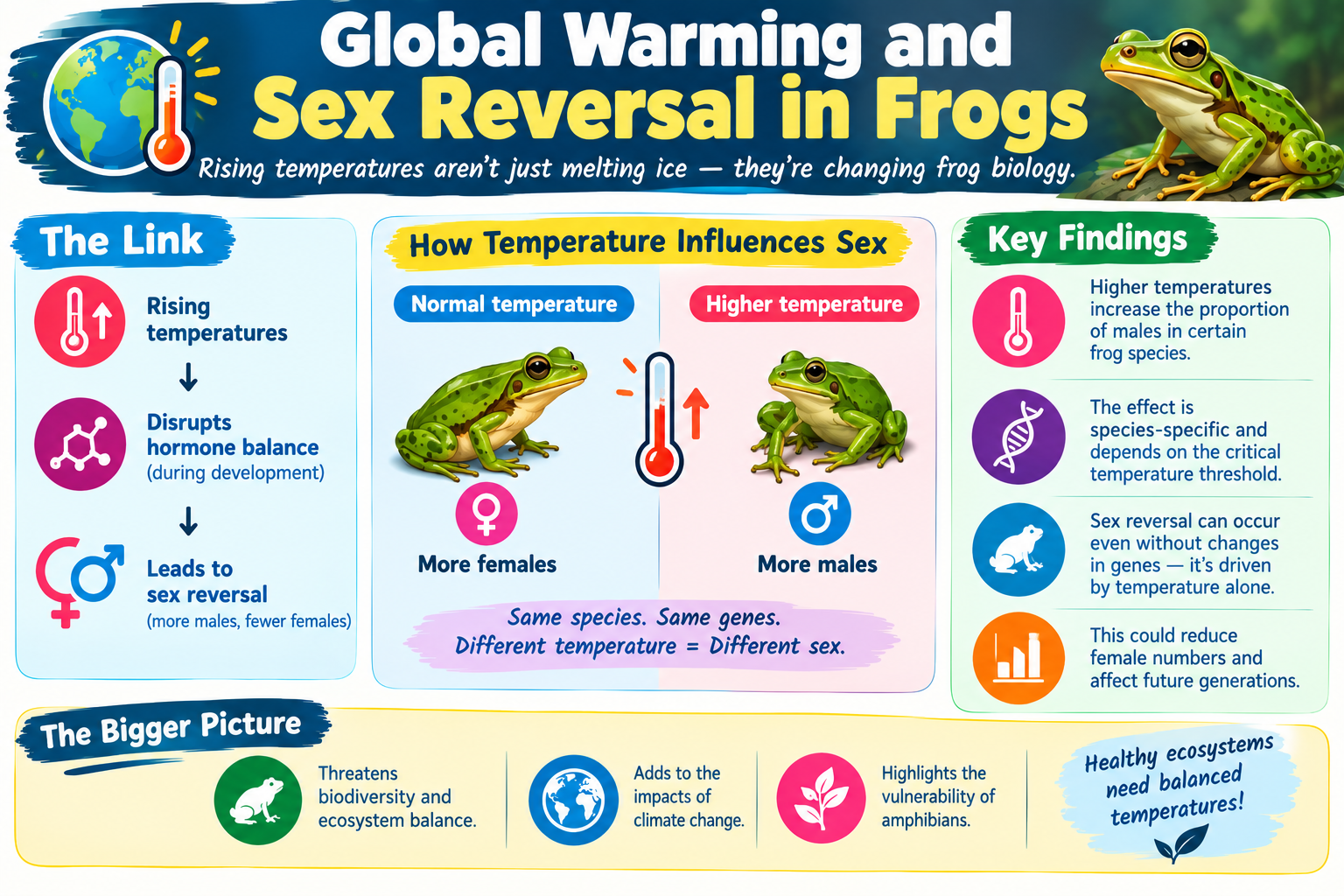
Recently, a study revealed that climate-change-induced sex reversal in wild Agile Frogs (Rana dalmatina) where extreme heat overrides genetic chromosomes to turn female tadpoles into physical males.
- Phenomenon - Sex reversal occurs when an organism develops anatomical and physiological reproductive traits that differ from its genetically determined sex.
- The Heat Effect- In agile frogs, chromosomal sex determination typically yields females (XX) and males (XY).
- However, heatwaves during early tadpole development interfere with hormonal signals and gene expression, causing genetically female (XX) tadpoles to develop into fertile physical males.
Key Scientific Findings
- Reproductive Failure
- Although sex-reversed (XX) males are fertile, wild females exhibit a lower mating response toward them.
- Field observations across 16 populations revealed that while sex-reversed males constituted 20% of the wild male population, they fathered only 4% of total egg clutches.
- Inherited Vulnerability in Offspring
- Offspring fathered by sex-reversed males demonstrated higher susceptibility to heat-induced sex reversal.
- Under heat stress, 61% of offspring from sex-reversed fathers developed as males despite carrying XX chromosomes, compared to only 17% from normal XY males.
- Synergy with Lethal Pathogens
- Laboratory heatwave experiments showed that tadpoles fathered by sex-reversed males carried significantly higher viral loads when exposed to Ranavirus.
- Accelerated Extinction Timelines
- Computer modeling indicates that small, isolated frog populations subjected to skewed male-biased sex ratios could face collapse within 60 to 70 years.
- When Ranavirus-induced mortality among offspring of sex-reversed males was factored in, population collapse occurred ~10 years earlier, and total extinction arrived 9.5 years sooner.
Significance
- Hidden Driver in Threatened Amphibians- Amphibians are already the most threatened vertebrate class globally, with ~40% of species facing extinction according to IUCN estimates.
- Undetected sex reversal means field surveys relying purely on physical traits overestimate effective female breeding populations.
- Implications for Indian Biodiversity - In India's Western Ghats, a global hotspot for endemic frogs rising temperatures combined with deadly pathogens like Chytrid fungus (Batrachochytrium dendrobatidis) and Ranavirus present a dual threat.
- Policy Imperative - Highlights the necessity of incorporating genetic sex-monitoring, micro-habitat shading, and thermal buffer management into species action plans under the Wild Life (Protection) Act, 1972.
Reference
The Hindu | Frogs’ sex reversal into an extinction risk



