Prelims: Current events of national and international importance | Species
Why in News?
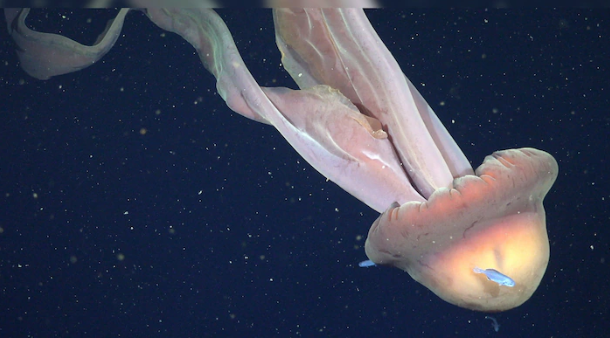
Recently, Scientists filmed the rare giant phantom jellyfish (Stygiomedusa gigantea) alive off Argentina, revealing new deep-sea biodiversity insights.
Scientific name – Stygiomedusa gigantea
Genus –Stygiomedusa
Discovery –Observed off the coast of Argentina 250 metres below the South Atlantic surface.
First collected in 1899 and recognised as a distinct species 60 years later.
Habitat –Midnight zone, deep-sea layer up to 13,000 feet, living in extreme, low-food conditions.
Distribution –South Atlantic off Argentina, including deep waters around Patagonia.
Rarely documented in other oceans globally.
Characteristics –Size – One of the largest jellyfish species.
Bell – Up to 3 feet (1 m) in diameter.
Arms – Ribbon-like tendrils up to 30 feet (10 m) long.
Hunting – Uses long ribbon-like arms to catch plankton and small fish.
Diet – Feeds on plankton and small fish by reeling them into its mouth using long arms.
Behaviour – Provides shelter to smaller fish in the deep sea.
Symbiotic interaction – Maintains symbiotic relationships with fish species that feed on its parasites, such as pelagic brotula and Centrolophus species.
Uniqueness – It is a rare deep-sea species rarely seen alive, and is elusive in nature.
Ecological Significance –Highlights deep-sea biodiversity and underscores the importance of conserving extreme ocean ecosystems.