Recognising Rights, Securing Livelihoods
- The Forest Rights Act (FRA), 2006 recognises individual and community forest rights of Scheduled Tribes (STs) and Other Traditional Forest Dwellers (OTFDs).
- Received Presidential assent on 29 December 2006 and came into force on 31 December 2007.
- Objectives:
- Recognise previously unrecorded forest rights.
- Ensure land tenure, livelihood and food security.
- Promote sustainable forest management and biodiversity conservation.
- Nodal Ministry: Ministry of Tribal Affairs.
- Implemented in 20 States and one UT (Jammu and Kashmir).
Forest Rights Title?
- An official document recording the holder's forest rights, village, land area and boundaries.
- Signed by the Divisional Forest Officer, District Tribal Welfare Officer and District Collector.
- Community titles are issued to Gram Sabhas; individual titles to eligible households.
- Titles are inheritable but non-transferable.
- Entry into revenue records enables access to PM-KISAN and other livelihood schemes.
Key Milestones
|
Date
|
Milestone
|
|
29 December 2006
|
FRA received Presidential assent.
|
|
31 December 2007
|
Act came into force.
|
|
1 January 2008
|
FRA Rules notified.
|
|
12 July 2012
|
Implementation guidelines issued.
|
|
23 April 2015
|
Community Forest Resource guidelines issued.
|
|
11 February 2019
|
PM-KISAN extended to forest rights title holders.
|
|
12 September 2023
|
Community Forest Resource management guidelines issued.
|
|
2 October 2024
|
DA-JGUA launched.
|
|
5 January 2026
|
PVTG Habitat Rights guidelines issued.
|
|
24 June 2026
|
Advisory issued to update revenue and forest records.
|
|
27 July 2026
|
Advisory on expediting FRA implementation and fund convergence.
|
Who Can Claim and What the Act Protects?
Eligible beneficiaries:
- Forest-Dwelling STs: Primarily reside in forests and depend on them for livelihood.
- Other Traditional Forest Dwellers: Have depended on forests for at least three generations (75 years) before 13 December 2005.
Key Provisions:
- Rights cover forest land occupied before 13 December 2005, with individual rights limited to actual occupation, up to four hectares.
- Covers reserved forests, protected forests, Sanctuaries and National Parks.
- No eviction until claims are verified and recognised.
- Less than one hectare of forest land can be diverted for specified government facilities on Gram Sabha recommendation.
Types of Forest Rights and Titles
1. Individual Forest Rights (IFR)
- Rights over land used for habitation and cultivation, up to four hectares.
- Titles generally issued jointly in the names of spouses.
2. Community Forest Rights (CFR)
- Rights over grazing areas, fishing grounds, water bodies and minor forest produce.
Community Forest Resource Rights
- Empowers Gram Sabhas to protect, conserve, regenerate and manage customary forests.
Other Rights:
- Ownership and disposal of minor forest produce, including bamboo, honey, tendu leaves, lac and medicinal plants.
- PVTGs receive habitat rights over their customary territories.
- Habitat rights granted to 11 PVTGs in Odisha, Chhattisgarh and Madhya Pradesh.
How Are Claims Decided?
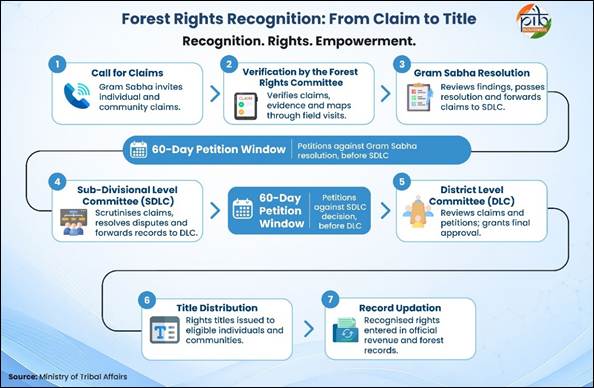
Gram Sabha:
- Initiates claims, verifies evidence, maps land and passes resolutions.
- Constitutes a Forest Rights Committee of 10–15 members, with at least two-thirds ST members and one-third women.
Sub-Divisional Level Committee (SDLC): Examines Gram Sabha resolutions and prepares records of forest rights.
District Level Committee (DLC) – Takes the final and binding decision.
Appeals and Monitoring:
- Appeals can be filed within 60 days, extendable by 30 days.
- Rejections must provide written reasons.
- Recognised rights must be entered into revenue and forest records within three months.
- State Level Monitoring Committee, chaired by the Chief Secretary, meets quarterly.
Progress So Far
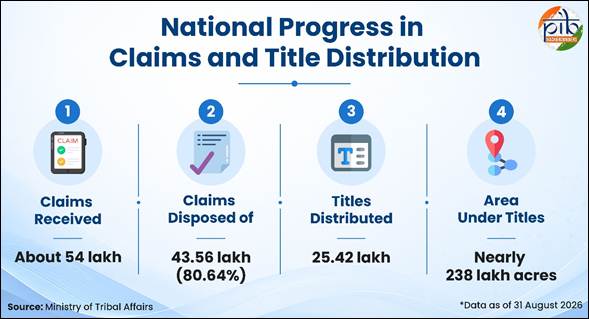
As of 31 August 2026:
- 54 lakh claims received; 43.56 lakh (80.64%) disposed of.
- 25.42 lakh titles distributed, covering nearly 238 lakh acres.
- Individual titles: 24.18 lakh; Community titles: 1.24 lakh.
Top Five States in Titles Distributed
|
State
|
Total titles
|
|
Chhattisgarh
|
5,34,068
|
|
Odisha
|
4,73,936
|
|
Madhya Pradesh
|
2,89,461
|
|
Telangana
|
2,31,456
|
|
Andhra Pradesh
|
2,28,489
|
Support for States
- Ministry collects monthly progress reports on claims, titles and rejections.
- National FRA Portal and mobile app facilitate digitisation and mapping of records.
- National FRA Digital Platform (November 2026): Integrates the entire claims process, from Gram Sabha submission to digitally signed titles.
- Regular review meetings and grievance redressal mechanisms support implementation.
Dharti Aaba Janjatiya Gram Utkarsh Abhiyan (DA-JGUA)
- Provides funding for State and district FRA cells for two years to expedite pending claims.
- Supports digital mapping, State FRA portals and technical infrastructure.
- Provides ₹15 lakh per Community Forest Resource Management Plan and ₹1 lakh for technical assistance.
- Community plans can be aligned with Forest Department Working Plans while retaining Gram Sabha authority.
- iGOT offers free FRA courses and States organise legal literacy camps.
State-Level Initiatives:
- Maharashtra: Introduced Forms 7E and 12E to facilitate crop loans, KCC, crop insurance and DBT.
- Andhra Pradesh: Integrated Giribhumi FRA portal with revenue and banking systems.
- Telangana: Integrated online titles with the BhuBharathi revenue portal.
- Three regional review conferences were held in September–October 2026.
Conclusion
- The FRA, 2006, secures tribal land and livelihood rights while promoting community-led forest conservation.
- Priorities include updating land records, linking beneficiaries with welfare schemes and strengthening Gram Sabha participation in forest management.
Reference
PIB



