0.2744
7667766266
x

Europe Heatwave

iasparliament Logo
July 04, 2026

Mains: GS I Geography | GS III Environment

Why in News?

Europe is facing a record heatwave with temperatures crossing 40°C in several countries, records several deaths due to heat wave.
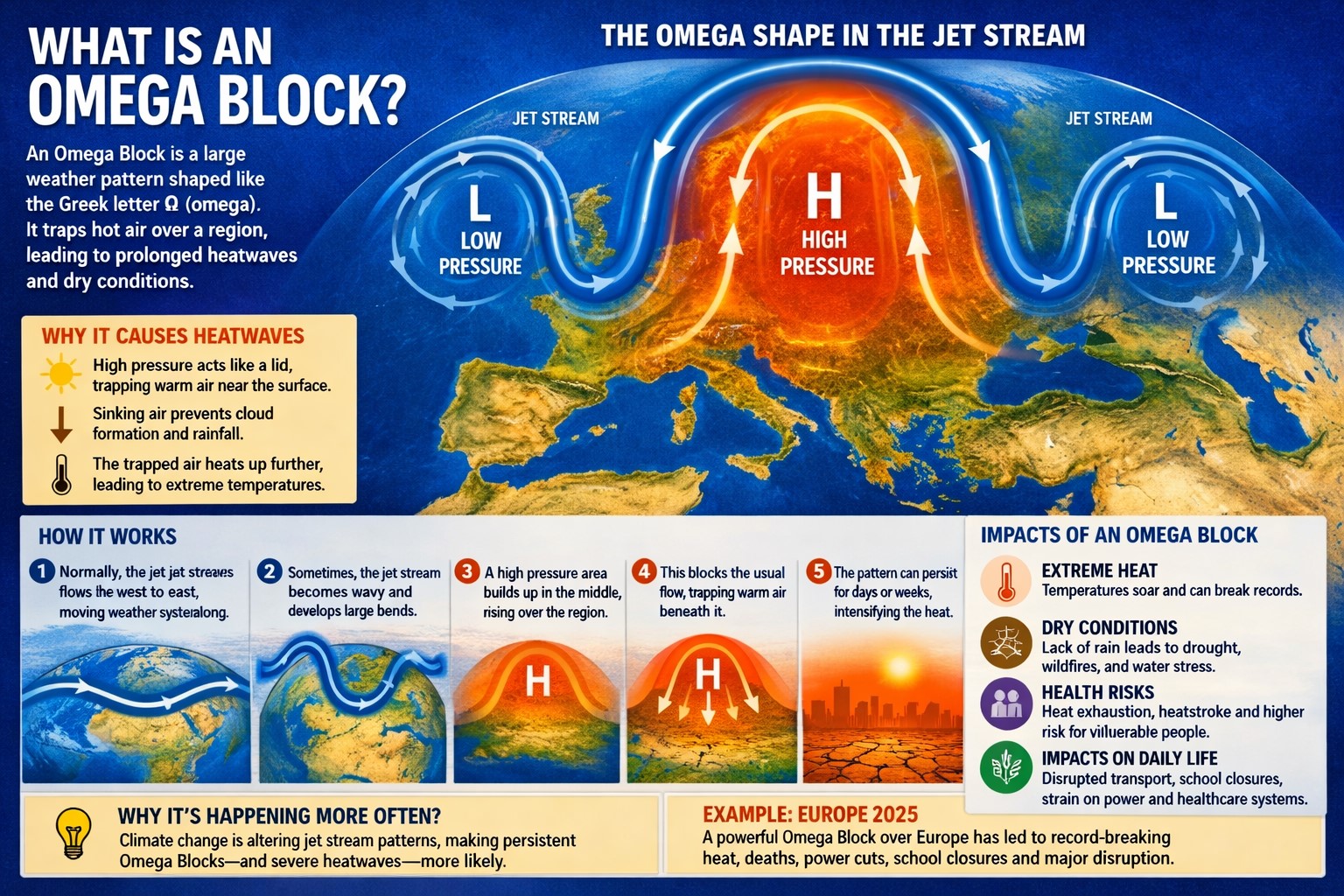
What is Omega Block and how is it related Europe’s heatwave?

  • Europe’s heatwave – The current crisis is linked to an Omega block over western Europe, intensifying heat and raising night-time temperatures.
  • Definition – An Omega block is a large atmospheric circulation pattern resembling the Greek letter Ω.
  • Mechanism – A high-pressure system gets trapped between two low-pressure systems, creating stagnant weather.

Omega Block

  • Impact – Locks regions into prolonged extreme conditions, in summer, it sustains heatwaves by preventing cooler Atlantic air from moving in.
  • Significance – Climate change is making such blocking patterns more frequent and severe, prolonging deadly heat events.

An omega block is the large-scale atmospheric weather pattern that frequently creates and traps a heat dome at the surface

Aspect

Heat Dome (Cause)

Heatwave (Effect)

Definition

A strong, persistent high‑pressure system that traps and compresses hot air.

A prolonged period of abnormally high temperatures compared to the region’s average.

Mechanism

Acts like a lid, blocking clouds and cooler air, allowing sun to bake the ground.

Results from trapped heat or other weather factors, leading to sustained hot conditions.

Role

Major driver that creates extreme heat events.

The outcome — the actual hot spell experienced by people.

Independence

Heat domes specifically cause severe heatwaves.

Heatwaves can occur even without a heat dome, due to other meteorological factors.

What exactly World Weather Attribution (WWA) says?

  • Climate change – Extreme heat events that were rare or impossible 50 years ago are now tens to hundreds of times more common.
  • Daytime heat – Climate change has raised daytime temperatures by 2–4°C compared to past heatwaves.
  • Hot nights – Night temperatures are also 1–4°C higher, adding more stress on people and systems.
  • Main cause – Scientists confirm El Nino is not responsible and greenhouse gases from human activity are the key driver.
  • Hot air flow – Winds from the Sahara carry very hot, dry air into Europe.
  • Due to clear skies, the sun heats the land strongly and dry soil cannot cool the air, so the heat keeps building up.
  • Urban heat island effect – Major European cities with dense infrastructure, concrete, and lack of green spaces trap heat during the day, releases heat at night, which amplifies intensity of heat.

How does climate change influence the occurrence of compound extreme weather events?

  • Warming temperature and water cycle – A hotter atmosphere holds more moisture, causing heavier rains, but also speeds up evaporation that dries soil quickly.
  • Concurrent heat and drought– Rising temperatures reduce soil moisture, creating a loop where dry land worsens heatwaves (compound drought‑heat events).
  • Cascading disasters – Dry land sparks wildfires; later heavy rains cause mudslides and water pollution.
  • Coastal hazards – Rising seas plus stronger storms and heavy rains lead to severe flooding that overwhelms drainage and power systems.

How do heat domes and jet stream disruptions contribute to prolonged heat waves?

  • Jet Stream Disruption – The jet stream is a fast wind that moves weather systems. When it slows or forms big loops, it gets stuck, keeping weather patterns in place for days or weeks.
  • Heat Dome Formation – A stalled jet stream creates a strong high‑pressure ridge and this acts like a dome, pressing hot air downward as the air sinks, it compresses and heats up more.
  • Trapped Heat – The dome blocks clouds, so the sun keeps shining and heating the air without relief, causing long, intense heat waves.

What is the impact of Arctic amplification on global weather patterns?

  • Jet stream weakening – The Arctic warms faster than mid‑latitudes, reducing the temperature contrast. This slows the jet stream and makes it loop in large waves.
  • Trapped weather systems – Slow, looping jet streams trap weather systems in place, causing long heatwaves, droughts, or extended cold spells.
  • Polar vortex disruption – A weaker gradient destabilizes the polar vortex, pushing very cold Arctic air far south into populated regions.
  • Moisture Evaporation – Melting Sea ice exposes ocean water, adding moisture to the air. This changes rainfall patterns and can cause stronger storms or heavy snow.

How El Nino is impacting Europe?

  • Northern and northwestern Europe – El Nino raises pressure over Scandinavia, drives a southward shift in Atlantic storm tracks.
  • This makes the northwest drier and can trigger late‑winter cold due to a weak polar vortex.
  • Southern Europe and mediterranean – Winters often get wetter in the mediterranean and while transitioning into the spring, it leads to reduced rainfall and longer dry spells.
  • Heatwave and temperature interaction – El Nino combines with global warming, causing hotter summers, prolonged droughts, and stress on farming across Europe.

Why is the consensus being challenged?

  • Rising Heatwaves – Europe warming faster than any other continent, longer heatwaves are more frequent and more intense.
  • Public Health RisksHeat kills silently, especially among elderly, children, and outdoor workers while air conditioners are seen as life-saving technology during extreme heat.
  • Political DivideThe rightist push AC loans as health need and leftists prefer green urban design as mass AC adoption conflicts with climate goals., UK Conservatives back more energy (including fossil fuels) for cooling demand.

What are the concerns for Europe?

  • Architecture – Governments should ensure cool indoor spaces for vulnerable groups during heatwaves.
  • Long-term adaptation should prioritise better building design, insulation, and urban greening.
  • Energy demand surge – AC adoption increases electricity demand during peak heatwaves.
  • Climate contradiction – Higher fossil fuel use undermines EU climate commitments.
  • Urban heat islands – AC releases waste heat outdoors, worsening city temperatures.
  • Equity issues – High costs make AC inaccessible for poorer households, deepening inequality.

What is the way forward?

  • Balanced approach – Combine short-term AC access for vulnerable groups with long-term sustainable solutions.
  • Green cooling – Promote energy-efficient ACs, renewable-powered cooling, and passive cooling technologies.
  • Urban greening – Expand tree cover, reflective surfaces, and shaded public spaces.
  • Building codes – Mandate insulation, ventilation, and heat-resilient design in new construction.
  • Equitable access – Subsidise cooling for schools, hospitals, and low-income households.
  • Integrated policy – Align public health needs with climate commitments through innovation and regulation.

To take mains test click here

Reference

The Hindu | Europe heatwave


Login or Register to Post Comments
There are no reviews yet. Be the first one to review.

ARCHIVES

MONTH/YEARWISE ARCHIVES

sidetext
Free UPSC Interview Guidance Programme
sidetext


