Why in News?
Recently, UP minister claimed the state could soon be divided into four parts.
What is the constitutional mechanism under Article 3 for the division of a state?
- Constitutional Provision (Article 3) – Under Article 3 of the Indian Constitution, Parliament may by law form a new State by separation of territory from any State, uniting two or more States, or uniting parts of States or territories.
- Procedural Prerequisites –
- No Bill for state division can be introduced in either House of Parliament except on the recommendation of the President.
- The President must refer the Bill affecting the area, boundaries, or name to the concerned State Legislature for expressing its views within a specified time period.
- Non-Binding Nature of State Views – The views expressed by the State Assembly are not binding on Parliament.
- Voting Requirement – Altering state boundaries requires only a simple majority of both Houses of Parliament, making it possible for Parliament to alter state boundaries by ordinary legislation even without the consent of the State Assembly.
What are the proposed regional divisions of UP and the historical political motives behind them?
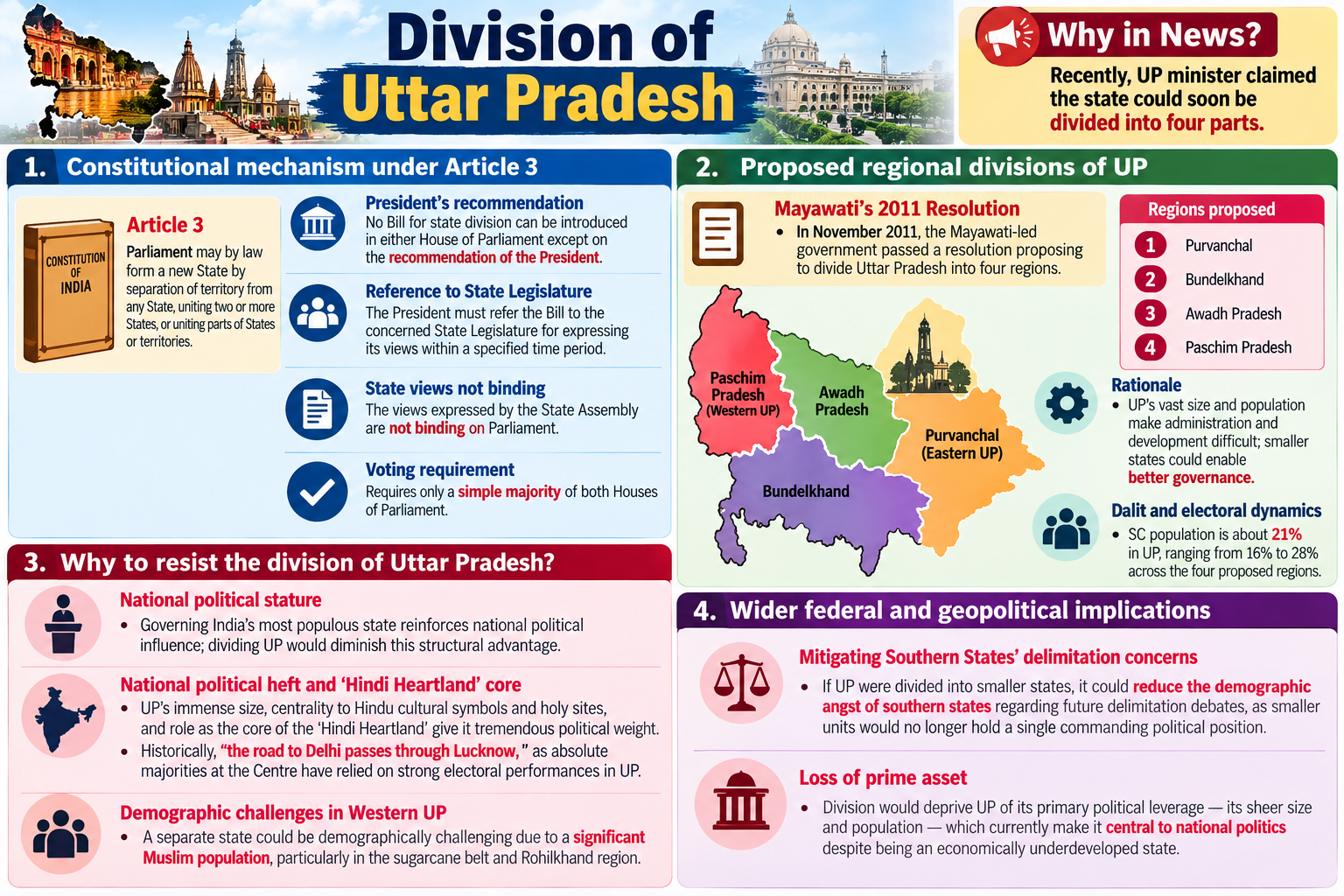
- Mayawati’s 2011 Resolution – In November 2011, the Mayawati-led government passed a resolution in the Assembly proposing to divide Uttar Pradesh into four distinct regions –
- Purvanchal
- Bundelkhand
- Awadh Pradesh
- Paschim Pradesh
- Administrative and Governance Rationale – The state government argued that UP's vast size and population made administration and development difficult, whereas smaller states could enable better governance.
- Dalit and Electoral Dynamics – The Scheduled Caste (SC) population constitutes about 21% of UP, ranging from 16% to 28% across all four proposed regions.
Why to resist the division of Uttar Pradesh?
- National Political Stature – It is reinforced by governing India’s most populous state; dividing UP would diminish this structural advantage.
- National Political Heft and 'Hindi Heartland' Core –
- UP's immense size, centrality to Hindu cultural symbols and holy sites, and role as the core of the 'Hindi Heartland' grant it tremendous political weight.
- Historically, the "road to Delhi passes through Lucknow," as absolute majorities at the Centre have relied on strong electoral performances in UP.
- Demographic Challenges in Western UP – A separate state could be demographically challenging due to a significant Muslim population, particularly in the sugarcane belt and Rohilkhand region.
What are the wider federal and geopolitical implications of dividing Uttar Pradesh?
- Mitigating Southern States' Delimitation Concerns – If UP were divided into smaller states, it could reduce the demographic angst of southern states regarding future delimitation debates, as smaller units would no longer hold a single commanding political position.
- Loss of Prime Asset – Division would deprive UP of its primary political leverage its sheer size and population which currently make it central to national politics despite being an economically underdeveloped state.
Reference
Indian Express | Uttar Pradesh



