Mains: GS-I – Geography & GS – III – Energy
Why in News?
State-owned Oil India Ltd (OIL) has reported its second natural gas discovery in the Andaman offshore region, strengthening expectations that the basin could develop into a key hydrocarbon-producing zone in the years ahead.
What about the location of Andaman and Nicobar Islands?
- Andaman and Nicobar Islands – These are a cluster of 836 islands, split into two groups — the Andaman Islands to the north and the Nicobar Islands to the south in the Bay of Bengal.
- From mainland India, it is ~1,190 km from Chennai, ~1,255 km from Kolkata.
- Separated By – The Ten Degree Channel (150 km wide) divides the northern Andaman Islands from the southern Nicobar Islands.
- Southernmost Point – Indira Point (Great Nicobar Island) at 6°45′N — the southernmost tip of India.
- Island Groups
- Andaman Islands (north) – Includes North, Middle, and South Andaman (collectively “Great Andaman”), plus smaller islands like Ritchie’s Archipelago and Sentinel Islands.
- Nicobar Islands (south) – Comprising 22 main islands, 10 of which are inhabited.
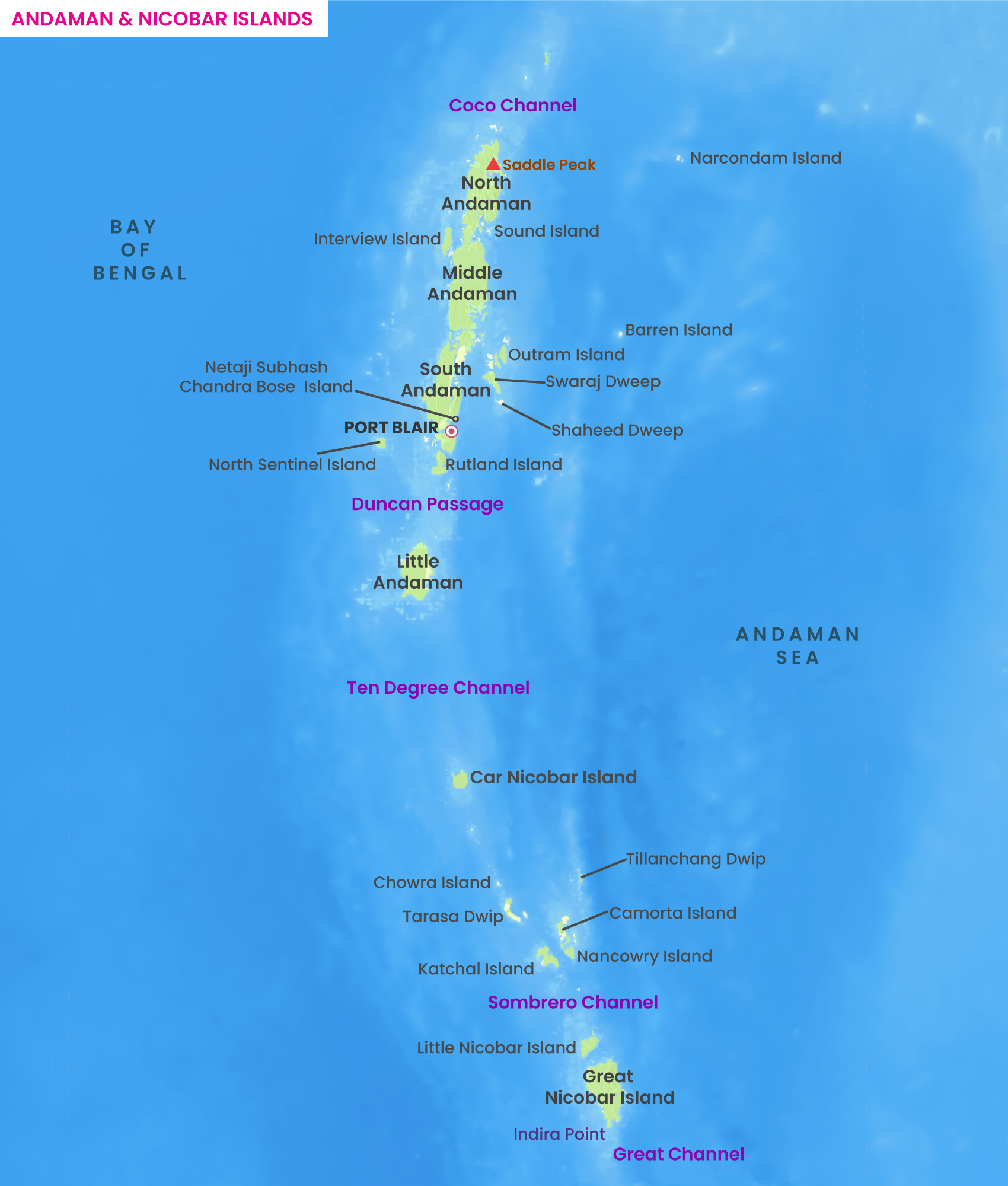
- Proximity to Other Countries – Myanmar, Indonesia (Sumatra), Thailand.
- Geological Features – The Andaman-Nicobar Basin forms part of the Bengal-Arakan sedimentary system.
- Its tectonic setting along the boundary between the Indian and Burmese plates has created numerous stratigraphic traps conducive to hydrocarbon accumulation.
- Example – Similar tectonic traps in Assam’s oil fields have historically yielded petroleum reserves.
- Prospectivity & Petroleum Systems – The basin’s prospectivity is further enhanced by its proximity to proven petroleum systems in
- Myanmar (e.g., the Shwe gas fields) &
- North Sumatra, Indonesia (major oil-producing region)
- Global Interest – The global interest in the Andaman-Nicobar Basin has increased following significant gas discoveries offshore South Andaman in Indonesia, highlighting geological continuity across this region.
What are the key takeaways from the recent natural gas findings?
- Recent Discovery – The latest find was made at the Vijayapuram-3 exploratory well, situated around 15 kilometres off the eastern coast of the Andaman Islands at a depth of 355 metres.
- Previous Exploration – The discovery follows OIL’s earlier gas strike at the Vijayapuram-2 well in September 2025, making it the second gas-bearing well identified in the block.
Other Exploration sites in India – Exploration continues in deepwater fields in the Krishna-Godavari (KG), Mahanadi, Cauvery, and Mumbai offshore basins.
- Production Testing – The initial production testing conducted at a depth of more than 1,900 metres in the Eocene formation confirmed the presence of natural gas through continuous flaring.
- After perforation, the well witnessed a rapid pressure build-up and began producing gas, indicating favourable reservoir characteristics.
- Offshore Exploration Success – The consecutive discoveries are being regarded as a significant achievement for India’s offshore exploration sector, particularly in the relatively unexplored Andaman Basin.
- The Vijayapuram-3 discovery provides further evidence of a functioning petroleum system and may indicate the existence of additional hydrocarbon reserves in the region.
- Promising Frontier – Out of three exploratory wells drilled, two have yielded gas; the Andaman offshore basin is increasingly being seen as one of India’s most promising frontiers for future oil and gas exploration.
- Energy Security Goals – The government is taking sustained measures to explore & identify crude oil and hydrocarbon reserves in the A&N basin to contribute to the country’s long-term energy security and reduce import dependence.
- Policy Support – Under the Hydrocarbon Exploration and Licensing Policy (HELP), the Government allocated four blocks for oil and gas exploration in the Andaman-Nicobar Basin, covering approximately 23,261 square kilometres (SKM).
What about the Samudra Manthan Mission & Deep Ocean Mission?
- Samudra Manthan Mission – It is also known as the National Deep Water Exploration Mission and was announced by the Prime Minister of India on Independence Day 2025.
- Aim – To discover oil and gas reserves beneath the seabed to boost domestic production and reduce the country’s multi-billion-dollar import bill.
- Under it, numerous deepwater and ultra-deepwater exploration wells are planned across offshore basins to maximise the country’s hydrocarbon resources.
Deep Ocean Mission (DOM)
- Launched in – September 2021
- Aim – To develop technologies for exploring and sustainably utilising the deep ocean’s living and non-living wealth.
- 6 Vertices of DOM
- Develop technologies for deep-sea mining, underwater vehicles and robotics, and a crewed submersible (which needs support from a larger vehicle)
- Develop an ocean climate change advisory service, with observations and models for future projections of climate variables.
- Look for technological innovations to explore and conserve deep-sea biodiversity.
- Conduct deep ocean surveys, mainly to look for mineral deposits. Of particular interest are polymetallic nodules, which comprise layers of iron and manganese hydroxides and are found on the ocean floor, often containing materials such as nickel, rare earths and cobalt.
- Develop technologies to derive energy and freshwater from the ocean.
- Establish an advanced marine station for developing capacities in ocean biology and engineering.
To know more about Deep Ocean Mission, click here
To know about Samudrayaan Mission, click here
What is the significance of recent findings of gas in Andaman basin?
- Enhanced Energy Security – India currently relies on imports for about 87% of its crude oil and 50% of its natural gas.
- Tapping into these deposits could significantly reduce the country's dependence on costly foreign imports over the long term.
- Geopolitical Importance – The Andaman and Nicobar Islands lie near the Strait of Malacca, a critical global trade corridor; developing hydrocarbon reserves here enhances India’s maritime and strategic leverage.
- Future Exploration & Challenges – While discoveries are promising, commercial production may take years (likely by the 2030s), & advanced seismic studies and appraisal drilling are needed to estimate reserve size and viability.
To take Mains Test, click here
References
- Indian Express | Oil India’s latest gas find in Andaman offshore
- Indian Express | Natural Gas found in Andaman offshore



