Mains: GS-III- Infrastructure-Energy
Why in news?
Recently, India made a remarkable progress in its clean energy transition by achieving 50% of its installed electricity capacity from non-fossil fuel sources five years ahead of its 2030 target under the Paris Agreement.
What is solar energy?
- Definition – Solar energy is a renewable and sustainable form of power derived from the radiant energy of the sun.
- Technology used – Photovoltaic cells and solar thermal systems.
- Photovoltaic (pv) cells – It convert sunlight directly into electricity by utilizing the photoelectric effect.
|
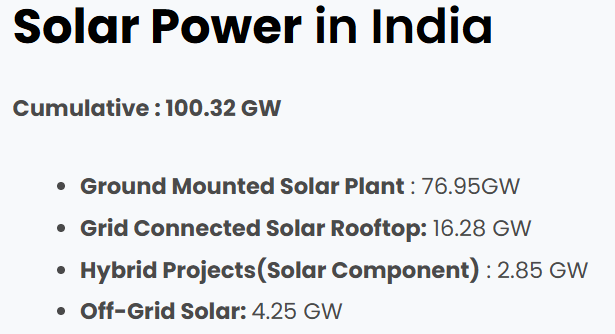
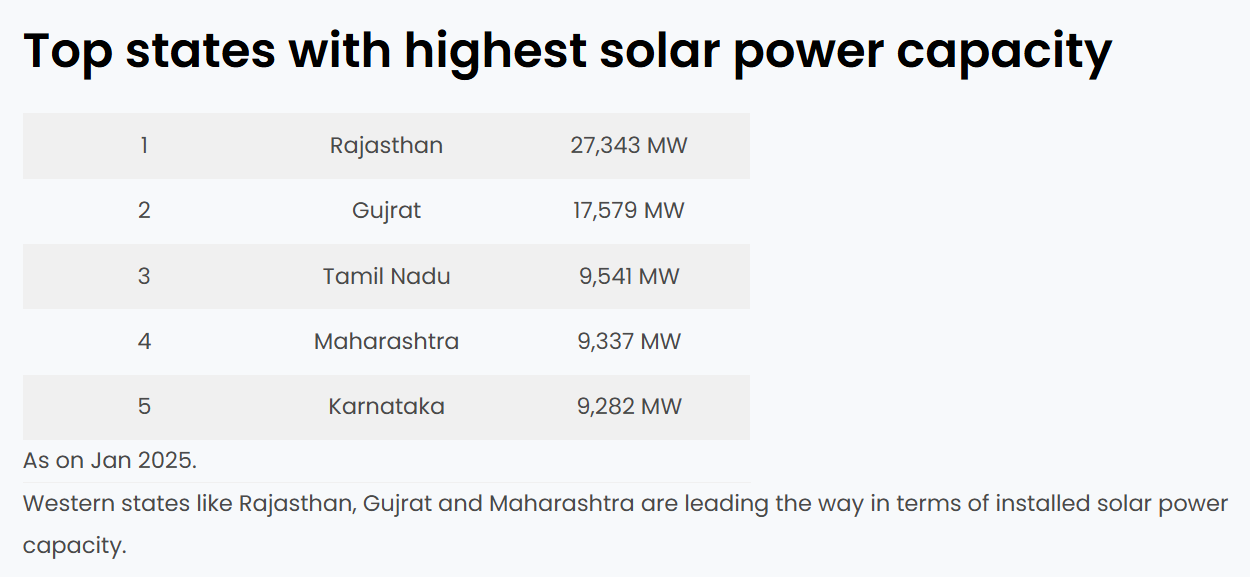
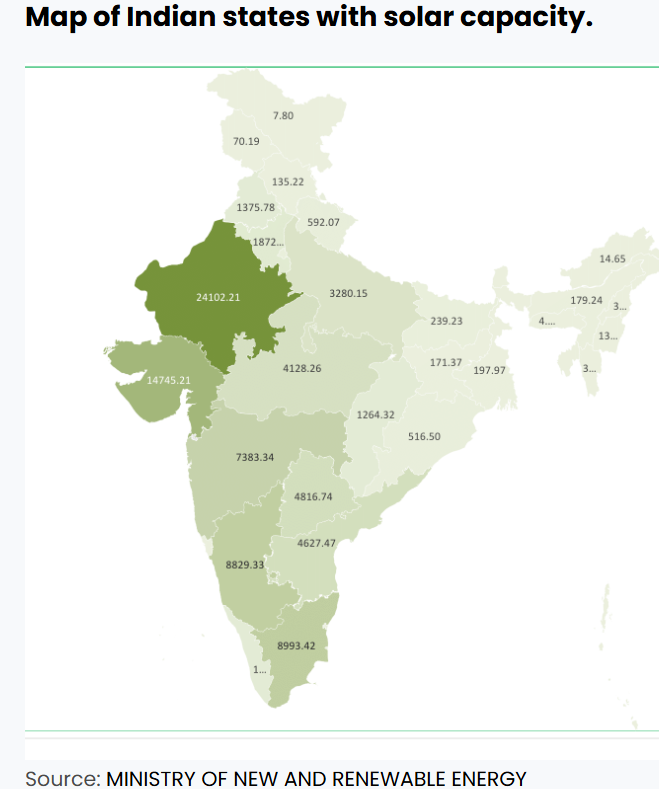
Status of Solar Energy in India
|
|
|
What are the challenges for India?
- Dependent on imports – India depends on imports for nearly 80% of its solar equipment.
- China’s dominance – India still relies on China for over 50% of its solar cells and modules,
- India also sources from Southeast Asian partners such as Vietnam and Malaysia which also often rely on Chinese raw materials like polysilicon and wafers.
- Lack of capacity – It lacks manufacturing strength in components like polysilicon and ingots, and efforts to build local capacity.
- Insufficient policies – The Production Linked Incentive (PLI) scheme still heavily rely on Chinese equipment suppliers.
- One Indian solar company lists all seventeen of its supply chain partners as Chinese firms.
- Outdated technology – Indian manufacturers had the capacity to produce only 3 GW of solar cells and 9-10 GW of solar panels, far below the country’s needs.
- High production cost – India’s higher energy costs and lower labour productivity makes solar module manufacturing more expensive in the country.
- Unintentional consequences – National Solar Mission accidentally incentivised reliance on cheaper imports over supporting domestic manufacturing.
- Lack of global support – Government support manufacturers through the Domestic Content Requirement and safeguard duties.
- But it has faced challenges including World Trade Organization disputes and practical implementation issues, leading to inconsistent support.
How India can diversify its supply chains?
- Strengthening domestic manufacturing – India needs to develop an integrated manufacturing supply chain from silica mining to module assembly to achieve true self-reliance.
- Robust policy support & investment – Government-assisted projects to source India-made modules, is another vital step.
- These efforts require consistent, long-term planning and sufficient funding, especially for capital-intensive upstream production.
- Diversifying international cooperation – India should actively seek collaborations with a variety of partners, such as the United States, European Union, and Japan.
- For instance, the US Development Finance Corporation has already lent nearly $1 billion for solar cell and module production in India but diplomatic tensions delayed it.
- These partnerships can offer concessional financing, advanced technologies and expertise moving beyond simple reliance on a single source.
- For example, green hydrogen, offshore wind technology can be applied from other nations.
- Research and development – Investment in domestic R&D is also vital for technological self-reliance and global competitiveness.
- Strategic balancing – The non-aligned foreign policy of India can be leveraged to strategically engage with both the US and China.
What lies ahead?
- Balancing affordability with innovation could be done to serve national interests without succumbing to external pressures.
- More strategic approach could allow India to capitalise on the competitive aspects of US-China climate policies to negotiate mutually beneficial terms.
Reference
Down to Earth| India’s Solar Energy Strategy



