Mains: GS III – Environment pollution and degradation| Science and Technology
Why in News?
Recently many countries have developed technologies to capture carbon and utilize it, and it is important to know about the CCU mechanisms.
What is Carbon Capture and Utilisation?
- CCU – Carbon Capture and Utilisation (CCU) refers to a set of technologies that capture carbon dioxide emissions from industrial sources or directly from the air and convert them into useful products.
- Process – It removes carbon from the atmosphere and puts it into the economy as inputs for fuels, chemicals, building materials, or polymers.
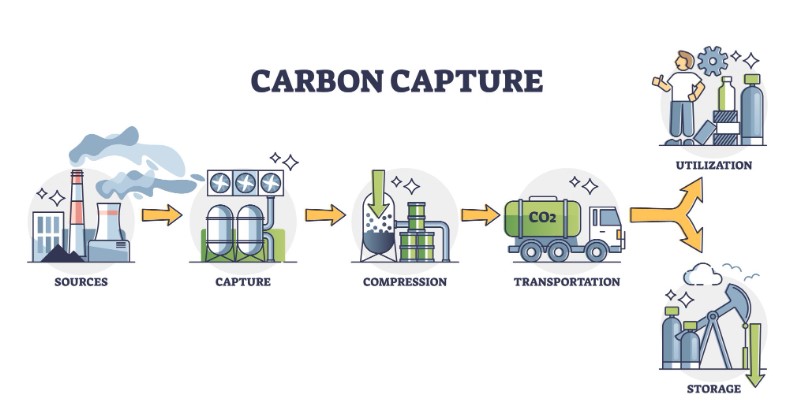
- Unlike carbon capture and storage, where captured CO₂ is permanently stored underground rather than reused, CCU uses up the captured carbon.
- Utilization Pathways:
- Chemicals – Converted into urea, methanol, and polymers.
- Fuels – Combined with green hydrogen to produce synthetic fuels (e-methanol, aviation fuels).
- Materials – Used in carbon-cured concrete and building materials.
- Biological – Utilized by microalgae for biofuel production.
Why does India need CCU?
- Large CO2 emissions – India has consistently been the world’s third-largest emitter of CO₂, with emissions driven largely by power generation, cement, steel, and chemicals.
- While renewable energy may reduce future emissions, many industrial processes are inherently carbon-intensive and difficult to decarbonise.
- Potential of CCU – The CCU offers a pathway to reduce emissions from these “hard-to-abate” sectors while simultaneously creating new industrial value chains.
- Supports net zero target – It also aligns with India’s net-zero target for 2070 and its push to build a circular, low-carbon economy.
Where does India stand today?
- Research funding – India has begun supporting CCU through research funding from the Department of Science and Technology which has created a specific research and development roadmap for these technologies.
- 2030 Roadmap – The draft 2030 roadmap for Carbon Utilisation and Storage (CCUS) presented by the Ministry of Petroleum and Natural gas has identified projects that can be used for CCUS purposes.
- Private sector activities – Ambuja Cements (Adani Group) is working on an Indo-Swedish CCU pilot with IIT Bombay to convert captured CO₂ into fuels and materials.
- JK Cement is collaborating on a CCU testbed to capture CO₂ for applications such as lightweight concrete blocks and olefins.
- Beyond cement, Organic Recycling Systems Limited (ORSL) is leading India’s first pilot-scale Bio-CCU platform, valorising CO₂ from biogas streams into bio-alcohols and specialty chemicals.
What are other countries doing?
- European Union – The EU Bioeconomy Strategy and Circular Economy Action Plan explicitly supports CCU as a way to turn CO₂ into feedstocks for chemicals, fuels, and materials, linking it to circularity and sustainability targets.
- ArcelorMittal and Mitsubishi Heavy Industries, Ltd. are working with a climate tech company, D-CRBN, to trial a new technology to convert CO2 captured at ArcelorMittal’s plant in Gent, Belgium into carbon monoxide which can be used in steel and chemical production.
- United States – The U.S. uses a combination of tax credits and funding to scale CCUs, particularly for CO₂-derived fuels and chemicals.
- UAE – The UAE’s Al Reyadah project and planned CO₂-to-chemicals hubs leverage CCU with green hydrogen.
What are the risks ahead?
- Cost issues – The foremost risk in scaling CCU in India is cost competitiveness.
- Capturing, purifying, and converting CO₂ is energy-intensive and expensive.
- Without policy incentives, CCU-derived products will struggle to compete with cheaper, fossil-based alternatives.
- Infrastructure readiness – CCU requires co-located industrial clusters, reliable transport of CO₂, and integration with downstream manufacturing, all of which are unevenly developed across Indian industrial regions.
- Governance issues – The absence of clear standards, certification, and market signals creates uncertainty for investors and limits demand for CO₂-derived products.
Reference
The Hindu| Carbon Capture and Utilisation



