Mains: GS Paper III – Energy & Infrastructure
Why in News?
In response to escalating geopolitical conflicts in West Asia and maritime chokepoint vulnerabilities, India is considering a comprehensive, decade-long Strategic Fuel Reserve Programme.
What is the current capacity and the proposed strategic fuel system?
|
Fuel Category
|
Existing Infrastructure & Status
|
Proposed Expansion Target
|
Targeted Cover Period
|
|
Crude Oil
|
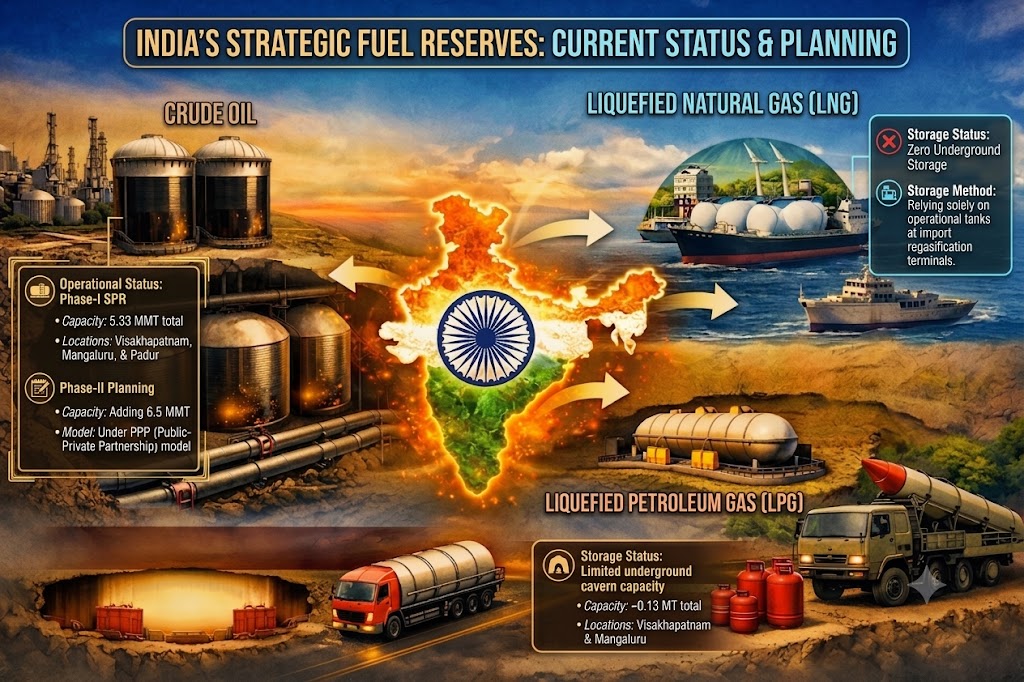
Operational - Phase-I SPR (5.33 MMT across Visakhapatnam, Mangaluru, & Padur).
Planned - Phase-II adding 6.5 MMT under PPP model.
|
+28 million Tonnes (MT)
|
~2 Months of national demand
|
|
Liquefied Natural Gas (LNG)
|
Zero Underground Storage.
Relying solely on operational tanks at import regasification terminals.
|
+9 million Tonnes (MT)
|
~56 Days (~2 Months) of import demand
|
|
Liquefied Petroleum Gas (LPG)
|
Limited underground cavern capacity (~0.13 MT at Visakhapatnam & Mangaluru).
|
+4 million Tonnes (MT)
|
~6 Weeks of cooking gas consumption
|
What are the key challenges?
Geological & Technical Constraints
- Cryogenic Gas Storage - LNG must be stored as a cryogenic liquid at –162°C.
- It requires heavily insulated double-walled tanks or specialized subsurface geology (depleted gas reservoirs / salt caverns) that are currently unproven for commercial gas storage in India.
- 30-Fold LPG Scale-Up - Expanding LPG storage to 4 MT requires an enormous expansion in rock-cavern engineering, pumping systems, and regional bottling networks.
Capacity vs. Withdrawal Rate
- Physical cavern capacity does not equal immediate usability.
- During an emergency, the critical metric is the maximum daily withdrawal rate and whether the fuel can be evacuated quickly via connected pipelines to refineries and power plants.
High Capital Expenditure
- Developing infrastructure alongside purchasing and holding strategic fuel inventories is estimated at ~$42 billion.
- While consumer cesses have been ruled out, funding will likely rely on a commercial-cum-strategic PPP model.
- In this model, Private operators utilize storage commercially during peacetime while keeping stocks reserved for state drawdown during crises.
Maritime & Shipping Logistics
- Strategic reserves only buy time during a blockade or conflict. Energy security remains tied to long-distance maritime routes and key chokepoints like the Strait of Hormuz.
What are the key policy proposals?
- Mandatory Terminal Buffer - A proposal under review requires LNG import terminals to maintain 10% operational storage capacity over normal requirements, reserved exclusively for government drawdown during price spikes or supply cuts.
- Subsurface Exploration - Accelerating geological testing across sedimentary basins (e.g., Krishna-Godavari, Cambay, Mumbai Offshore, and Rajasthan salt formations) to identify suitable formations for underground gas and oil storage.
- Integrated Governance Framework - Establishing clear statutory guidelines regarding emergency release authority, minimum stock obligations, pricing models during drawdown, and inventory replenishment financing.
What is the way forward?
- Connecting underground storage caverns directly with cross-country natural gas grids, crude pipelines, and railway bottling plants to eliminate evacuation bottlenecks.
- Leveraging up to 60% VGF under PPP models (as seen in Phase-II SPR) to attract private and foreign investments in commercial-cum-strategic storage.
- Expanding Indian-flagged crude/LNG vessel fleets and acquiring overseas equity oil assets to ensure physical delivery during global shipping crises.
Reference
The Hindu | Building India's Strategic Fuel Reserves System



