Celebrating the International Day for Biosphere Reserves
- The International Day for Biosphere Reserves is observed annually on 3 November, proclaimed by UNESCO.
- India has 18 notified Biosphere Reserves, of which 13 are recognised by UNESCO.
- They protect biodiversity while promoting sustainable development and community livelihoods.
Balancing Biodiversity Conservation with Sustainable Development
- Biodiversity refers to the variety of living organisms across terrestrial, marine and aquatic ecosystems.
- The Convention on Biological Diversity (CBD) recognises three levels:
- Genetic Diversity: Variations within a species, such as rice varieties.
- Species Diversity: Variety of species, including tigers, elephants and orchids.
- Ecosystem Diversity: Different habitats such as forests, wetlands and coral reefs.
- Biosphere reserves protect natural habitats, maintain ecological balance and promote sustainable resource utilisation.
- They support food security, water availability, climate resilience and community livelihoods.
- India accounts for 7–8% of recorded global species, despite occupying only 2.4% of Earth's land area.
Biosphere Reserves: Understanding the Concept
- Biosphere reserves are areas identified by national governments for biodiversity conservation and sustainable development.
- UNESCO launched the Man and the Biosphere (MAB) Programme in 1971.
- They function as living laboratories for scientific research and sustainable development.
- They promote harmony between local communities and their natural environment.
Biosphere Reserves Vs. Other Protected Areas
- National Parks and Wildlife Sanctuaries primarily protect wildlife and their habitats under India's wildlife protection laws.
- Biosphere reserves adopt a broader approach by integrating ecosystem conservation with surrounding communities and sustainable livelihoods.
Functions of Biosphere Reserves
- Conservation: Protect biodiversity, genetic resources, ecosystems and associated cultural diversity.
- Sustainable Economic Development: Promote economic activities respecting ecological limits and local cultural values.
- Scientific Support: Encourage research, environmental monitoring, education, training and knowledge exchange.
The Three Interconnected Zones
- Core Area: Provides the highest protection to biodiversity and ecosystems. Human activities are strictly restricted, except compatible research and monitoring.
- Buffer Zone: Surrounds or adjoins the core zone. Permits scientific research, environmental education and regulated ecotourism.
- Transition Area: Supports settlements and sustainable livelihoods through responsible agriculture, forestry and ecotourism.
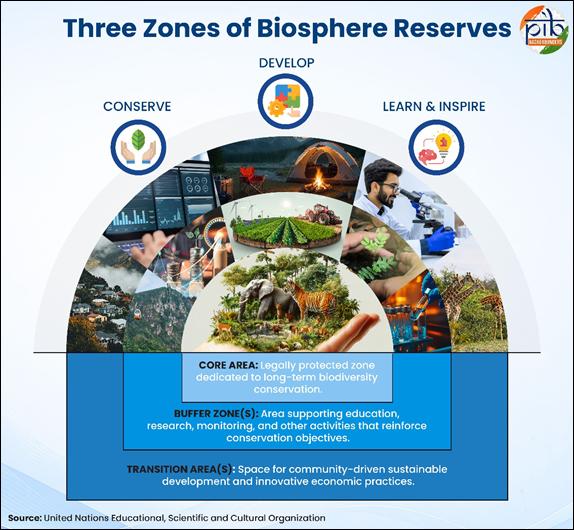
Global Average Distribution:
- Core Zone – 18%.
- Buffer Zone – 30%.
- Transition Zone – 52%.
|
Did you know?
|
- UNESCO's World Network of Biosphere Reserves comprises 797 reserves across 145 countries.
- Around 300 million people directly benefit from these reserves.
- They cover 5% of Earth's terrestrial surface but sustain over 60% of global terrestrial vertebrate species richness.
- Around 40% may face more extreme climate events by 2050.
|
India's Biosphere Reserves
India's Biosphere Reserve Network
- India has 18 notified Biosphere Reserves, of which 13 are included in UNESCO's World Network of Biosphere Reserves (WNBR).
- India has the highest number of internationally recognised Biosphere Reserves in South Asia.
|
No.
|
Biosphere Reserve
|
Year
|
UNESCO Inclusion
|
|
1
|
Nilgiri
|
1986
|
2000
|
|
2
|
Nanda Devi
|
1988
|
2004
|
|
3
|
Nokrek
|
1988
|
2009
|
|
4
|
Gulf of Mannar
|
1989
|
2001
|
|
5
|
Sundarbans
|
1989
|
2001
|
|
6
|
Manas
|
1989
|
—
|
|
7
|
Great Nicobar
|
1989
|
2013
|
|
8
|
Similipal
|
1994
|
2009
|
|
9
|
Dibru-Saikhowa
|
1997
|
—
|
|
10
|
Dehang-Dibang
|
1998
|
—
|
|
11
|
Pachmarhi
|
1999
|
2009
|
|
12
|
Khangchendzonga
|
2000
|
2018
|
|
13
|
Agasthyamalai
|
2001
|
2016
|
|
14
|
Achanakmar-Amarkantak
|
2005
|
2012
|
|
15
|
Great Rann of Kutch
|
2008
|
—
|
|
16
|
Cold Desert
|
2009
|
2025
|
|
17
|
Seshachalam
|
2010
|
—
|
|
18
|
Panna
|
2011
|
2020
|
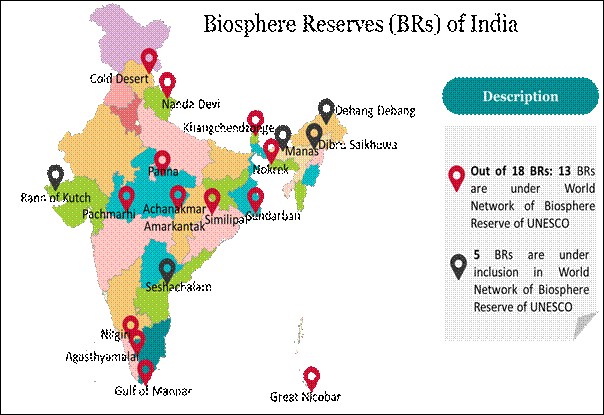
Government Initiatives for Conservation
- MoEFCC administers the Biodiversity Conservation Scheme under the umbrella scheme Conservation of Natural Resources and Ecosystems.
- It provides financial assistance to States for conservation activities under approved management plans.
- Funding pattern:
- Other States: 60:40 (Centre:State).
- North-Eastern and Himalayan States: 90:10 (Centre:State).
- Since 2022–23, five-year Integrated Management Plans have been piloted in:
- Nanda Devi – Uttarakhand.
- Pachmarhi – Madhya Pradesh.
- Dehang-Dibang – Arunachal Pradesh.
- Agasthyamalai – Kerala and Tamil Nadu.
- Priorities include habitat restoration, biodiversity monitoring, scientific research and sustainable livelihoods.
A Glimpse into India's Biosphere Reserves
1. Nilgiri Biosphere Reserve
- Located in the Western Ghats across Tamil Nadu, Kerala and Karnataka.
- Supports endangered lion-tailed macaques and Nilgiri tahrs, besides elephants, tigers and over 550 bird species.
2. Cold Desert Biosphere Reserve
- Located in Himachal Pradesh, covering 7,770 sq. km at elevations of 3,300–6,600 metres.
- Supports snow leopards, Himalayan ibex and blue sheep.
- Local livelihoods include pastoralism, yak and goat herding and farming.
3. Gulf of Mannar Biosphere Reserve
- Located along Tamil Nadu's southeastern coast, covering approximately 1.05 million hectares.
- Includes coral reefs, seagrass beds and mangroves.
- Supports 4,223 plant and animal species and around 25 lakh people.
Success Story: People at the Heart of Conservation
- Indigenous communities in the Nilgiri Biosphere Reserve convert invasive Lantana vines into elephant sculptures, furniture and handicrafts.
- In 2021, 125 life-sized Lantana elephants were displayed in London.
- The initiative generates livelihoods while raising awareness about invasive species.
|
Did You Know? – Lantana camara
|
- This invasive shrub covers approximately 3 lakh sq. km of Indian forests.
- It suppresses native vegetation, reduces biodiversity and alters natural fire patterns.
- Despite eradication efforts since 1916, controlling it remains challenging.
|
Way Forward
- Strengthen scientific research, habitat restoration and biodiversity monitoring.
- Promote community-led conservation and sustainable livelihoods.
- Integrate traditional knowledge with modern monitoring technologies.
- Strengthen cooperation among governments, researchers and local communities.
- Biosphere reserves can reconcile biodiversity conservation with sustainable development and human well-being.
Reference
PIB



