Mains: GS II - Governance & Social Justice
Why in News?
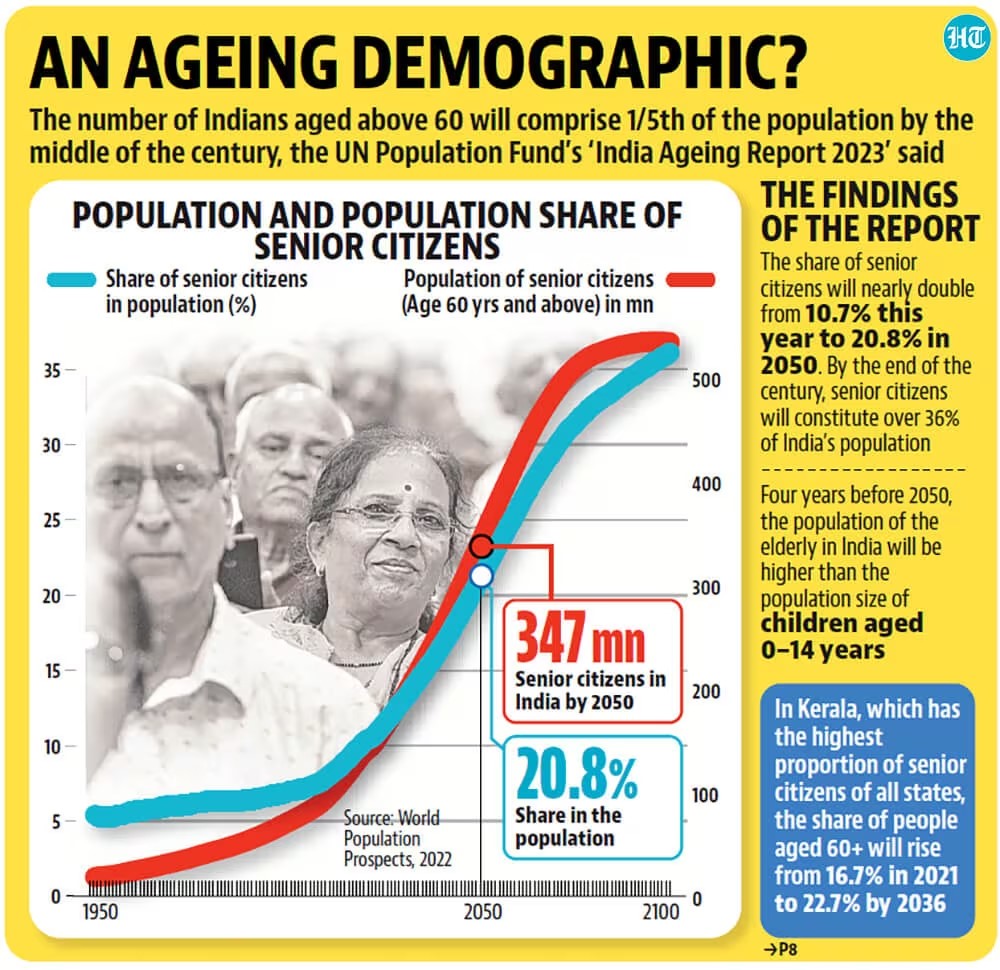
NFHS-6 (2026) shows India’s elderly population has risen to 12.9%, highlighting the need for better age-specific health and care data to address the challenges of an ageing population.
What is the current status of India’s Ageing Transition?
- India is undergoing a demographic transition with a steadily increasing elderly population.
- Spatial unevenness of Ageing –
- Kerala: 20.7% elderly
- Goa: 17.2%
- Himachal Pradesh: 16.4%
- Tamil Nadu: 16.3%
- In contrast, States such as Bihar and Uttar Pradesh remain relatively young.
- Ladakh witnessed a sharp increase in its elderly share, from 8.9% to 14.6% in four years.
- Implication – India requires State-specific and region-specific ageing policies, rather than a uniform national approach.
What are the Key Data Gaps?
- Lack of elderly-specific health data – NFHS-6 records hypertension and high blood sugar for adults aged 15+.
- It makes difficult to identify the specific disease burden among senior citizens.
- Nutrition remains poorly measured – NFHS does not adequately measure BMI and nutritional status of older adults.
- Elderly have increased vulnerability to malnutrition and functional decline.
- Limited information on healthcare expenditure – Health insurance and financing indicators are largely available at the household level.
- It provides limited information about the actual financial burden faced by elderly individuals.
- Elderly not adequately interviewed – NFHS interviews women up to 49 and men up to 54 years.
- Gaps in holistic data – Older people are largely represented through household information and selected biomedical measurements, leaving gaps regarding:
- Healthcare-seeking behaviour
- Treatment adherence
- Lifestyle factors
- Employment
- Functional ability
- Social support
Why Does Better Data Matter?
- Effective implementation of AB-PMJAY – The extension of Ayushman Bharat PM-JAY to all citizens aged 70+ increases the need for reliable information about:
- Chronic disease prevalence
- Healthcare utilisation
- Out-of-pocket expenditure
- Long-term care requirements
- Ageing increases demand for - Geriatric services, chronic disease management, Long-term and home-based care, Rehabilitation, Palliative care.
- States ageing faster need healthcare infrastructure and elderly-care services earlier and at greater scale than relatively younger States.
|
Longitudinal Ageing Study in India (LASI)
|
- LASI, conducted by the International Institute for Population Sciences (IIPS), provides comprehensive information on ageing.
- It covers:
- Health conditions
- Healthcare utilisation and expenditure
- Economic circumstances
- Social networks
- Functional health
- Biomarkers
- Its first wave covered 73,000+ adults aged 45+ during 2017–18.
- Concern – The first-wave data are now around eight years old, reducing their usefulness for current policy planning.
|
What are the measures taken by government to address elderly needs?
- National Social Assistance Programme (NSAP) – Provides monthly financial aid and old-age pensions to individuals from lower-income, marginalized backgrounds.
- Eg. Indira Gandhi National Old Age Pension Scheme.
- Ayushman Bharat PM-JAY Expansion – Extends free health insurance coverage up to rs.5 lakh per year to all senior citizens aged 70 and above.
- Rashtriya Vayoshri Yojana (RVY) – Distributes free assisted-living devices (such as wheelchairs, walkers,) to elderly individuals facing age-related physical limitations.
- SAGE Initiative – Encourages innovative startups to design customized products, services, and living solutions suited for the elderly.
What could be done?
- Strengthen existing surveys – Instead of creating another large survey, improve and update NFHS and LASI.
- Generate age-disaggregated data – Report health indicators separately for 60+, 70+, 80+ and other relevant age groups.
- Regularly update LASI – More frequent waves would provide policymakers with current evidence on India's rapidly changing age structure.
- Integrate datasets – NFHS and LASI should be designed to enable comparability and complementary analysis.
- Focus on functional health – Data collection should include disability, mobility, activities of daily living and dependency levels, not merely disease prevalence.
- Strengthen State-level planning – Ageing indicators should guide State-specific healthcare infrastructure, insurance and long-term care policies.
What lies ahead?
- India's ageing challenge is not merely about how many elderly people there are, but about how they live, what diseases they face, what care they require.
- Strengthening existing data systems through regular surveys can enable India to shift from a reactive approach to evidence-based elderly healthcare planning.
Reference
The Hindu| An Ageing India: Counting to Understanding Elderly Needs



