Mains Syllabus: GS II - Bilateral, regional and global groupings and agreements involving India and/or affecting India’s interests; Important International institutions, agencies and fora- their structure, mandate.
Why in the News?
Instead of trade routes, global value chains are being reshaped by force recently.
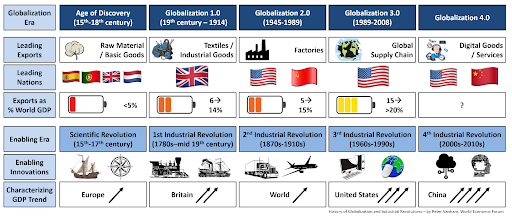
How has the globalization evolved?
- Globalization – It refers to the increasing interconnectedness and integration of economies, cultures, and societies worldwide.
- It is a 75-year-old post-colonial order characterised by multilateralism and rule-based restrictions on all for the common good.
- Early Waves and Pre-20th Century - The first wave of globalization occurred in the 19th century up to 1914, characterized by increased trade and migration facilitated by industrial advances and imperial expansion
- Interwar Period and World Wars - Globalization slowed significantly during the World Wars and the interwar period due to geopolitical conflicts and protectionism.
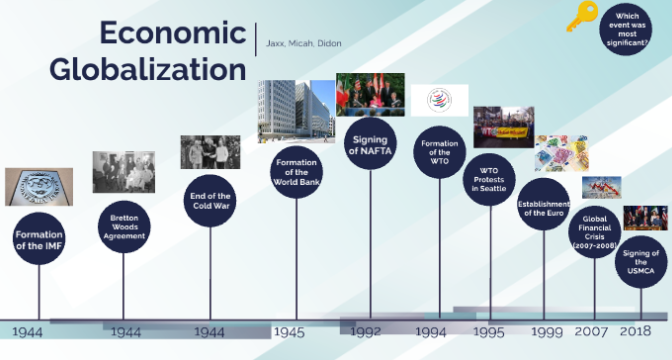
- Post-World War II Resurgence - After WWII, the 2nd wave of globalization revived under U.S. leadership with institutions like
- Bretton Woods system
- International Monetary Fund
- World Bank
- General Agreement on Tariffs and Trade (GATT), which evolved into the World Trade Organization (WTO).
- This period saw a rules-based international order promoting free trade, economic cooperation, and technological advances such as container shipping and aviation, which lowered costs and connected markets globally.
- Decolonization- The dismantling of European empires and the rise of independent nations in Asia and Africa.
- 3rd Wave - The 1990s and early 2000s marked the expansion of global trade, multinational corporations, and digital communication, further accelerating integration.
- China’s accession to the WTO in 2001 was a major milestone, establishing it as a global economic superpower and reshaping global supply chains.
What are the recent changes in the global order?
- Multipolarity - Global power is no longer dominated by a single superpower (e.g. the U.S.) but is increasingly distributed among multiple centers — notably China, the European Union, India, and other regional blocs.
- Loss of trust in international organizations - The World Trade Organization and the United Nations and Treaties lost their utility to the proponents, leading to U.S. withdrawals.
- Decline of G 7 - The COVID-19 pandemic exposed the G-7 scrambling to corner medicines, oblivious of the plight of others.
- Now, the G-7 is splitting leaving a vacuum and global institutions such as BRICS will soon have more requests for membership.
- Rise of Asia - Asia will soon again have two-thirds of global wealth and power.
- Shifting Alliances and Partnerships - Countries are increasingly forming bilateral deals and regional alliances to pursue their specific interests.
- Geo-economics - Countries are using economic tools (tariffs, sanctions, investment restrictions, export controls) as weapons in geopolitical conflicts.
- For example, U.S. chip export bans to China
- Digital Globalization - Data, digital services, and software flows now drive more of the global economy than physical goods.
- Green Globalization - Climate goals are reshaping trade and investment patterns.
- For example , EU’s Carbon Border Adjustment Mechanism (CBAM) — taxes on imports from high-emission countries.
What lies ahead?
- India has to be strategic to grasp new opportunities with the ‘dismantling’ of the WTO just as China used its entry into the WTO for its rise.
- As the WTO’s ‘most-favoured nation’ clause of non-discrimination withers away, it is in India’s longer term interest to propose a new cooperative architecture to ASEAN and the African Union, as their potential consumption will exceed current consumption in the U.S. and Europe.
- The turmoil within the Association of Southeast Asian Nations (ASEAN) is an opportunity to jointly work towards an Asian common market, with bilateral concessions to share prosperity.
- A new type of principles of global governance is the need of the hour for a more equal world.
- Gaining from global value chains that are dependent more on technology than on tariffs requires laying out a new type of rules that reduce non-tariff barriers .
- Linkages between goods, services, investment and infrastructure need to be treated as part of composite agreements, with a review of national impacts annually.
- New policy groups need to engage and seek complementarity with China, ASEAN and Africa as value chains get restructured.
Reference
The Hindu | A profound shift in the global order



