Prelims: Current events of National and International Importance| History
Why in News?
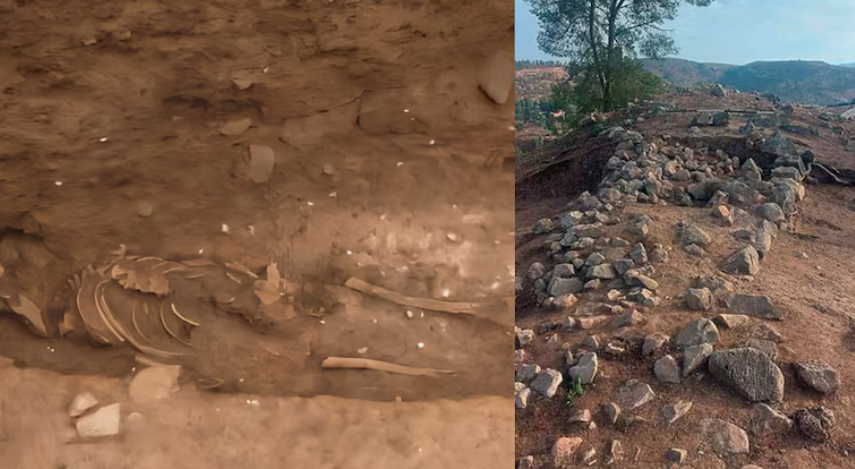
Archaeologists have uncovered a mysterious, 4,000-year-old defensive structure at the Oued Beht site in northwestern Morocco, marking the oldest known large-scale fortified system in North Africa outside the Nile Valley.
- Location– Situated in the hills of north-west Morocco, overlooking the Oued Beht river valley east of Rabat.
- Age– Radiocarbon dating of seed and charcoal deposits places the original construction between 4,000 and 3,500 years ago (around the second millennium BC, coinciding with the Bronze Age in the western Mediterranean).
- Structure– The system consists of a multi-phase ditch, a packed-earth/mud rampart built on a gravel base, and a wall cutting across a narrow ridge to protect the southern tip of the settlement.
- Earlier Agricultural Hub– Prior research at Oued Beht already revealed an extensive prehistoric agricultural complex (dating back 5,400 to 4,900 years) featuring large grain-storage pits and livestock management, showing the site was a major hub long before the wall went up.
- Medieval Re-occupation– The same ridge was later reused centuries later during the medieval period (11th to 13th centuries AD), when the defensive lines were rebuilt and a farm and cemetery were established nearby.
Why It Rewrites North African History?
- Pushes Back Complex Architecture– Traditional historical models often assumed that large-scale, organized construction and complex societal coordination in North Africa (outside of Pharaonic Egypt) appeared much later or relied on external influence. This wall proves indigenous prehistoric communities were capable of massive, coordinated public works
- Local Competition Over Resources– Researchers believe the wall was built not to fend off foreign invaders, but likely to handle local competition over land, water, food resources, or control over regional trade and movement.
- Mediterranean Connections– The findings challenge older "diffusionist" theories, demonstrating that the Maghreb was an active, interconnected participant in broader Bronze Age Mediterranean networks rather than an isolated periphery.
Reference
Money Control| 4,000-year-old wall in Morocco



