Mains: GS IV – Corporate Governance
Why in News?
Recently, The Confederation of Indian Industry (CII) has come up with 15 action points that can induce regulators to reduce compliance burdens and move towards a trust-based corporate governance.
What is corporate governance?
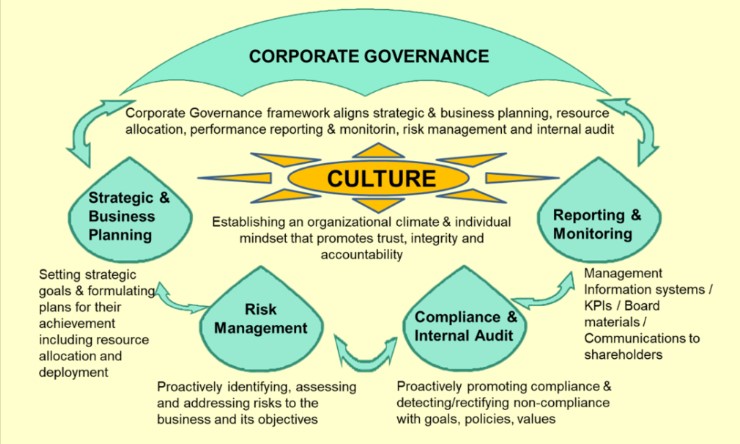
- Definition – It refers to the system of rules, practices, and processes by which a company is directed and controlled.
What are the importance of trust in corporate governance?
- Serves as a valuable asset – Building trust is a powerful asset for Indian industry, enabling companies to thrive in a competitive and globalised environment.
- Builds collective goals – In the current geo-economics and geopolitical environment, the responsibility of building trust needs to be ideally shared between businesses, the government and various stakeholders.
- This enables them to work in coordination and shared values.
- Enable stakeholders engagement – On the governance side, this will enhance stakeholder engagement, build brand value, deepen customer loyalty, inspire employees and strengthen resilience during crises.
- As stakeholders increasingly seek transparency and accountability, businesses that invest in trust can meet these expectations more effectively.
- Leads to efficient policy making – Building trust can encourage regulators to adopt more supportive and streamlined policies, reducing compliance burdens and fostering a more business-friendly environment.
- Promotes business – Companies known for integrity and good governance gain a competitive edge by attracting talent, investors and global partnerships—fuelling innovation and long-term success.
- This involves taking actionable steps towards conservation and sustainability, digital transformation and responsible use of AI.
- Equity, inclusivity and welfare, community engagement, education and upskilling, R&D and innovation, leadership commitment and financial integrity among others.
What are the 15 action points to improve corporate governance?
- Establish a clearly defined purpose – A clear corporate purpose grounded in ethics, sustainability and long-term value creation should be established.
- This must reflect both the organisation’s vision and stakeholder aspirations.
- It should act as a reference point for strategic decisions, fostering alignment, accountability, and transparency across the enterprise.
- Develop a robust risk and crisis management framework - Trust is tested during uncertainty.
- Identify areas of vulnerability— Indian businesses must identify challenges of geopolitical, financial, operational, or technological and implement comprehensive risk mitigation plans.
- Companies can reinforce stakeholders’ confidence by demonstrating preparedness and responsiveness during crises
- Ensure regulatory compliance and financial integrity – Clear policies, internal controls, and early corrective mechanisms should be institutionalised.
- Transparent financial reporting and timely statutory disclosures affirm the company’s integrity and commitment to ethical governance, which in turn fosters regulatory trust and investor confidence.
- Embrace technology and innovation responsibly – Adopting AI, block chain and automation tools can enhance transparency, efficiency and data protection.
- Companies must be explicit about technological integration, train employees accordingly, prevent misuse and ensure that innovation aligns with ethical standards.
- Optimise supply chain management – A reliable and ethical supply chain enhances both operational efficiency and stakeholder trust.
- Businesses should use technology for transparency, predictive analytics to foresee disruptions and ensure fair and timely payments to suppliers.
- Strong relationships across the value chain promote resilience and shared accountability.
- Assign clear roles for trust stewardship – Titular designation or appointing an existing senior executive to lead trust-building initiatives highlights the strategic priority.
- This executive shall coordinate efforts across compliance, risk, stakeholder engagement, and data security, working collaboratively with other all executives.
- Manage conflict constructively – Proactive conflict resolution helps maintain internal cohesion and external credibility.
- Companies should foster two-way communication to resolve disagreements swiftly.
- Institutionalising mechanisms for redressed minimises escalation and promotes a culture of openness and fairness.
- Maintain transparent stakeholder communication – Consistent, honest communication reinforces credibility.
- Creating feedback loops and listening actively to stakeholders’ concerns builds deeper engagement and reduces misinformation.
- Deliver consistently on promises – Companies should meet or exceed the set expectations on Reliability.
- By setting realistic goals and consistently delivering, businesses establish trustworthiness.
- Uphold ethical practices and integrity – A clear code of conduct, regular ethics training and strict enforcement of behavioural standards are crucial for maintaining trust.
- Ethical leadership must be demonstrated across all levels of the organisation.
- Empower and engage with employees – Investing in professional development, recognise achievements and encourage collaboration.
- Open communication, psychological security and inclusive policies enhance internal trust and employee loyalty.
- Adopt a customer-oriented approach – Providing seamless service, quick issue resolution, and multiple communication channels.
- It includes respecting data privacy which strengthens customer relationships and enhances brand credibility over time.
- Commit to the environmental, social and governance responsibility – Businesses should prioritise environmental stewardship and community development demonstrate a broader commitment to the common good.
- Investment in sustainability initiatives help earn public goodwill and societal trust.
- Nurture collaborative and transparent partnerships – Regular communication, fair negotiations and mutual goal-setting help establish dependable, long-term partnerships built on trust and mutual respect.
- Champion the trust agenda – Transparent decision-making, openness to accountability and ethical role modelling by senior executives shape organisational culture.
- When trust is channelled from the top, it embeds throughout the company.
What lies ahead?
- By working on these 15 points, Indian industry could meet the rising expectations of stakeholders and also be future-resilient.
- A trust-centred approach and global competitiveness could lead to collective progress, policy vitality and enhanced trade and investment.
Reference
The New Indian Express| Leadership in Corporate Governance



