Prelims: Current events of national and international importance | Geography
Why in News?
Recently, Greenland has been in focus after U.S. President Donald Trump called for immediate talks on acquiring the island.
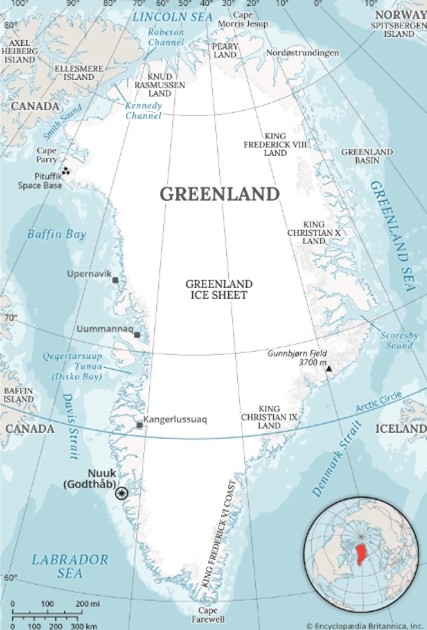
Greenland, the world’s largest non-continental island, functions as a semi-autonomous territory of Denmark.
Location & Extent – Situated in the North Atlantic and Arctic Oceans, between North America and Europe.
Though part of the North American continent, it is politically associated with Europe through Denmark.
Canada’s Ellesmere Island (north) and Iceland (southeast) are its nearest neighbours.
Arctic Position – About two-thirds lies above the Arctic Circle.
Experiences 24-hour daylight in summer and near-total darkness in winter.
Landscape – Dominated by the Greenland Ice Sheet, which shapes most of the terrain and is the second largest in the world after Antarctica.
Protected Areas – Nearly half of Greenland is protected as the National Park of Greenland, the world’s largest national park.
Major mountain ranges – Watkins Range, Stauning Alps
Major rivers – Børglum, Qinnguata Kuussua, Majorqaq
Geopolitics – NATO Linkage – Greenland is part of NATO through Denmark’s membership, giving it strategic relevance in the transatlantic alliance.
Strategic Location – Positioned between North America, Europe and the Arctic, making it vital for military surveillance and security.
U.S. Military Presence – Hosts a key U.S. air base, highlighting its importance in Arctic and North Atlantic defence.
Resource Competition – Greenland lies in a region rich in oil, gas and critical minerals, increasing interest from major powers amid Arctic thaw.
Arctic Geopolitics – Melting ice is opening new Arctic shipping routes, increasing global and regional competition from global powers such as the U.S., Russia and China.
India’s stand – Climate Linkage – India’s Arctic Policy recognises that Greenland’s ice melt affects global sea levels and alters atmospheric circulation, influencing the Indian monsoon.
Arctic Council Role –India has Observer status in the Arctic Council since 2013 and engages in discussions on environmental protection and sustainable resource use.
Market Impact – Geopolitical uncertainty linked to the “Greenland factor” has contributed to global financial market instability.
Scientific Presence – India operates the Himadri research station in Svalbard, with long-term scientific engagement with Arctic climate processes.