Ministry of Environment Forest and Climate Change (MoEFCC)
- MoEFCC is the nodal agency for planning, co-ordination and overseeing the implementation of India’s environmental and forestry policies and programmes.
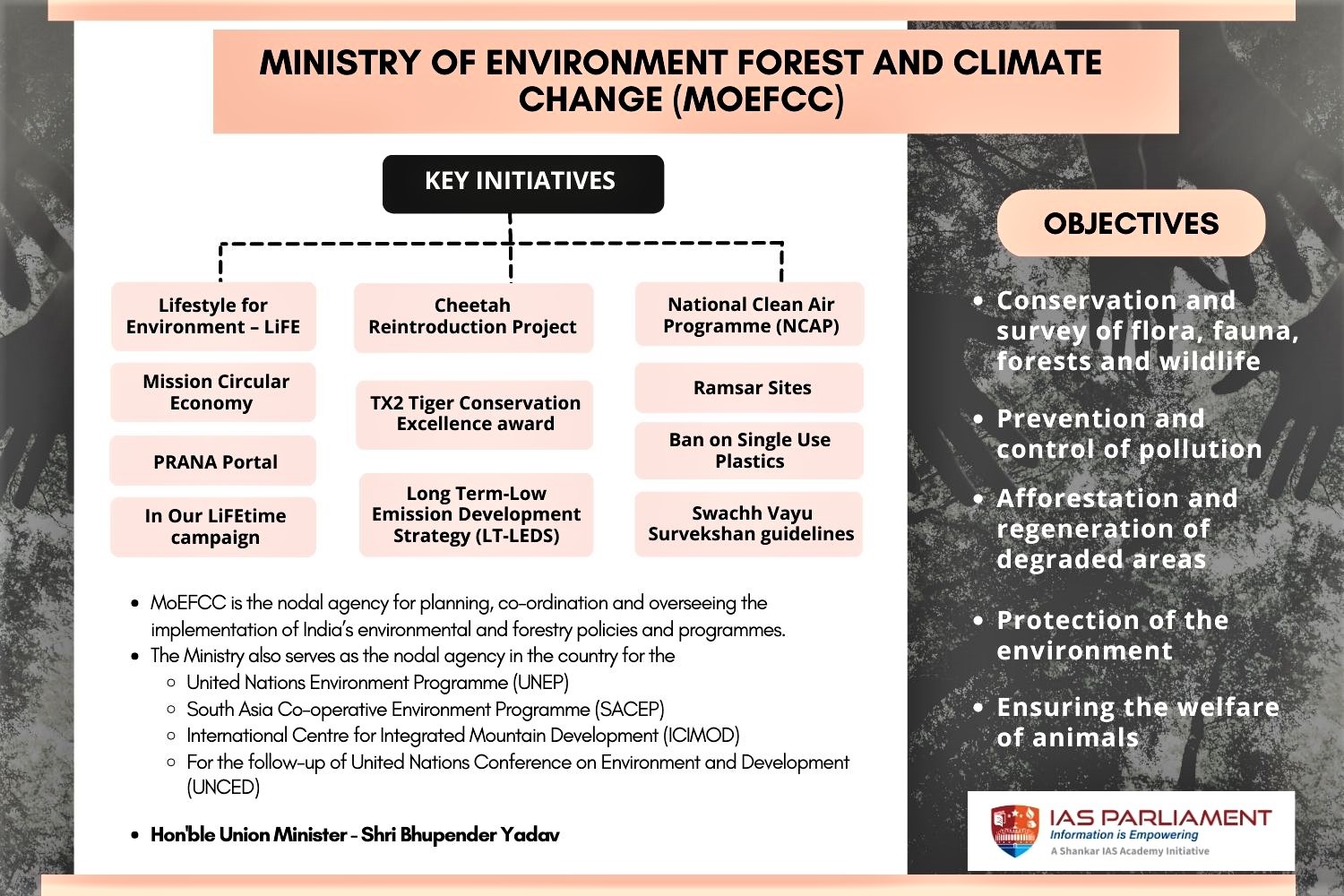
KEY INITIATIVES OF MoEFCC
1. Lifestyle for Environment – LiFE
- The concept of Lifestyle for Environment (LiFE) was introduced by Indian Prime Minister during UNFCCC - Conference of Parties (COP25) at Glasgow in 2021.
- LiFE is an international mass movement to protect and preserve the environment by replacing the prevalent 'use-and-dispose' economy with a circular economy.
- Approach of LiFE Campaign
- Focus on individual behaviours - Make life a mass movement (Jan Andolan) by focusing on behaviours and attitudes of individuals and communities
- Co-create globally - Crowdsource scalable ideas from the best minds of the world
- Leverage local cultures - Leverage climate-friendly social norms, beliefs and daily household practices of different cultures
- Pro-planet people - LiFE plans to leverage the strength of social networks to influence social norms surrounding climat
2. Long Term-Low Emission Development Strategy (LT-LEDS)
- At the 27th UN COP27 in Egypt’s Sharm el-Sheikh, India submitted the long-term low emission development strategy to the UNFCCC.
- The Paris Agreement of the UNFCCC states that all parties should strive to formulate long-term low greenhouse gas emission development strategies, taking into account their common but differentiated responsibilities.
- India’s LT-LEDS - India’s LT-LEDS was launched to transition to a low emissions pathway.
- The LT-LEDS has been prepared in the framework of India’s right to an equitable and fair share of the global carbon budget.
- Objectives - The strategy focuses on
- Rational utilisation of national resources with due regard to energy security
- Increased use of biofuels, especially ethanol blending in petrol
- Maximizing the use of green hydrogen fuel to drive the low carbon development of the transport sector
- Expanding its nuclear power capacity by at least three-fold in the next decade
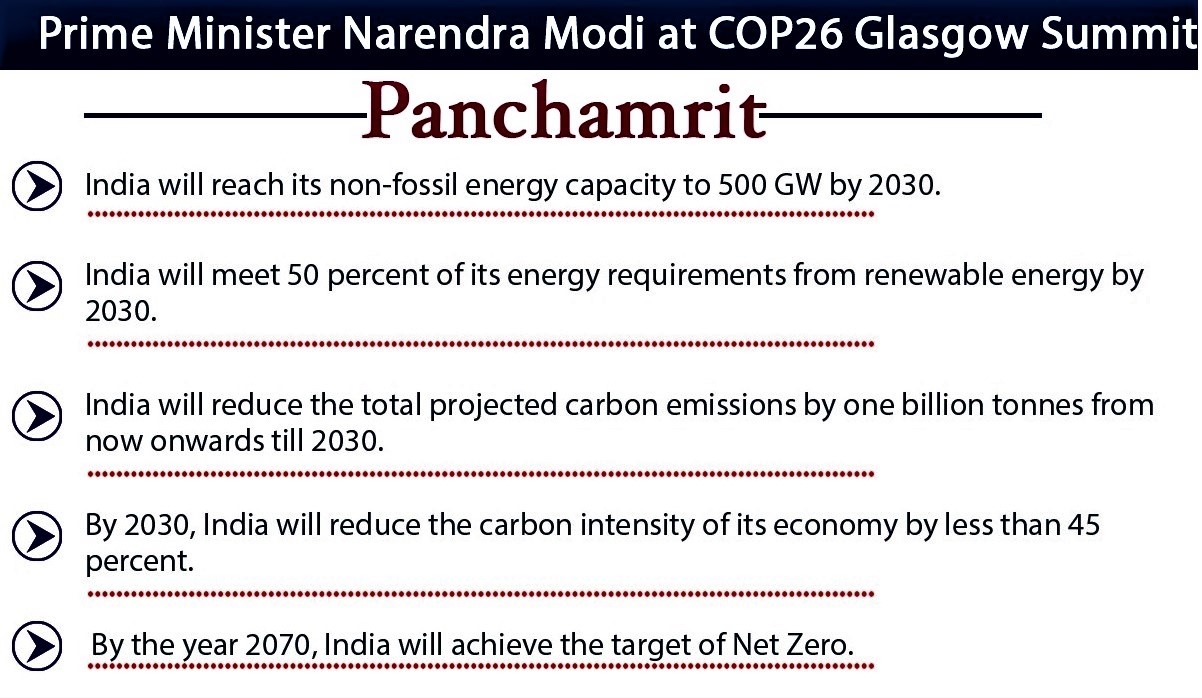
- Significance - The LT-LEDS aims to go beyond India’s nationally determined contributions (NDC) and builds on India’s Panchamrit (five nectar elements) pledges at COP26 of the UNFCCC.
- It is in consonant with India’s five-decade journey to being carbon neutral by 2070 - a commitment made by India at COP 26.
- India’s LT-LEDS rests on 7 key transitions to low-carbon development pathways - electricity systems, transport systems, urbanization, industrial systems, CO2 removal, forestry, economic and financial aspects of low carbon development.
|
India’s Updated NDCs
|
- Achieving 50% of India’s cumulative electric power installed capacity from non-fossil sources by 2030
- Reducing emission intensity of GDP by 45% below 2005 levels by 2030
- Creation of additional carbon sink of 2.5 to 3 billion tonnes of CO2 equivalent through additional forest and tree cover
|
3. In Our LiFEtime campaign
- National Museum of Natural History (NMNH), under the MoEFCC and United Nations Development Programme (UNDP), jointly launched “In Our LiFEtime” campaign at COP 27.
- Aim - To encourage youth between the ages of 18 to 23 years to become message bearers of sustainable lifestyles.
- It tends to foster responsible consumption patterns and influence the lifestyle choices of the younger generations to make them Pro-Planet-People.
4. Promoting Circular Economy - Waste-to-Wealth
- Significance - The Waste-to-Wealth Mission or Mission Circular Economy is bound to create new business models and employment opportunities, thereby integrating the informal sector.
- It will result in moving away from mindless consumption to mindful utilisation and will help achieve the vision of Mission LiFE - Lifestyle for Environment.
- Efforts - The country is emphasising on Mission Circular Economy through policies and promoting projects such as
- Plastic Waste Management Rules
- e-Waste Management Rules
- Construction and Demolition Waste Management Rules
- Metals Recycling Policy, etc.
- To expedite the transition of the country from a linear to a circular economy, 11 committees have been formed for 11 focus areas such as scrap metal, Li-ion batteries, electronic wastes, etc.
- The Indian Railways has set a target of becoming net zero carbon emitter by 2030.
- Regulations on market based Extended Producer Responsibility (EPR) principle have been notified for 4 categories of wastes - plastic packaging waste, battery waste, e-waste and waste tyre.
5. National Clean Air Programme (NCAP)
- The National Clean Air Program (NCAP) was launched in 2019 to address air pollution in around 122 cities.
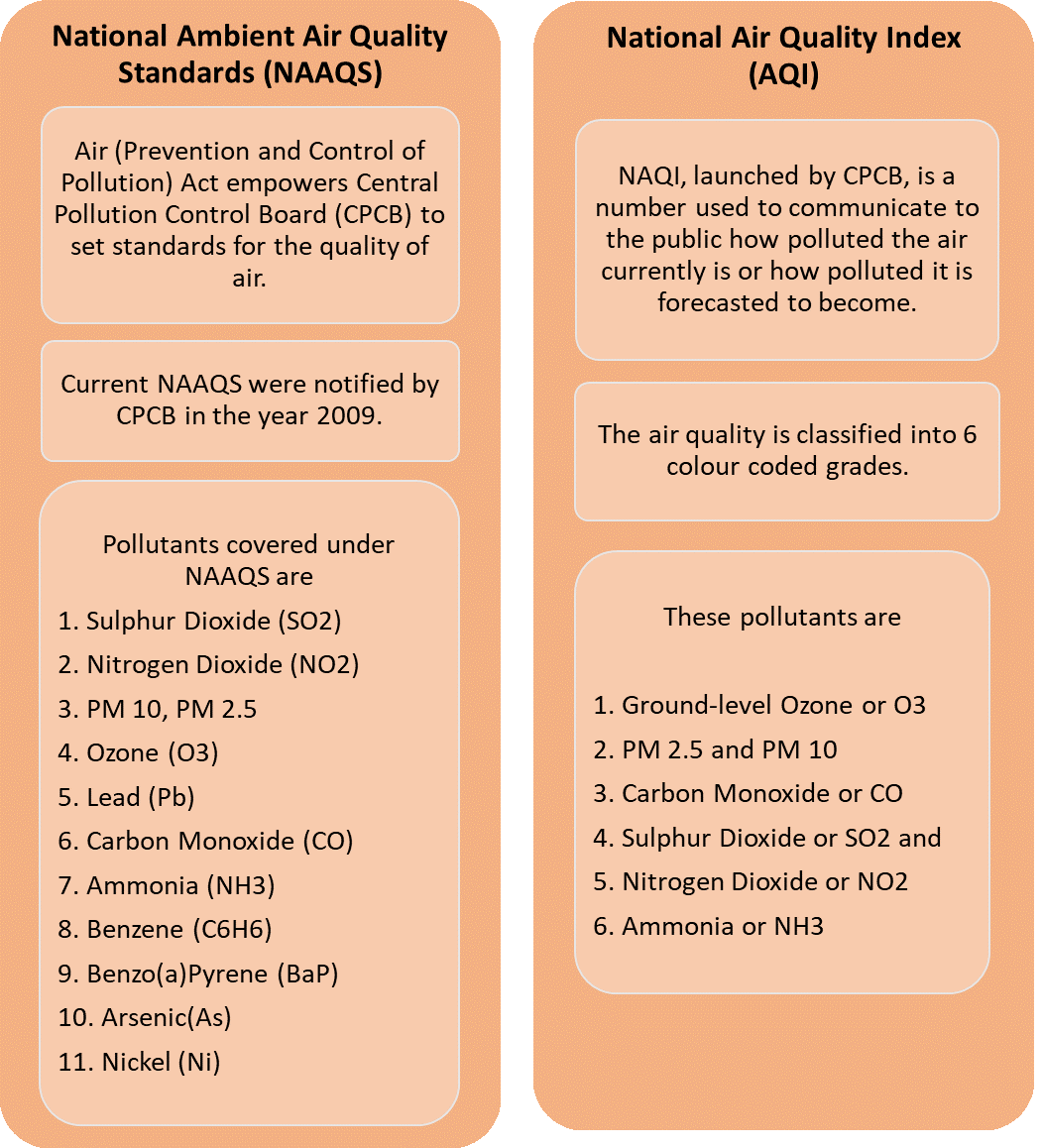
- These cities are referred to as non-attainment cities (NACs) as they did not meet the national ambient air quality standards (NAAQS) for 2011-15 under the National Air Quality Monitoring Program (NAMP).
- The NCAP has set a target of reducing key air pollutants PM10 and PM2.5 by 20-30% in 2024 taking 2017 as the base year.
- An overall improvement in ambient air quality has been observed in 95 cities during 2021-22 as compared to 2017.
- MoEF&CC has launched “PRANA”, a portal for monitoring implementation of NCA
- The Swachh Vayu Survekshan guidelines for ranking of cities under NCAP has been issued to cities.
To know about Part-2, click here
Reference
PIB | Year End Review: Ministry of Environment Forest and Climate Change



