Prelims: Current events of national and international importance | Environment
Why in News?
A landmark study has revealed that despite the extraordinary diversity of avian vocalizations across the globe every bird song is constructed from a fundamental 8-note acoustic "alphabet" (core motifs).
Key Highlights of the Study
- Researchers analyzed over 116,000 song recordings from 3,160 passerine species (perching birds or songbirds) sourced from global citizen-science sound databases like Xeno-canto.
- They used Modulation Power Spectrum (MPS) for each recording reducing complex acoustic signals to underlying patterns of frequency and temporal modulation mapped within a 37-dimensional acoustic space.
- Acoustic signatures across all species universally clustered around 8 primary poles, demonstrating that bird song diversity operates through modular combinations of these eight building blocks.
- Individual songbird species typically incorporate an average of 5 out of the 8 motifs into their song repertoire, with 65.3% of species relying on a single dominant motif for more than 80% of their vocalizations.
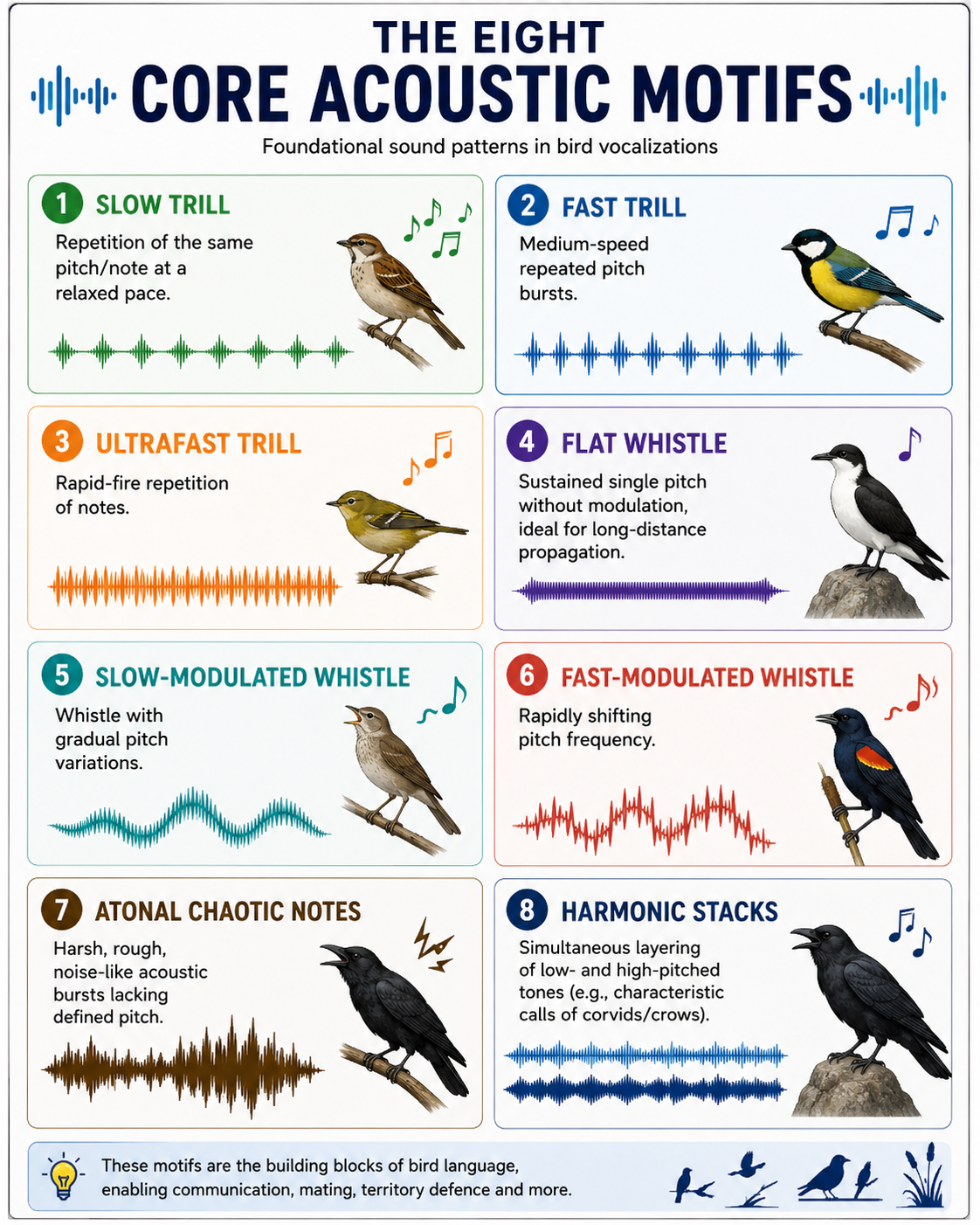
The Eight Core Acoustic Motifs
- Slow Trill - Repetition of the same pitch/note at a relaxed pace.
- Fast Trill- Medium-speed repeated pitch bursts.
- Ultrafast Trill- Rapid-fire repetition of notes.
- Flat Whistle- Sustained single pitch without modulation, ideal for long-distance propagation.
- Slow-Modulated Whistle- Whistle with gradual pitch variations.
- Fast-Modulated Whistle- Rapidly shifting pitch frequency.
- Atonal Chaotic Notes - Harsh, rough, noise-like acoustic bursts lacking defined pitch.
- Harmonic Stacks- Simultaneous layering of low- and high-pitched tones (e.g., characteristic calls of corvids/crows).
Acoustic Adaptation Hypothesis
-
- Birds communicating over long distances or through dense tropical canopy (e.g., Southeast Asian rainforests) rely on simpler motifs like flat whistles and slow trills that resist reverberation and physical barrier distortion.
- Birds in open habitats or communicating at close range favor complex, fast-modulated motifs (ultrafast trills and harmonic stacks) that carry high information density.
- Larger birds produce simpler, lower-frequency motifs, whereas smaller species generate faster, highly complex acoustic variations.
- Species subjected to intense sexual selection and female choice employ significantly more complex motif combinations compared to those under weaker mating competition.
Reference
The Hindu | A hidden eight-note alphabet



