0.3039
7667766266
x

The Politics and Pragmatism of Sovereign Credit Ratings

iasparliament Logo
July 02, 2026

Mains: GS Paper | Economy

Why in News?

Following Union Commerce Minister Piyush Goyal’s recent address at a business conference in London, India’s historical friction with global credit rating agencies has once again stepped into the spotlight.

What do credit rating agencies measure?

  • Sovereign Credit Rating Agencies (CRAs) evaluate a country's economic and political environment to determine its creditworthiness.
  • Core role - To measure the ability and willingness of an entity to repay its debt.
  • These entities can be companies, municipal corporations, states, and, in the case of sovereign ratings, Central or Union governments.
  • Components
    • Ability to Repay- A highly quantitative metric.
    • It evaluates hard economic data such as Gross Domestic Product (GDP) growth, fiscal deficit, foreign exchange reserves, and external debt obligations.
    • Willingness to Repay- A heavily qualitative metric.
    • It gauges a government's political commitment, institutional robustness, and historical track record in honoring debt obligations during economic distress.
  • Regulation - Credit rating agencies (CRAs) are regulated by national and regional authorities to ensure the accuracy, transparency, and objectivity of their financial evaluations.
    • In India - Regulated primarily by the Securities and Exchange Board of India (SEBI) under the SEBI (Credit Rating Agencies) Regulations.

What is the Scale and Impact?

  • International Rating Agencies - India is rated by 7 international sovereign credit rating agencies
    • Standard and Poor’s (S&P),
    • Moody’s Investors Service,
    • Morningstar DBRS,
    • Fitch Ratings,
    • Japanese Credit Rating Agency (JCRA) and
    • Rating and Investment Information (R&I), and
    • CareEdge Ratings.
  • The "Big 3" agencies
    • Standard & Poor's (S&P),
    • Fitch, and
    • Moody's, dominate the global market.
  • The rating spectrum determines a nation's borrowing costs in international markets.
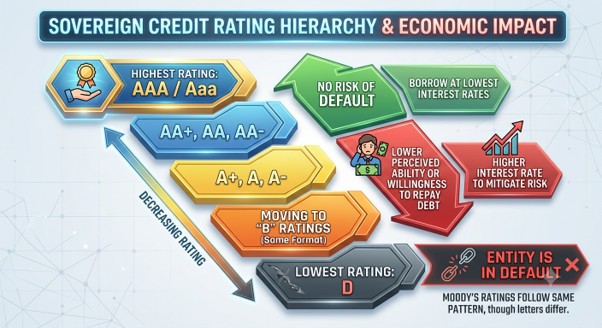
  • Ratings are assigned on an alphabet scale, with Fitch and S&P assigning AAA to their highest rating and Moody’s assigning Aaa to it.
  • The next lower scales are AA+, AA, AA-, A+, A, and A-, before moving on to the ‘B’ ratings in the same format.
  • The lowest rating is D, implying the entity is in default. Moody’s ratings follow the same pattern, though its letters differ.
  • If an entity is rated AAA, then that means there is no risk of a default and so that entity can borrow at the lowest interest rates.
  • However, the lower the rating, the lower the perceived ability or willingness to repay debt, and so higher the interest rate to mitigate that risk.

CRA 1

Where does India Stands in Credit Rating?
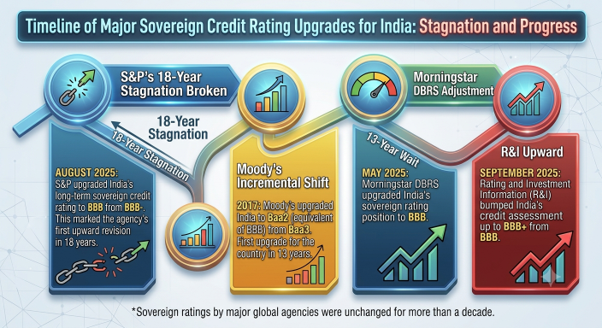
  • Historically, India has been anchored at the absolute lowest tier of "investment grade" just a notch or two above speculative or junk status.
  • While India’s economic fundamentals surged over the last two decades, rating adjustments remained stagnant, prompting immense domestic frustration.

CRA 2

What are India’s issues with the ratings?

  • Despite the recent upgrades, India’s ratings still remain just above junk grade.
  • The structural disconnect in global methodologies centers on 3 primary arguments
  • Size vs. Rating Anomalies - India is the fifth-largest economy in the world, yet it holds ratings usually shared by significantly smaller economies with far weaker macroeconomic indicators.
  • Underestimated "Willingness" - India holds a flawless sovereign repayment track record.
  • Despite severe balance-of-payments crises in the past (such as in 1991), India has never defaulted on its external debt.
  • The government argues this concrete history should render any "willingness to pay" concerns void.
  • The Subjectivity of the "Expert Consensus" - Global CRAs weigh qualitative institutional indicators heavily such as perceived governance quality, political stability, and institutional efficacy.
  • The Indian government argues these parameters rely on the subjective opinions of a small pool of Western-centric experts, resulting in a systemic bias that fails to capture ground realities.

What is the CareEdge Alternative?

  • The appreciation of CareEdge Ratings by Indian policy leaders stems directly from its revised, transparent approach to emerging market realities.
  • As the first global sovereign rating agency headquartered in India, its framework directly addresses the flaws New Delhi has highlighted for years.

Evaluation Pillar

Primary Nature

Methodological Alignment

1. Economic Structure & Resilience

Quantitative

Combined with Fiscal Strength, these two pillars command 50% of the total rating weightage.

2. Fiscal Strength

Quantitative

Focuses heavily on hard data indicators rather than subjective perceptions.

3. External Position & Linkages

Quantitative/Analytical

Evaluates forex reserves, trade structures, and debt-to-GDP ratios.

4. Monetary & Financial Stability

Quantitative/Policy

Monitors inflation control, banking health, and central bank efficacy.

5. Institutions & Quality of Governance

Qualitative

Used primarily as a secondary enhancement layer rather than the driving force of the rating.

What is the way forward?

  • By shifting the foundational 50% weightage entirely onto objective, quantitative metrics (Pillars 1 and 2), frameworks like CareEdge minimize the impact of qualitative biases.
  • For a country like India boasting robust growth rates, controlled inflation, and a flawless default record this methodology yields a far more accurate reflection of modern economic sovereign capability.


Reference

The Hindu | Credit ratings agencies

Login or Register to Post Comments
There are no reviews yet. Be the first one to review.

ARCHIVES

MONTH/YEARWISE ARCHIVES

sidetext
Free UPSC Interview Guidance Programme
sidetext