Why in news?
The WHO Director-general at the 76th world health assembly has cautioned against the threat of emerging pathogens.
What is a pandemic?
- A pandemic is a disease outbreak that spreads across countries or continents.
- COVID-19 is one such pandemic in recent years, which led to waves of infections and deaths in all countries.
- The World Health Organisation (WHO) declared that COVID-19 was no longer a Public Health Emergency of International Concern.
- The virus continues to have reservoirs in animals, but the likelihood to turn into a pandemic or public health threat is small.
How do pandemics happen?
- Air travel - Ease of travel makes it likely for infections to spread to a large number of populations and countries.
- Urbanisation - Large number of people living in close proximity.
- Travel and density of population has played a role in previous pandemics as well.
- The Spanish Flu of 1918 happened towards the end of World War I and spread through congested and overcrowded camps.
- The deadliest pandemic Black Death is also thought to have come to Europe with rats that were aboard trading ships.
How has climate change impacted outbreaks and pandemics?
- Climate plays several roles in outbreaks and pandemics.
- Deforestation and encroachment of habitats of other animals has brought the humans and animals closer.
- This increased human-animal interactions has led to more zoonotic transfer of diseases.
- The climate itself may change the habitats of the disease-carrying vectors.
- For example: The geographical range of dengue in the country expanded to hilly and colder regions.
- Climate change also leads to extreme weather events that can displace people and force them to live in poor hygienic conditions.
- Climate change may increase the risk of ‘viral spillover’ in some regions that could cause new pandemics.
What are pandemic potential pathogens?
- Pandemic potential pathogens - The bacteria, viruses, or microorganisms that are highly transmissible capable of spreading unchecked amongst humans and highly virulent capable of causing severe disease and death.
- Coronaviruses are one such pathogens that has pandemic potential.
- Priority List - The WHO has a priority list of pathogens that are pandemic potential and don’t have adequate drugs and vaccines against them.
- This list acts as the basis for prioritising research for developing diagnostics, drugs, and vaccines for these diseases.
- The list includes -
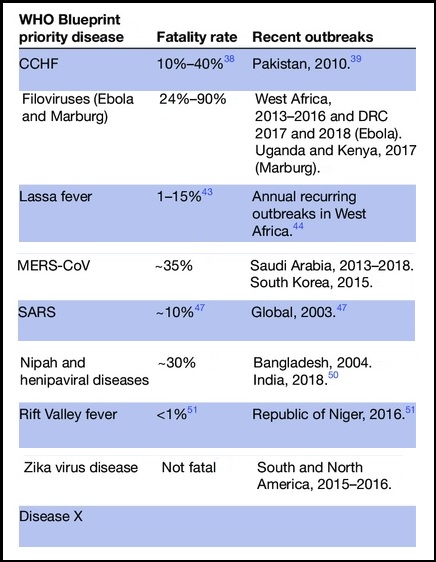
- The list also includes ‘Disease X’ which represents a serious international epidemic could be caused by a pathogen currently unknown to cause human disease.
What is the way forward?
- The countries and healthcare systems are required to prepare for such future pandemics.
- A one-health surveillance that can track outbreaks in both human and animal population.
- Recently, the WHO has launched the International Pathogen Surveillance Network (IPSN).
- Government should ensure sanitation and hygiene to reduce infection risks.
- There is a need to keep the health systems ready for a health emergency including systems to quickly come up with diagnostics, drugs, or vaccines.
- Similar Topics - WHO's Pandemic Treaty, India’s APPI and AHSSOH
References
- IE - Why the WHO Director-general has cautioned against the threat of emerging pathogens



