Mains: GSII – Polity| Governance
Why in News?
The Mines and Minerals (Development and Regulation) Amendment Act, 2026 has triggered a fresh Centre-State debate over mining regulation, taxation powers and fiscal federalism.
What are the Key Provisions of the Amendment?
- Centre powers – The Centre’s regulatory powers have been expanded to cover mines, mineral development and mineral-bearing lands.
- State powers – States are restricted from imposing new taxes on mineral rights and mineral-bearing lands, except as permitted by the Union government.
- Certain uncollected mineral-related taxes imposed before the amendment are rendered invalid.
- This can reduce the future mineral-linked revenue available to mineral-rich States.
- Constitutional Framework – Mining and mineral taxation involve overlapping constitutional powers –
- Entry 23, State List – States can regulate mines and mineral development, subject to Union legislation.
- Entry 54, Union List – Parliament can regulate mines and mineral development in the public interest.
- Entry 50, State List – States can tax mineral rights, subject to limitations imposed by Parliament.
- Entry 49, State List – States can tax lands and buildings, including mineral-bearing land.
- Thus, the amendment has expanded the Centre-State debate from regulation of mineral development to the fiscal autonomy of States.
- Supreme Court's Position – The Supreme Court’s 2024 judgment held that
- States possess the power to tax mineral rights, subject to Parliament’s power to impose limitations in public interest.
- Parliament cannot use its powers under Entry 54 to curtail the State’s power to tax mineral-bearing land.
- The 2026 amendment has therefore raised questions about its compatibility with the constitutional distribution of powers.
Why is the Issue Important for States?
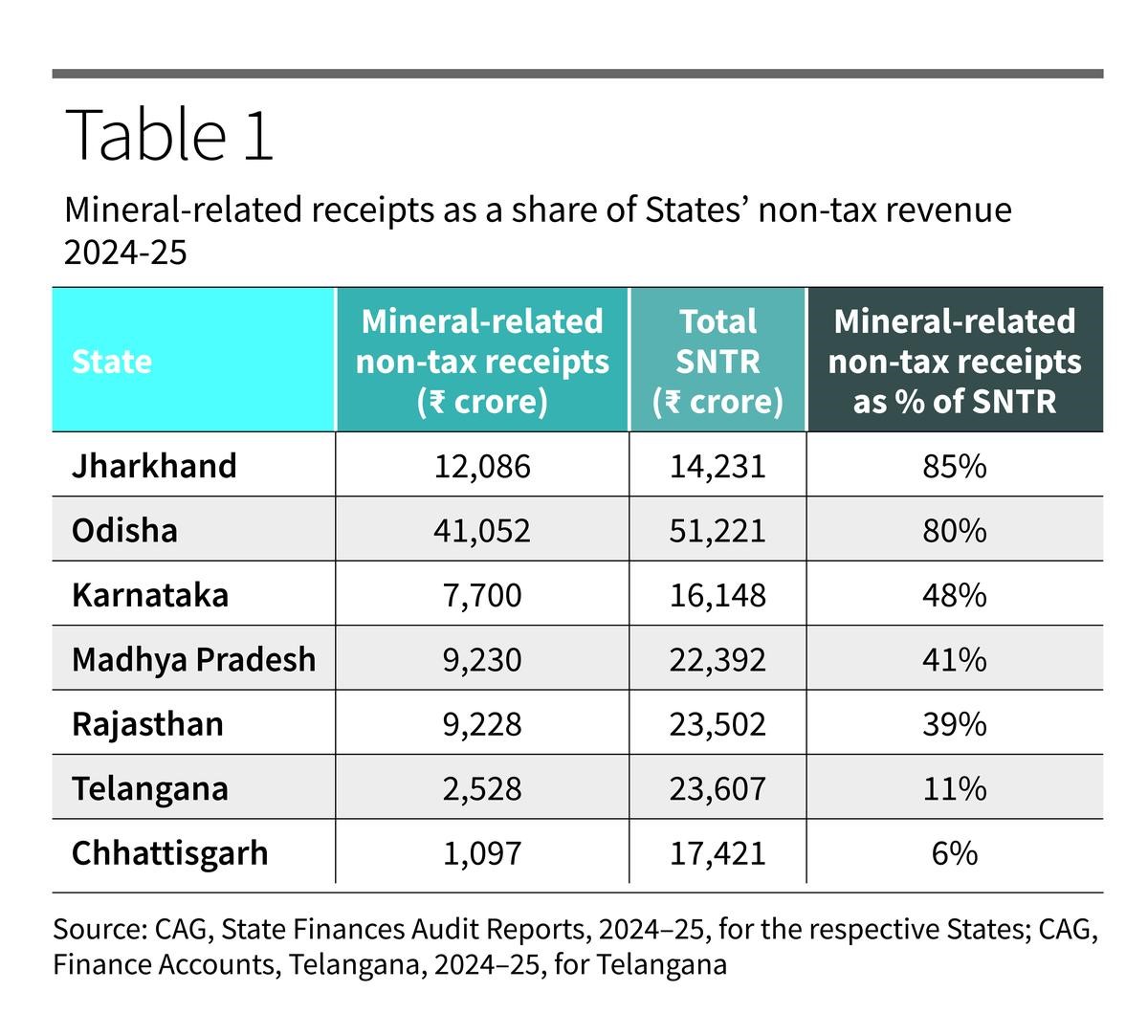
- Impact on Fiscal Autonomy – Mineral-rich States depend significantly on mineral-related receipts.
- Jharkhand and Odisha - Mineral receipts constitute around 80% of non-tax revenue.
- Karnataka - Around 48%.
- Madhya Pradesh - Around 41%.
- Rajasthan - Around 39%.
- Chhattisgarh - Around 6%.
- Telangana - Around 11%.
- Therefore, the fiscal impact of the amendment varies considerably across States.
- Impact on Welfare Expenditure – States may use mineral revenues to finance, Social-security programmes, Infrastructure, Local development.
- For instance, Jharkhand has argued that loss of mineral-tax revenue could affect social-security programmes.
- Federalism Concerns – States challenging the law argue that restrictions on their taxation powers could weaken –
- Fiscal federalism
- State autonomy
- Constitutional division of taxation powers
- Cooperative federalism.
Why are States Responding Differently?
- Economic Factors – States with greater dependence on mineral revenues have a stronger direct fiscal stake in the issue.
- Jharkhand has raised concerns over revenue losses.
- Political Alignment – Political alignment between the Centre and State governments can influence whether fiscal concerns become an organised Centre-State federal dispute.
- Karnataka, Telangana, Himachal Pradesh and Kerala are planning legal challenges.
- Others – Odisha presents a mixed response, with the Opposition demanding a special Assembly session while the State government has rejected the demand.
- Madhya Pradesh, Rajasthan and Chhattisgarh have not launched comparable State-government challenges so far.
- Thus, material economic interests and political factors interact in shaping State responses.
|
Larger Issues in Indian Fiscal Federalism
|
- India has an asymmetric fiscal federal structure –
- The Centre has relatively greater taxation powers.
- States have substantial expenditure responsibilities, particularly in areas such as health, education and welfare.
- States also depend significantly on tax devolution, grants and other transfers.
- Union control over certain aspects of State borrowing further affects fiscal autonomy.
- Consequently, disputes can emerge over –
- GST compensation
- Finance Commission terms of reference
- Borrowing limits
- Centrally sponsored schemes
- Resource allocation
- Legislative jurisdiction
- The mining amendment adds mineral taxation to this wider debate.
|
What are the Challenges to Cooperative Federalism?
- Unclear legislative powers – Overlapping legislative powers can create jurisdictional disputes.
- State limitations – Central restrictions may be perceived as reducing State fiscal space.
- Mixed political opinions – Different political alignments can make federal negotiations more difficult.
- Increased dependence on centre – Excessive dependence on transfers can weaken States’ bargaining capacity.
- Cascading levies – Multiple State-level mineral levies can also increase costs for industries, as argued by the Centre.
What can be Improved?
- Constitutional clarity – Ensure that the amendment respects the federal distribution of legislative and taxation powers.
- Centre-State consultation – Institutionalise consultation with mineral-rich States before major changes.
- Cooperative fiscal framework – Develop mechanisms that protect State revenues while avoiding excessive and overlapping levies.
- Transparent revenue-sharing – Ensure predictable compensation or alternative revenue mechanisms where State revenues are affected.
- Judicial resolution – Constitutional questions should be settled through an authoritative judicial interpretation.
- Strengthen institutions – Use the Inter-State Council, GST Council and Finance Commission mechanisms to facilitate dialogue on broader fiscal federal issues.
What lies ahead?
- The mining amendment illustrates the continuing push and pull between Union authority and State autonomy in India.
- The key challenge is to balance the Centre’s objective of creating a predictable and competitive mineral regime with the States’ constitutional and fiscal interests.
- A consultative and constitutionally grounded approach is essential to preserve both economic efficiency and cooperative federalism.
Reference
The Hindu| Why are States divided over the mining amendment?



