What is the issue?
Countless workers engaged in mines, construction and factories in India are silently dying of exposure to dust (Silicosis), utmost exploitation and apathy.
What is silicosis?
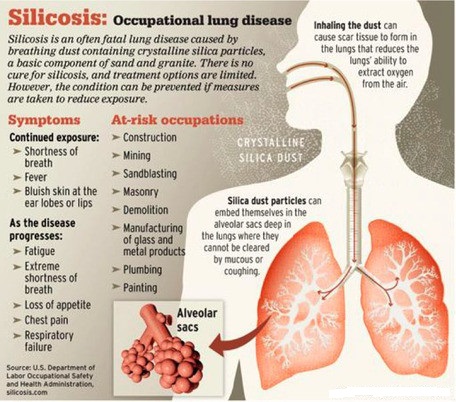
- Silicosis is part of the pneumoconiosis family of diseases.
- It is a long-term lung disease caused by inhaling large amounts of crystalline silica dust, usually over many years.
- Challenges to treatment - Silicosis usually develops after being exposed to silica for 10-20 years, or can even occur after only a few months of very heavy exposure.
- The symptoms usually take many years to develop. So, identifying and treating are challenging.
- The symptoms can also continue to get worse, even if someone is no longer exposed.
What is Rajasthan’s model for Silicosis prevention?
Rajasthan has the top-most share of over 17% in value of mineral production in India.
- Notified silicosis as an ‘epidemic’ in 2015, under the Rajasthan Epidemic Diseases Act, 1957.
- A formal Pneumoconiosis Policy in 2019 [only next to Haryana]
- ‘Silicosis portal’ hosted by the Department of Social Justice and Empowerment.
- A system of worker self-registration and diagnosis through district-level pneumoconiosis boards
- Compensation from the District Mineral Foundation Trust (DMFT) funds to which mine owners contribute
- In just 2 years, the State has certified and compensated over 25,000 patients of silicosis, of which 5,500 have already died of the disease.
What are the shortfalls in the system?
- In the mining sector alone, none of the silicosis cases diagnosed has been notified by mine owners.
- Nor are the cases reported by the examining doctors to the Directorate General of Mines Safety (DGMS), Ministry of Labour and Employment.
- They are legally required to report, according to Section 12 of the Occupational Safety, Health and Working Conditions (OSHWC) Code, 2020.
- But only 10%-20% of the over 33,100 mining leases and quarry licences in Rajasthan are DGMS-registered.
Why is reporting the cases significant?
- Shifts the paradigm from compensation to prevention
- Fixes the responsibility on mine owners, who now continue to slip away despite violating safety and preventive protocols
- The DGMS, the sole enforcement authority for health and safety in mines, can take action against mine owners.
What are the other provisions and concerns in the OSHWC Code?
Section 6 of the Code - Annual health checks free of cost to the employees
- Rules 92 to 102 in Section 6 of the code provide for initial and periodic examinations of all mine workers from their time of joining.
- But the draft Central rule 6 of Section 6 fixes an age floor of 45 years for workers in all establishments (including mines) to be eligible for the health checks.
Section 20 - Powers to the DGMS to conduct health and occupational surveys in mines
- It places no obligation on the mine owner to provide any form of rehabilitation - Alternative employment, or payment of a disability allowance/lump sum compensation for workers found medically unfit.
- Such provisions in the earlier Mines Act linked to the Workmen’s Compensation Act (also subsumed in the Code), have been deleted.
- Now, ‘medically unfit’ workers are expected to leave the job and fend for themselves.
- In Rajasthan, a compensation of Rs. 3 lakh is provided from the DMFT. In case of other states, even this is not available.
- The immediate impetus for silicosis prevention could come from course correcting Section 6 and Section 20 of the OSHWC Code.
What are the measures needed?
- State governments should use their powers to prevent the impacts on workers.
- Guidelines - The related State departments, in close dialogue with the DGMS, must draw up detailed guidelines for district-wise health surveys.
- The State rules must ensure that the health checks are provided to all workers in all establishments, irrespective of age.
- The State Advisory Board (Section 17 of the Code), along with technical committees, must be quickly constituted, with workers and their representatives having a say in them.
- Local manufacturers must be incentivised to innovate and develop low-cost dust-suppressant and wet-drilling mechanisms.
- These could either be subsidised or provided free of cost to the mine owners.
- Existing prototypes must be tested and scaled up.
- DMFT funds - These are both underutilised and spent in an entirely ad hoc manner.
- Their haphazard allocation for non-mineworker-related expenditure must be replaced by a streamlined and accountable system.
- Mineworkers should benefit from clearly defined budget heads.
- E.g. prevention (including innovation fund and subsidy for wet drilling equipment), disability compensation, solatium, administrative expenses
- For all this to materialise, bringing worker-employer identification on record is crucial.
Source: The Hindu



