Prelims: Current events of national and international importance | Health | International Relations
Why in News?
The World Health Organization (WHO) has called for stronger and coordinated ethical oversight of AI-related health research.
Need for Enhanced Oversight in AI Health Research – Key Issues and Associated Ethical Concerns
- Pace of AI Development – Research advancements may rapidly transition into real-world healthcare applications.
- Privacy – Artificial intelligence systems are capable of detecting unforeseen patterns, even within anonymized or publicly available datasets.
- Bias – Artificial intelligence may generate inaccurate or discriminatory results for specific demographic groups.
- Fairness and Equity – The distribution of benefits and risks associated with AI may be unequal across different groups.
- Transparency – The processes by which certain artificial intelligence systems generate outputs are often difficult to interpret.
- Accountability – Responsibility for adverse outcomes resulting from AI-assisted decisions is frequently ambiguous.
- Transferability – Artificial intelligence models trained on data from one population may not demonstrate equivalent accuracy when applied to different populations.
- Rapid Deployment – Unidentified issues present during the research phase may swiftly impact patient care.
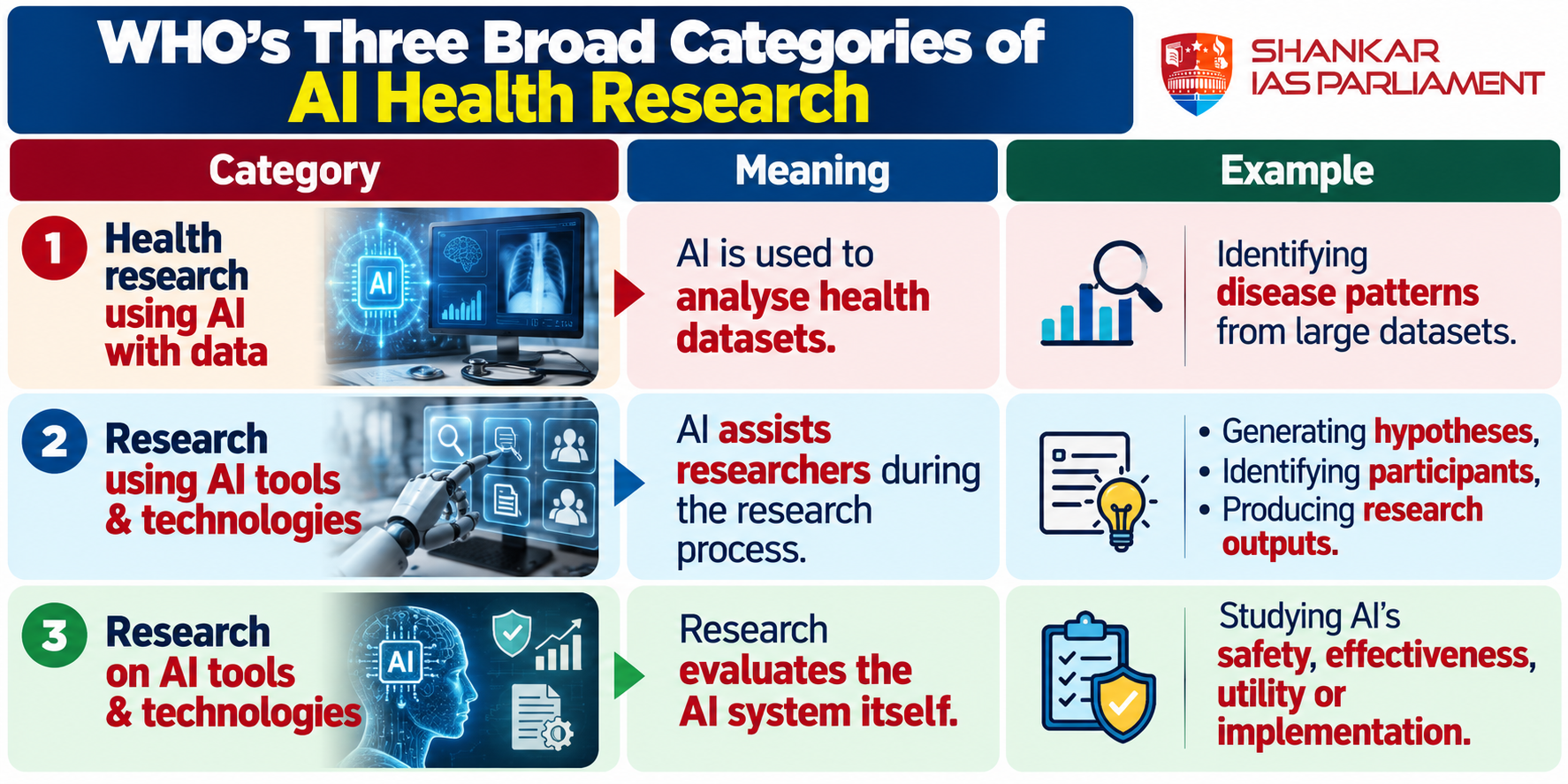
Role of Research Ethics Committees (RECs)
- RECs are traditionally responsible for protecting research participants.
- However, the emergence of artificial intelligence (AI) research introduces novel challenges.
- Research Ethics Committees may require enhanced technical expertise to adequately assess AI-related studies.
- Additional training and resources may be necessary to address the complexities of AI research.
- Certain AI studies do not involve direct interaction with human participants.
- Studies utilizing anonymized data may not be subject to traditional ethics review processes.
- The absence of direct human interaction does not eliminate potential ethical risks.
WHO's Approach
- Ethical oversight should not rely solely on Research Ethics Committees.
- Comprehensive ethical oversight may also require the involvement of researchers, funders, data access committees, scientific journals, professional societies, and regulatory agencies.
- WHO's Key Recommendations
- Enhance ethics training and certification for researchers.
- Identify ethical risks early in the research process.
- Increase transparency about known risks.
- Ensure responsible treatment of data workers.
- Strengthen communication with the public.
- Increase public engagement.
- Strengthen research capacity in developing countries.
- Promote equitable participation of local researchers and institutions.
|
India: Existing Ethical Framework
|
- India has established an ethical framework for the application of artificial intelligence in healthcare.
- ICMR Guidelines (2023)
- The Indian Council of Medical Research (ICMR) has issued ethical guidelines for the use of artificial intelligence in biomedical research and healthcare.
- Key principles include:
- Autonomy
- Safety
- Data privacy
- Accountability
- Fairness
- Equity
- Informed consent
|
Reference
Business Standard | WHO Call: Stronger AI Ethics in Health



