Prelims: Current events of national and international importance | Space
Why in News?
In Aug 2026, scientists reported evidence that vacuum near a super‑magnetic star behaves like a crystal, altering light travel and supporting quantum predictions that space is not truly empty.
Is space really empty?
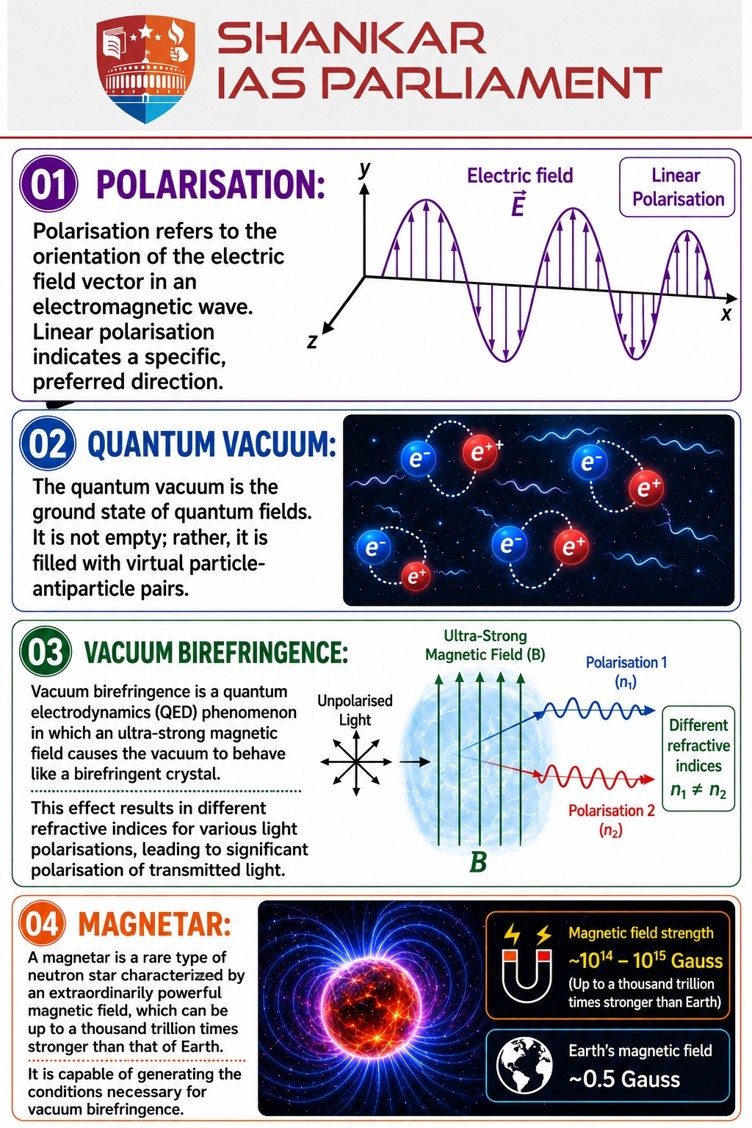
- According to classical physics, a vacuum is defined as complete nothingness.
- In contrast, quantum electrodynamics (QED) offers a different perspective.
- So-called empty space is permeated by virtual particle pairs, such as electron–positron pairs, which continuously appear and vanish.
- Under typical conditions, these virtual particles exert negligible influence on the propagation of light.
|
Heisenberg and Euler Theory
|
- In the 1930s, Heisenberg and Euler made a significant prediction regarding this phenomenon:
- They proposed that, within an extremely strong magnetic field, the quantum vacuum would behave analogously to a crystal, thereby altering the transmission of light.
- This phenomenon is known as vacuum birefringence.
|
- Vacuum birefringence – It is a phenomenon predicted by quantum electrodynamics (QED), in which an extremely strong magnetic field causes the quantum vacuum to behave similarly to a birefringent crystal.
- Meaning –"bi-" denotes two & “Refringence” means “refraction”.
- A birefringent material alters the behaviour of light depending on the direction of its polarisation.
- A calcite crystal is a classic example of a birefringent material.
- Quantum electrodynamics predicts that, under an extremely strong magnetic field, the vacuum itself can exhibit a similar birefringent effect.
- Instruments Utilized
- IXPE (Imaging X-ray Polarimetry Explorer) was employed to measure X-ray polarisation.
- NICER, located on the International Space Station, was used for X-ray timing and spectral analysis.
- Murriyang (Parkes radio telescope) conducted radio polarimetry to map the magnetic geometry.
- Recent study - The target of this study is magnetar 1E 1547.0−5408, located approximately 14,700 light-years away and classified as a rare radio-emitting magnetar.
- Observations – X-ray linear polarisation degree (PD) from the magnetar reached ~65–80%, far higher than in typical X-ray sources.
- PD decreased with increasing X-ray energy, matching QED predictions for vacuum birefringence.
- The polarisation angle behaviour also fit models where X-rays travel through a strongly magnetised quantum vacuum.
- Interpretation – Models including vacuum birefringence fit the data much better than those without it.
Reference
The Hindu | Space is Not Empty



