Prelims (GS I) – Current events of national and international importance| General issues on Environmental ecology, Bio-diversity and Climate Change.
Mains (GS I) – Conservation
Why in news?
A recent study published in Nature Climate Change provides a global perspective on how UHI impacts both heat and cold related mortality.
- Urban heat island (UHI) – A phenomenon that occurs when a city experiences much warmer ambient temperatures than nearby rural areas.
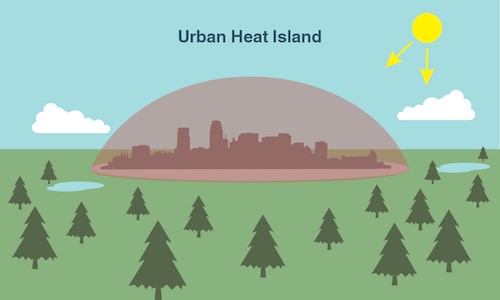
- Causes – Existence of Concrete buildings, asphalt roads and reduced vegetation in cities that lead to trap and absorb heat, limiting dissipation of heat.
- Lack of green spaces and high energy use (e.g., air conditioning), that further elevate temperatures.
- Temperature variation – Urban areas can be 3–5°C warmer than rural surroundings, sometimes more during heatwaves.
- Impacts – Increased energy consumption, air pollution, heat-related health issues and stress on nearby ecosystems.
Implications of UHI
- Dual impact of UHI on mortality – While heat islands increase heat-related deaths in hot seasons, they can reduce cold-related deaths in cooler conditions
- Heat-related mortality – UHI increases temperatures in hotter seasons, leading to higher heat exposure and subsequent deaths, particularly in summer.
- Cold-related mortality – In cooler seasons, the warmer urban temperatures reduce cold-related deaths by mitigating extreme cold exposure.
- Globally, in 2018, the reduction in cold-related mortality was 4.4 times greater than the increase in heat-related mortality due to UHI.
- Regional and seasonal variations – Cities at high latitudes experience a greater reduction in cold-related deaths.
- For instance, Moscow saw an 11.5 times greater reduction in cold-related mortality compared to heat-related mortality.
- Poor air and water quality – Urban heat islands can have worse air and water quality than their rural neighbours.
Way forward
- The Common strategies such as urban forests, green roofs and reflective buildings that mitigate the urban heat island could be avoided, since they potentially increase cold-related deaths more than they decrease the heat-related deaths.
- Cities need region and season specific strategies to balance UHI mitigation with health outcomes, avoiding unintended increases in cold-related deaths.
- Take a seasonal approach to heat island mitigation is crucial for effective urban planning in the context of climate change and urbanization.
- Using lighter-coloured materials on buildings helps to reduce the heat of the surrounding areas.
Reference
- The Hindu| Urban Heat Islands
- National geographic



