0.0993
7667766266
x

RAD-BAARG – Bow and Arrow Radio Galaxy

iasparliament Logo
July 07, 2026

Prelims: Current events of national and international importance | Science and Technology

Why in News?

Recently, 12 Indian researchers across 3 countries have discovered a rare bow‑and‑arrow shaped radio galaxy, named RAD‑BAARG.

Discovery

  • Location – About 2 billion light years from Earth.
  • Nomenclature –
    • RAD Refers to RAD@home Astronomy Collaboratory,
    • India’s first citizen science research platform in astronomy.
    • BAARG Stands for Bow and Arrow Radio Galaxy.
  • Identification Method – Identified using ultra‑sensitive images from the LOFAR Two‑metre Sky Survey one of the deepest radio surveys ever conducted at low frequencies.

LOFAR Two-metre Sky Survey (LoTSS) is a giant cosmic mapmaker that takes pictures of space using radio waves instead of normal light.

Radio galaxy is a galaxy whose central supermassive black hole drives active galactic nuclei (AGN) to eject two oppositely directed, ultra-powerful jets of relativistic, magnetized plasma deep into intergalactic space.
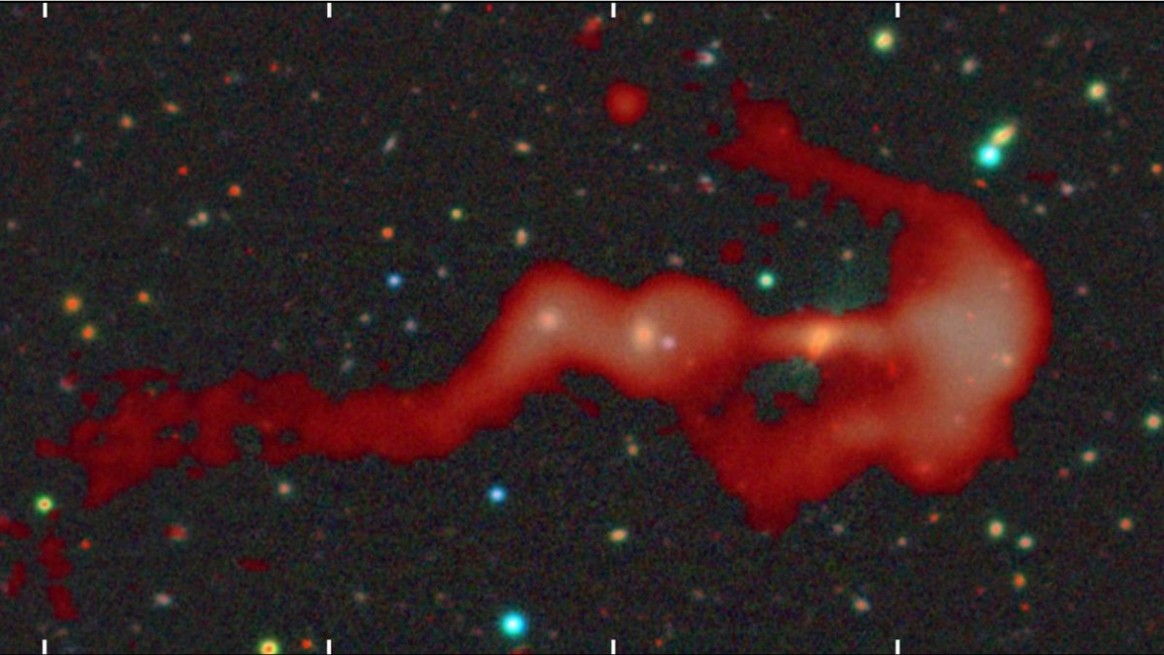
  • Typical radio galaxies project symmetric, mirror-image beams, but, RAD-BAARG is heavily distorted by violent external environmental pressures.

RAD-BAARG

  • Shape – Shaped like Bow and arrow and 1.8 million light years wide.
  • Asymmetric Nature - This radio galaxy looks very different from normal ones, with asymmetric features.
  • Environment - Astronomers have deduced that RAD-BAARG is located within a highly active, complex multi-halo galaxy cluster environment.
  • Supersonic Infall - The host galaxy is falling headlong toward the high-gravity center of a massive nearby galactic cluster.
  • The Sonic Boom Analogy - As the galaxy forcefully pushing through the dense, hot intracluster medium, it travels at supersonic speeds faster than the speed of sound within that medium.
  • Illuminating the Compressed Front - Just like a sonic boom created ahead of a supersonic aircraft, the galaxy’s rapid motion creates a massive bow shock wave ahead of it.
  • The relativistic plasma particles ejected from the galaxy's black hole have collided with and illuminated this compressed shock front, rendering an  invisible galactic collision visible to radio telescopes.

Reference

The Hindu | RAD-BAARG


Login or Register to Post Comments
There are no reviews yet. Be the first one to review.

ARCHIVES

MONTH/YEARWISE ARCHIVES

sidetext
Free UPSC Interview Guidance Programme
sidetext