Prelims: Current events of national and international importance | Reports & indices
Why in News?
The Potsdam Institute for Climate Impact Research (PIK), Germany, released the Planetary Health Check 2026 confirmed that 7 of the 9 planetary boundaries have crossed their safe operating space.
Planetary Boundaries Framework
- Origin - First proposed in 2009 by Johan Rockstrom (PIK) and Will Steffen.
- The framework defines 9 interconnected Earth-system processes that set environmental limits within which humanity can safely develop and flourish.
- For the last ~11,700 years (the Holocene epoch), Earth systems remained within these safe limits.
- Post-1950s pressures ("The Great Acceleration") pushed multiple systems beyond their thresholds.
- Quantification Metrics- Assessed across 13 control variables divided into 3 distinct risk zones
- Safe Operating Space (Green).
- Zone of Increasing Risk (Yellow).
- High-Risk Zone (Red).
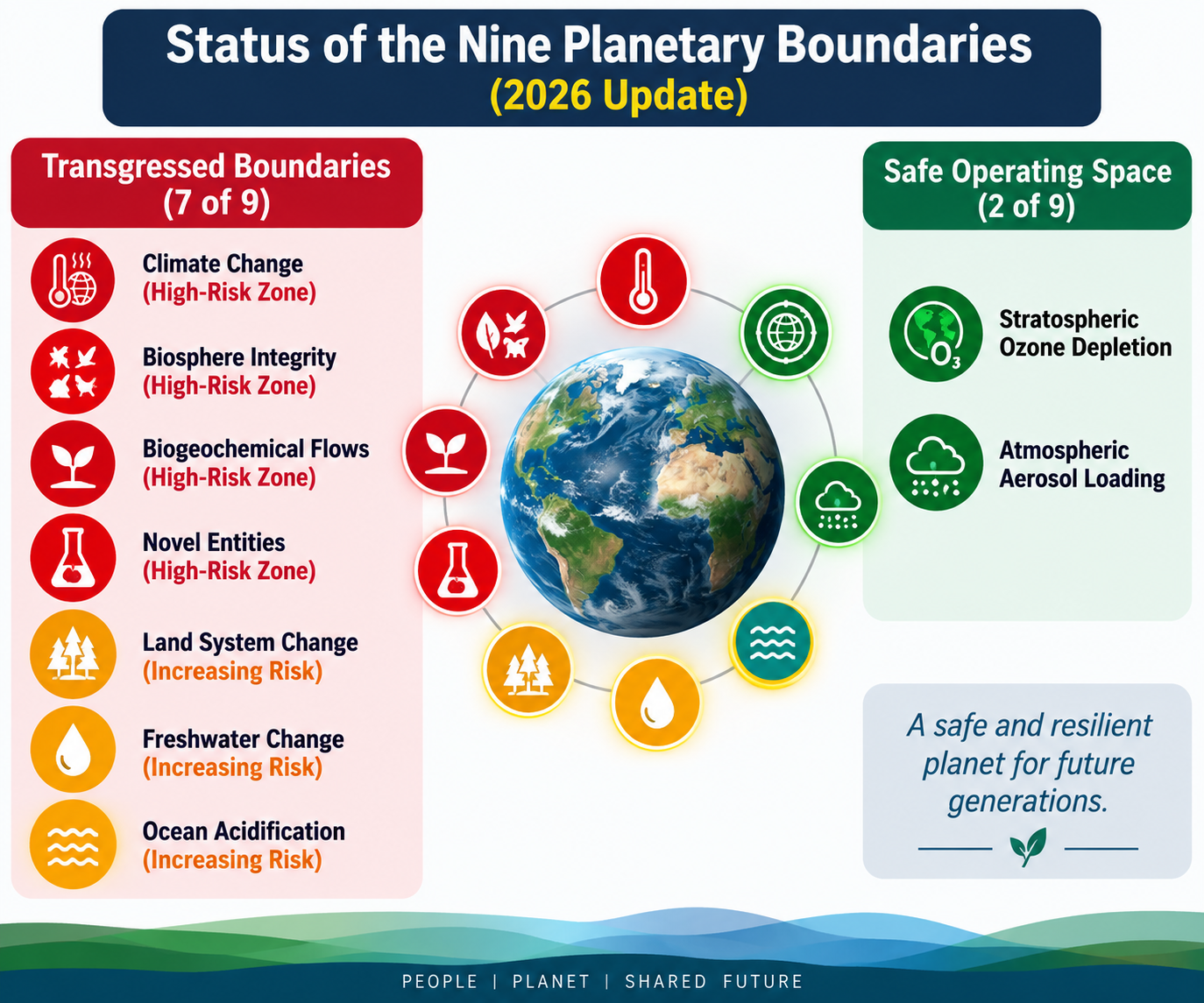
Status of the Nine Planetary Boundaries (2026 Update)
Transgressed Boundaries (7 of 9)
- Climate Change (High-Risk Zone) - Measured by atmospheric CO2concentration (safe: 350 ppm; current: >420 ppm) and radiative forcing.
- Change in Biosphere Integrity (High-Risk Zone) - Assessed via genetic diversity (extinction rates) and functional diversity (Human Appropriation of Net Primary Production / HANPP).
- Modification of Biogeochemical Flows (High-Risk Zone) - Excessive disruption of global Nitrogen (N) and Phosphorus (P) cycles from agricultural runoff and synthetic fertilizers.
- Introduction of Novel Entities (High-Risk Zone)- Mass accumulation of synthetic chemicals, microplastics, pharmaceuticals, and radioactive materials.
- Land System Change (Zone of Increasing Risk) - Global Forest loss, severe land degradation, and agricultural expansion.
- Freshwater Change (Zone of Increasing Risk)- Split into two variables
- Blue Water (surface/groundwater run-off) and
- Green Water (moisture available to plants and soils).
- Ocean Acidification (Zone of Increasing Risk — Latest Transgression) - Officially crossed into the transgressed zone due to rising surface ocean pCO2levels and falling aragonite saturation states, directly threatening marine calcifying organisms and coral reefs.
Safe Operating Space (2 of 9)
- Stratospheric Ozone Depletion - Remains within safe limits thanks to the global phase-out of ozone-depleting substances under the Montreal Protocol (1987), though recovery rates have recently slowed.
- Atmospheric Aerosol Loading- Remains within safe limits globally, though severe regional transgressions persist (notably across South Asia due to anthropogenic particulate matter PM2.5and PM10).
Reference
Down to Earth | Planetary Health Check 2026



