Prelims: Current events of national and international importance | Geography
Why in News?
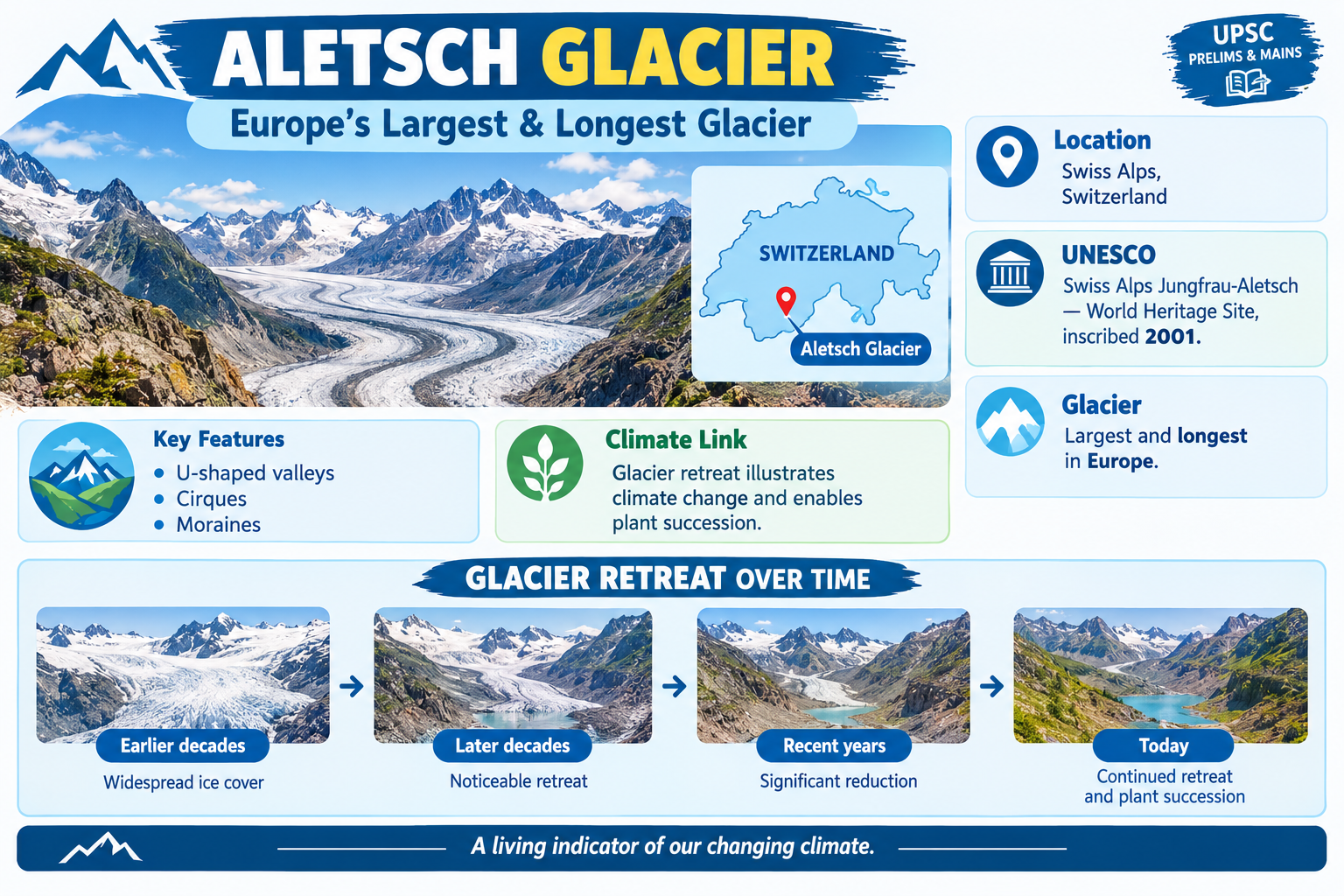
The recent findings confirm that the Aletsch Glacier, Switzerland and Europe’s largest glacier by area and ice volume, suffered its biggest single-year melt on record during 2026.
Primary Causes
- Severe Winter Snowfall Deficit - An unusually dry winter left minimal snowpack on glacier accumulation zones.
- Snow normally serves as a protective albedo shield reflecting solar radiation; its absence exposed bare ice early in the season.
- Record European Summer Heatwaves - Switzerland experienced its hottest summer on record in 2026, with consecutive temperature records set across June, July, and August.
- Accelerated Mass Loss- Average glacier thickness across Switzerland fell by 2.5 to 4 meters, with specific glacier tongues losing up to 10 meters of ice thickness.
- Smaller glaciers, including Bella Tola (Valais) and Griessfirn (Glarus), disappeared entirely.
Key Glaciological Data
- Across the entire country, Swiss glaciers lost 5.5% of their total remaining ice volume in 2026.
- This marks the second-worst national ice loss year after 2022, bringing cumulative Swiss glacier loss over the last five years to nearly 20% (one-fifth) of their total ice volume.
- Between May and September 2026, Swiss glaciers released approximately 2.2 trillion liters of meltwater, more than 4 times the annual domestic drinking water consumption of all Swiss households.
- While excessive melting provides short-term boost to summer streamflows during regional droughts, glaciologists warn that alpine river systems are fast approaching "Peak Water", after which annual runoff will permanently drop as the remaining ice reservoir shrinks.
Significance
- UNESCO World Heritage Landmark- The Aletsch Glacier lies in the Bernese Alps within the Swiss Alps Jungfrau-Aletsch UNESCO World Heritage Site.
- Impact on European Hydrology- Accelerates Alpine cryospheric loss affects headwaters for key transnational river basins, threatening downstream freshwater supply, inland barge navigation, and hydroelectric output.
Reference
Economic Times | Switzerland’s Largest Glacier



